

HIV may one day be able to be filtered from human blood saving the lives of millions of people, thanks to a world-first innovation by Queensland University of Technology scientists.

| Molecular & Cell Biology | February 15, 2007 10:59 PM |
Ting Xie, Ph.D., Associate Investigator, and Zhigang Jin, Ph.D., Postdoctoral Research Associate in the Xie Lab, have published results showing that the microRNA pathway is essential for controlling self-renewal of germline stem cells and somatic stem cells in the Drosophila ovary.
| Full story | 0 Comments | 9077 views |
| Molecular & Cell Biology | February 15, 2007 09:59 PM |
Here is some news that will certainly get on people's nerves: In a study to be published in the March 2007 issue of The FASEB Journal, scientists from East Carolina University report that a key molecular mechanism, RNA interference (RNAi), plays a role in the regeneration and repair of periphery nerves, which are the nerves located outside of the brain and spinal column. This research may lead to new therapies that manipulate RNAi to treat people with damaged nerves resulting from degenerative disorders and injury.
| Full story | 0 Comments | 5970 views |

| Health & Medicine | February 15, 2007 08:59 PM |
The sugar substitute xylitol affects the bacterial composition of the oral cavity even in low doses. On the other hand, a relatively high intake is needed to counteract the production of acid between the teeth, according to Pernilla Lif Holgerson in the dissertation she will defend at Umeå University in Sweden on February 23.
| Full story | 0 Comments | 7555 views |

| Environment | February 15, 2007 07:59 PM |
The warming most global climate models predict will do more harm than simply raise the sea levels that most observers fear. It will make drastic changes in fragile ecosystems throughout the world, especially in the Antarctic.
| Full story | 0 Comments | 5277 views |

| AIDS & HIV | February 15, 2007 06:59 PM |
Cancer cells are sick, but they keep growing because they don't react to internal signals urging them to die. Now researchers at Washington University School of Medicine in St. Louis have found an efficient way to get a messenger into cancer cells that forces them to respond to death signals. And they did it using one of the most sinister pathogens around — HIV.
| Full story | 0 Comments | 4661 views |

| Microbiology | February 15, 2007 06:05 PM |
When man made his way out of Africa some 60,000 years ago to populate the world, he was not alone: He was accompanied by the bacterium Helicobacter pylori, which causes gastritis in many people today. Together, man and the bacterium spread throughout the entire world. This is the conclusion reached by an international team of scientists led by Mark Achtman from the Max Planck Institute for Infection Biology in Berlin, Germany. The researchers also discovered that differences developed in the genetic makeup of the bacteria populations, just as it did in that of the various peoples of the world. This has also given scientists new insight into the paths taken by man as he journeyed across the Earth (Nature online, February 7, 2007).
| Full story | 0 Comments | 5269 views |

| Biology | February 15, 2007 05:59 PM |
Researchers, including a paleoethnobotanist at the University of Missouri-Columbia, recently found fossil evidence in seven archaeological sites ranging from the Bahamas to present-day Peru that showed people were eating domesticated chili peppers as long as 6,000 years ago. This makes chili peppers one of the oldest domesticated food sources in the Americas. The study will be published in the Feb. 15 edition of the journal Science.
| Full story | 0 Comments | 5375 views |
| Biology | February 15, 2007 05:05 PM |
The far-reaching influence of Spanish and Portuguese colonisers appears not to have extended to South American agriculture, scientists studying a 1,400-year-old Andean mummy have found.
| Full story | 0 Comments | 5106 views |
| Biology | February 15, 2007 04:05 PM |
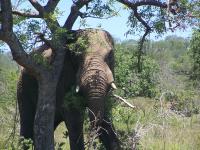
An elephant browsing for fruit in a female Marula tree. Being female can be a risky business, especially if you are a Marula tree in Africa receiving the attention of elephants. The tasty, nutritious and vitamin C-rich Marula fruits are much sought after by both man and animals. It is a stable "wild food" and base for the popular Amarula liquor. But Marula has separate male and female trees so fruiting females attract browsing elephants, which cause damage to branches and bark.
| Full story | 0 Comments | 8403 views |
| Biology | February 15, 2007 02:05 PM |
It was until now believed that nocturnally migrating songbirds, while venturing into the unfamiliar night sky for accomplishing their long, challenging trans-continental migrations, could at least release anti-predator vigilance thanks to the concealment of darkness. A new study by Spanish and Swiss scientists – published this week in PLoS ONE – shows that migration at night is not without predation risk for passerines.
| Full story | 0 Comments | 5293 views |
| Environment | February 15, 2007 12:05 PM |
Researchers from University of Bergen have found that trees, which are a main resource for desert people and their flocks, are in significant decline in the hyper-arid Eastern Desert of Egypt.
| Full story | 0 Comments | 6800 views |
| Molecular & Cell Biology | February 15, 2007 10:05 AM |
Scientists know that a better understanding of how proteins bond could lead to more effective treatments for genetic disorders and other life-threatening conditions.
| Full story | 0 Comments | 5049 views |

- In some genetic cases of microcephaly, stem cells fail to launch
- Yale team discovers how Zika virus causes fetal brain damage
- Scientists uncover the way a common cell enzyme alerts the body to invading bacteria
- Arctic gives clues on worst mass extinction of life
- Calcium channel blockers caught in the act at atomic level
Search Bio News Net
Free Biology Newsletter
- Flexibility That A.C.A. Lent to Work Force Is Threatened by...International Herald Tribune
- Bacteria Behind Legionnaires’ Disease Found at New York Police StationInternational Herald Tribune
- Prescription Price Crisis? 28 Million Americans See Spike in Drug...MSNBC.com: Health
- Seizing on Opioid Crisis, a Drug Maker Lobbies Hard for...International Herald Tribune
- Republicans are taking a big political risk on health careAP Health News
- Why We're So Divided Over Saving WolvesNational Geographic News