


The primary targets of HIV-1 infection in the human vagina have been definitively identified in a new study published in the February 2007 issue of the journal Immunity, published by Cell Press. The findings are likely to guide development of new strategies that will prevent HIV-1 transmission.

| Biotechnology | February 16, 2007 04:59 PM |
Analyzing human blood for a very low virus concentration or a sample of water for a bioterrorism agent has always been a time-consuming and difficult process. Researchers at the Georgia Institute of Technology and Emory University have developed an easier and faster method to detect these types of target molecules in liquid samples using highly porous, micron-sized, silica beads.
| Full story | 0 Comments | 5923 views |

| Health & Medicine | February 16, 2007 02:59 PM |
As a night of bad sleep can have an adverse effect on an adult’s performance at work the next day, an insufficient amount of rest can also have a negative impact on how well middle or high school students perform in the classroom. A study published in the February 15th issue of the Journal of Clinical Sleep Medicine (JCSM) finds that adolescents who experience sleep disturbances are more likely to receive bad grades in school.
| Full story | 0 Comments | 6404 views |

| Molecular & Cell Biology | February 16, 2007 12:59 PM |
Two critical characteristics of breast cancer that are important to treatment can be identified by measuring gene expression in the tumor, a research team led by scientists at The University of Texas M. D. Anderson Cancer Center reports in Lancet Oncology online.
| Full story | 0 Comments | 5253 views |

| Stem Cell Research | February 16, 2007 10:59 AM |
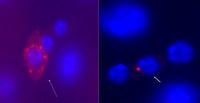
Intestinal stem cells (ISCs) in the gut of the fruit fly, Drosophila melanogaster, directly determine the fate of their daughter cells. The signaling protein called Delta, seen here in red, determines what type of cell the ISCs will produce. Large amounts of Delta signal the daughter cells to become gut-lining enterocytes (left panel), while small amounts of Delta signal them to become hormone-generating enteroendocrine cells (right panel). Credit: Images used with permission of the American Association for the Advancement of Science, Science, February 16, 2007. From roundworm to human, most cells in an animal's body ultimately come from stem cells. When one of these versatile, unspecialized cells divides, the resulting "daughter" cell receives instructions to differentiate into a specific cell type. In some cases this signal comes from other cells. But now, for the first time, researchers at the Carnegie Institution's Department of Embryology have found a type of stem cell that directly determines the fate of its daughters.
| Full story | 0 Comments | 7294 views |

- In some genetic cases of microcephaly, stem cells fail to launch
- Yale team discovers how Zika virus causes fetal brain damage
- Scientists uncover the way a common cell enzyme alerts the body to invading bacteria
- Arctic gives clues on worst mass extinction of life
- Calcium channel blockers caught in the act at atomic level
Search Bio News Net
Free Biology Newsletter
- Flexibility That A.C.A. Lent to Work Force Is Threatened by...International Herald Tribune
- Bacteria Behind Legionnaires’ Disease Found at New York Police StationInternational Herald Tribune
- Prescription Price Crisis? 28 Million Americans See Spike in Drug...MSNBC.com: Health
- Seizing on Opioid Crisis, a Drug Maker Lobbies Hard for...International Herald Tribune
- Republicans are taking a big political risk on health careAP Health News
- Why We're So Divided Over Saving WolvesNational Geographic News