

Plant poisoning is a significant problem around the world. In the United States, exposures to plant toxins account for approximately ten percent of the annual calls to the nation's Poison Control Centers. Responding to the need for a useful guide to the harmful potential of plants, Handbook of Poisonous and Injurious Plants provides portable, comprehensive information to the toxic plants encountered everywhere, both inside and outside the home.

| Molecular & Cell Biology | February 14, 2007 10:05 PM |
Every time a cell repairs or replicates its DNA, the resulting single strand is wrapped up by a dedicated protein complex. In eukaryotes or organisms whose cells have a nucleus, this job is handled by a tripartite complex called replication protein A (RPA). Researchers at the Salk Institute for Biological Studies have now unearthed a novel RPA-like complex that specifically homes in on the short single-stranded DNA "tail" end of yeast chromosomes.
| Full story | 0 Comments | 5477 views |

| Biotechnology | February 14, 2007 09:05 PM |
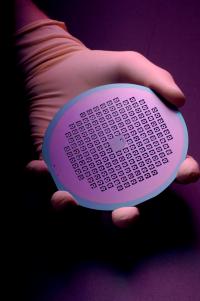
Nanofilter array: 4" wafer with 160 membranes. A newly designed porous membrane, so thin it's invisible edge-on, may revolutionize the way doctors and scientists manipulate objects as small as a molecule.
| Full story | 0 Comments | 6847 views |

| Health & Medicine | February 14, 2007 08:05 PM |
The most important genes associated with a risk of developing type-2 diabetes have been identified, scientists report today in a new study.
| Full story | 0 Comments | 5563 views |
| Molecular & Cell Biology | February 14, 2007 07:05 PM |
Just as homes have smoke detectors, cells have an enzyme that responds to a buildup of fatty acids by triggering the production of a key molecule in the biochemical pathway that breaks down these fatty acids, according to investigators at St. Jude Children's Research Hospital. This breakdown of fatty acids, in turn, provides the cell energy while reducing the chance that excess fatty acids will accumulate.
| Full story | 0 Comments | 6254 views |

| AIDS & HIV | February 14, 2007 06:05 PM |
In a finding that could have profound implications for AIDS vaccine design, researchers led by a team at the National Institute of Allergy and Infectious Diseases (NIAID), part of the National Institutes of Health (NIH), have generated an atomic-level picture of a key portion of an HIV surface protein as it looks when bound to an infection-fighting antibody. Unlike much of the constantly mutating virus, this protein component is stable and—more importantly, say the researchers—appears vulnerable to attack from this specific antibody, known as b12, that can broadly neutralize HIV.
| Full story | 0 Comments | 5425 views |
| Health & Medicine | February 14, 2007 05:05 PM |
When a virus infects a person, it triggers a series of biochemical reactions in immune-system cells that literally may have life or death consequences.
| Full story | 0 Comments | 5435 views |
| Molecular & Cell Biology | February 14, 2007 04:00 PM |
Plants have an immune system that resists infection, yet 10% of the world's agricultural production is lost annually to diseases caused by bacteria, fungi, and viruses. Understanding how disease resistance works may help combat this scourge.
| Full story | 0 Comments | 6340 views |
| Molecular & Cell Biology | February 14, 2007 02:00 PM |
The Scripps Research team, led by neuroscientists Manuel Sanchez-Alavez and Tamas Bartfai, discovered that mice genetically altered to lack a molecule known as the EP3 receptor tend to be more active during their normal sleep cycle and to eat more. In the study, this led to weight increases of up to 30 percent relative to mice with the receptors.
| Full story | 0 Comments | 4377 views |

| Biology | February 14, 2007 12:00 PM |
Researchers have found evidence that chimpanzees from West Africa were cracking nuts with stone tools before the advent of agriculture, thousands of years ago. The result suggests chimpanzees developed this behaviour on their own, or even that stone tool use was a trait inherited from our common ancestor. Julio Mercader, Christophe Boesch and colleagues found the stones at the Noulo site in Cote d'Ivoire, the only known prehistoric chimpanzee settlement.
| Full story | 0 Comments | 8059 views |
| Biotechnology | February 14, 2007 10:00 AM |
An artificial nose could be a real benefit at times: this kind of biosensor could sniff out poisons, explosives or drugs, for instance. Researchers at the Max Planck Institute for Polymer Research and the Max Planck Institute of Biochemistry recently revealed a technique for integrating membrane proteins into artificial structures. Membrane proteins have several important functions in the cell, one of which is to act as receptors, passing on signals from molecules in the air, for example, to the cell interior.
| Full story | 0 Comments | 4693 views |

- In some genetic cases of microcephaly, stem cells fail to launch
- Yale team discovers how Zika virus causes fetal brain damage
- Scientists uncover the way a common cell enzyme alerts the body to invading bacteria
- Arctic gives clues on worst mass extinction of life
- Calcium channel blockers caught in the act at atomic level
Search Bio News Net
Free Biology Newsletter
- Flexibility That A.C.A. Lent to Work Force Is Threatened by...International Herald Tribune
- Bacteria Behind Legionnaires’ Disease Found at New York Police StationInternational Herald Tribune
- Prescription Price Crisis? 28 Million Americans See Spike in Drug...MSNBC.com: Health
- Seizing on Opioid Crisis, a Drug Maker Lobbies Hard for...International Herald Tribune
- Republicans are taking a big political risk on health careAP Health News
- Why We're So Divided Over Saving WolvesNational Geographic News