

Weaning is a problematic time for pigs, especially in intensive production. Piglets commonly become susceptible to bacterial infections, restricting their growth rate; and often leading to losses of 10% or more. The antibiotics used routinely for many years to control these rapidly-spreading infections have now fallen out of use, mainly due to the increase in resistant strains of bacteria.

| Microbiology | January 19, 2007 08:25 PM |
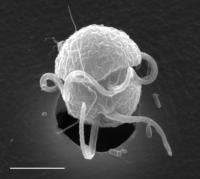
Scanning electron microscope image of Pfiesteria piscicida. Scale bar is 10 micrometers long. The hole in the background is a perforation in the filter that was used to collect the cells.
Credit: North Carolina State University Center for Applied Aquatic Ecology A team of researchers from the Hollings Marine Laboratory in Charleston, S.C., has uncovered a subtle chemical pathway by which a normally inoffensive algae, Pfiesteria piscicida, can suddenly start producing a lethal toxin. The discovery, reported last week in Environmental Science and Technology,* could resolve a long-standing mystery surrounding occasional mass fish kills on the East Coast.
| Full story | 0 Comments | 9773 views |

| Molecular & Cell Biology | January 19, 2007 05:42 PM |
A research team, led by UC Riverside's Ludwig Bartels, was the first to design a molecule that can move in a straight line on a flat surface. Now this team has found a way to attach cargo: two CO2 molecules, making the nano-walker a molecule carrier.
| Full story | 0 Comments | 5072 views |
| Microbiology | January 19, 2007 04:42 PM |
A tiny whitefly is responsible for spreading a group of plant viruses that cause devastating disease on food, fiber, and ornamental crops, say plant pathologists with The American Phytopathological Society (APS).
| Full story | 0 Comments | 5696 views |

| Biology | January 19, 2007 02:42 PM |
All bumblebees always aren't as busy as, well, a bee. It all depends on what their job is.
| Full story | 0 Comments | 6247 views |
| Biology | January 19, 2007 12:42 PM |
The chestnut-capped piha is an unassuming robin-sized bird restricted to a few tiny remnant forest patches in the Antioquia Department of Colombia, in the Central Cordillera of the Andes. It is so restricted in its distribution that it evaded discovery until 1999, and has been identified by the Alliance for Zero Extinction as a priority conservation species (see www.zeroextinction.org).
| Full story | 0 Comments | 9276 views |

| Biotechnology | January 19, 2007 10:42 AM |
Investigators at the University of Pennsylvania School of Medicine describe the basis for developing a biological interface that could link a patient's nervous system to a thought-driven artificial limb. Their conceptual framework - which brings together years of spinal-cord injury research - is published in the January issue of Neurosurgery.
| Full story | 0 Comments | 10021 views |

- In some genetic cases of microcephaly, stem cells fail to launch
- Yale team discovers how Zika virus causes fetal brain damage
- Scientists uncover the way a common cell enzyme alerts the body to invading bacteria
- Arctic gives clues on worst mass extinction of life
- Calcium channel blockers caught in the act at atomic level
Search Bio News Net
Free Biology Newsletter
- Flexibility That A.C.A. Lent to Work Force Is Threatened by...International Herald Tribune
- Bacteria Behind Legionnaires’ Disease Found at New York Police StationInternational Herald Tribune
- Prescription Price Crisis? 28 Million Americans See Spike in Drug...MSNBC.com: Health
- Seizing on Opioid Crisis, a Drug Maker Lobbies Hard for...International Herald Tribune
- Republicans are taking a big political risk on health careAP Health News
- Why We're So Divided Over Saving WolvesNational Geographic News