

It has been speculated that lead poisoning may have played a role in the fall of the Roman Empire: it is thought to have been caused by the concentration of grape juice in lead containers. Though the introduction of lead-free gasoline has reduced damage to the environment, the annual production of lead continues to increase worldwide because lead is still used in batteries, glass, and electronic components. However, there has thus far been little research into what, at a molecular level, causes the toxic effects of lead. French researchers have now applied quantum chemistry to very simple enzyme models and gained new insights. As they have reported in Angewandte Chemie, it seems that the lead's "electron shield" is the main culprit.

| Molecular & Cell Biology | January 17, 2007 09:33 PM |
A new line of developing research is underway that hopes to use a patient's own immune cells to fight cancer. The field, known as adoptive immunotherapy, is a specialty procedure performed in only a handful of institutions, which may one day include University Hospitals Case Medical Center.
| Full story | 0 Comments | 4662 views |

| Biotechnology | January 17, 2007 08:33 PM |
The next big idea in preventing wrinkles is very, very small.
| Full story | 0 Comments | 5731 views |

| Health & Medicine | January 17, 2007 07:33 PM |
Northwestern University researchers have discovered a genetic cause of a mysterious neurological disease in which people have trouble recalling and using words. The illness, Primary Progressive Aphasia, differs from Alzheimer's Disease in which a person's memory becomes impaired. In PPA, a little known form of dementia, people lose the ability to express themselves and understand speech.
| Full story | 0 Comments | 4899 views |
| Health & Medicine | January 17, 2007 06:33 PM |
A new investigation into Napoleon Bonaparte's cause of death might finally put to rest nearly 200 years of lingering mysteries about the illness that killed the French emperor during his island exile, a UT Southwestern Medical Center scientist reports.
| Full story | 0 Comments | 5075 views |

| Microbiology | January 17, 2007 05:33 PM |
Northwestern University researchers have discovered how malaria parasites persuade red blood cells to engulf them -- and how to block the invading parasites. The malaria marauders hack into the red cell's signaling system and steal the molecular equivalent of its password to spring open the door to the cell. But researchers have found that a common blood pressure medication – propranolol – jams the signal to prevent the parasite from breaking in.
| Full story | 0 Comments | 5208 views |
| Microbiology | January 17, 2007 04:33 PM |

Ug99 infection on wheat being screened at the Kenya Agriculture Research Institute Njoro Research Centre. A new form of stem rust, a virulent wheat disease, has jumped from eastern Africa and is now infecting wheat in Yemen in the Arabian Peninsula.
| Full story | 1 Comment | 6457 views |

| Bioinformatics | January 17, 2007 03:33 PM |
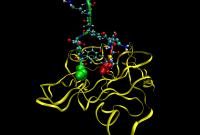
Intein crystal prior to protein splicing. Using powerful computers to model the intricate dance of atoms and molecules, researchers at Rensselaer Polytechnic Institute have revealed the mechanism behind an important biological reaction. In collaboration with scientists from the Wadsworth Center of the New York State Department of Health, the team is working to harness the reaction to develop a "nanoswitch" for a variety of applications, from targeted drug delivery to genomics and proteomics to sensors.
| Full story | 0 Comments | 6819 views |
| Health & Medicine | January 17, 2007 02:33 PM |
Researchers led by Howard Hughes Medical Institute (HHMI) international research scholar Peter St George-Hyslop have identified a new genetic risk factor associated with the most common form of Alzheimer's disease. The research implicates a gene called SORL1 in late-onset Alzheimer's, which usually strikes after age 65.
| Full story | 0 Comments | 7455 views |
| Molecular & Cell Biology | January 17, 2007 12:33 PM |
The freeze-frame image of a molecular relay race, in which one enzyme passes off a protein like a baton to another enzyme, has solved a key mystery to how cells control some vital functions, according to investigators at St. Jude Children's Research Hospital. A report on this work appears in the January 14 advanced online publication issue of Nature.
| Full story | 0 Comments | 5921 views |
| Health & Medicine | January 17, 2007 10:33 AM |
A tablet designed to emulate the healing power of the sun could be available for the treatment of advanced prostate cancer as early as 2009. But it remains to be seen whether the drug will be the revolution in prostate cancer care that its makers claim.
| Full story | 0 Comments | 6131 views |

- In some genetic cases of microcephaly, stem cells fail to launch
- Yale team discovers how Zika virus causes fetal brain damage
- Scientists uncover the way a common cell enzyme alerts the body to invading bacteria
- Arctic gives clues on worst mass extinction of life
- Calcium channel blockers caught in the act at atomic level
Search Bio News Net
Free Biology Newsletter
- Flexibility That A.C.A. Lent to Work Force Is Threatened by...International Herald Tribune
- Bacteria Behind Legionnaires’ Disease Found at New York Police StationInternational Herald Tribune
- Prescription Price Crisis? 28 Million Americans See Spike in Drug...MSNBC.com: Health
- Seizing on Opioid Crisis, a Drug Maker Lobbies Hard for...International Herald Tribune
- Republicans are taking a big political risk on health careAP Health News
- Why We're So Divided Over Saving WolvesNational Geographic News