

In the most thorough study to date of the Neanderthal genome, scientists suggest an early human-Neanderthal split. The two species have a common ancestry, say the authors, but do not share much else after evolving their separate ways. The study, published in this week's issue of Science, also finds no evidence of genetic admixture between Neanderthals and humans.

| Microbiology | November 15, 2006 10:56 PM |
A visiting biologist at the University of California, San Diego and her colleagues in Africa and Britain have shown that there are close linkages between outbreaks of Ebola hemorrhagic fever in human and wildlife populations, and that climate may influence the spread of the disease.
| Full story | 0 Comments | 5613 views |

| Biology | November 15, 2006 09:56 PM |
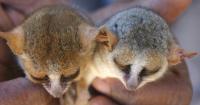
Mouse lemurs with distinct coat colors and shared genetics. Credit: L. R. Godfrey Researchers have found that lemurs suspected to belong to different species because of their strikingly different coat colors, are not only genetically alike, but belong to the same species.
| Full story | 0 Comments | 8701 views |

| Biotechnology | November 15, 2006 08:56 PM |
Tiny particles one-billionth of a meter in size can be loaded with high concentrations of drugs designed to kill brain cancer. What's more, these nanoparticles can be used to image and track tumors as well as destroy them, according to researchers at the University of Michigan Comprehensive Cancer Center.
| Full story | 0 Comments | 5868 views |

| Health & Medicine | November 15, 2006 07:56 PM |
A novel vascular targeting agent completely prevented the development of bone tumors in 50 percent of the mice tested in a preclinical study, providing early evidence that it could treat, or thwart, growth of tumors in bone, a common destination for a number of cancers when they start to spread.
| Full story | 0 Comments | 4537 views |

| Molecular & Cell Biology | November 15, 2006 06:28 PM |
Acute lung injury caused by cell death, high and potentially toxic concentrations of oxygen (hyperoxia), and the resulting excess fluid in the lungs (pulmonary edema), may be controlled by modulating levels of the angiopoietin2 (Ang2) protein, researchers at Yale School of Medicine report in the November 5 online issue of Nature Medicine.
| Full story | 0 Comments | 4365 views |
| Molecular & Cell Biology | November 15, 2006 05:28 PM |
Ghrelin, a hormone produced in the stomach, induces food intake and operates through a brain region that controls cravings for food and other energy sources, researchers at Yale School of Medicine report in the October 19 online issue of The Journal of Clinical Investigation.
| Full story | 0 Comments | 5311 views |

| Environment | November 15, 2006 04:27 PM |
Global warming strikes again. A University of Illinois researcher reports that a red-winged black bird population in Ontario, Canada has decreased by 50 percent since 1972. The decrease is related to a positive shift in the North Atlantic Oscillation which has resulted in warmer, wetter winters in the southeastern United States.
| Full story | 0 Comments | 4962 views |
| Molecular & Cell Biology | November 15, 2006 03:27 PM |
Scientists are using genetic studies and natural chemicals, such as plant-derived triterpenoids, to further our knowledge on how genetic and early molecular interactions can lead to cancer, and how those early interactions can be manipulated to stave off a variety of cancers. The latest studies with new and promising chemopreventive agents were presented at the American Association for Cancer Research's Frontiers in Cancer Prevention Research meeting today.
| Full story | 0 Comments | 4210 views |
| Molecular & Cell Biology | November 15, 2006 02:27 PM |
Mary Lee Dequeant, Ph.D., a Predoctoral Researcher at the Stowers Institute for Medical Research, and Olivier Pourquié, Ph.D., Stowers Institute Investigator and an investigator with the Howard Hughes Medical Institute, are the first and last authors, respectively, on a paper that identifies a network of cyclic genes that shed light on the molecular basis of spine formation in the embryo.
| Full story | 0 Comments | 4064 views |
| Biotechnology | November 15, 2006 12:27 PM |
The principal raw material used for manufacturing paper pulp is wood. However, growing demand in the paper industry, at a time of dwindling forest resources, have compelled the sector to turn to other sources of raw materials, such as cereal straw, reeds, bamboo or sugar-cane bagasse.
| Full story | 0 Comments | 7991 views |
| Biology | November 15, 2006 10:27 AM |
Six million years ago, chimpanzees and humans diverged from a common ancestor and evolved into unique species. Now UCLA scientists have identified a new way to pinpoint the genes that separate us from our closest living relative – and make us uniquely human. The Proceedings of the National Academy of Sciences reports the study in its Nov. 13 online edition.
| Full story | 0 Comments | 5809 views |

- In some genetic cases of microcephaly, stem cells fail to launch
- Yale team discovers how Zika virus causes fetal brain damage
- Scientists uncover the way a common cell enzyme alerts the body to invading bacteria
- Arctic gives clues on worst mass extinction of life
- Calcium channel blockers caught in the act at atomic level
Search Bio News Net
Free Biology Newsletter
- Flexibility That A.C.A. Lent to Work Force Is Threatened by...International Herald Tribune
- Bacteria Behind Legionnaires’ Disease Found at New York Police StationInternational Herald Tribune
- Prescription Price Crisis? 28 Million Americans See Spike in Drug...MSNBC.com: Health
- Seizing on Opioid Crisis, a Drug Maker Lobbies Hard for...International Herald Tribune
- Republicans are taking a big political risk on health careAP Health News
- Why We're So Divided Over Saving WolvesNational Geographic News