

A vaccine for treating a recurrent cancer of the central nervous system that occurs primarily in the brain, known as glioma, has shown promising results in preliminary data from a clinical trial at UCSF Medical Center.

| Biology | November 16, 2006 10:26 PM |
Countering the widespread view of evolution as a process played out over the course of eons, evolutionary biologists have shown that natural selection can turn on a dime -- within months -- as a population's needs change. In a study of island lizards exposed to a new predator, the scientists found that natural selection dramatically changed direction over a very short time, within a single generation, favoring first longer and then shorter hind legs.
| Full story | 0 Comments | 9261 views |

| Molecular & Cell Biology | November 16, 2006 09:26 PM |
Rutgers researcher Richard H. Ebright and his collaborators have resolved key questions regarding transcription, the fundamental life process that was the subject of the 2006 Nobel Prize in Chemistry.
| Full story | 0 Comments | 5481 views |

| Health & Medicine | November 16, 2006 08:26 PM |
Active individuals lacking in B-vitamins – including college athletes and other elite competitors -- may perform worse during high-intensity exercise and have a decreased ability to repair and build muscle than counterparts with nutrient-rich diets, according to recent Oregon State University research published in the International Journal of Sport Nutrition and Exercise Metabolism.
| Full story | 0 Comments | 7756 views |
| Biology | November 16, 2006 07:56 PM |
Controlling population peaks on the edges of the gypsy moth range may help to slow their invasion into virgin territory, according to a team of researchers.
| Full story | 0 Comments | 4300 views |

| Biotechnology | November 16, 2006 07:26 PM |
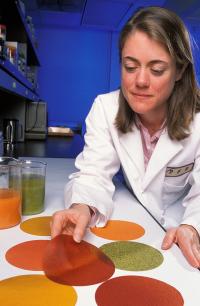
USDA chemist Tara McHugh displays edible food wraps designed to slow the spoilage of fresh fruits and vegetables. Similar wraps developed by McHugh also kill E. coli. Credit: Courtesy of USDA. Researchers have improved upon an edible coating for fresh fruits and vegetables by enabling it to kill deadly E. coli bacteria while also providing a flavor-boost to food. Composed of apple puree and oregano oil, which acts as a natural antibacterial agent, the coating shows promise in laboratory studies of becoming a long-lasting, potent alternative to conventional produce washes, according to a team of scientists from the U.S. Department of Agriculture (USDA) and the University of Lleida in Spain.
| Full story | 0 Comments | 6149 views |
| Biotechnology | November 16, 2006 06:56 PM |
Waiting a day or more to get lab results back from the doctor's office soon could become a thing of a past. Using nanotechnology, a team of University of Georgia researchers has developed a diagnostic test that can detect viruses as diverse as influenza, HIV and RSV in 60 seconds or less.
| Full story | 0 Comments | 4105 views |

| Microbiology | November 16, 2006 05:56 PM |
As public health officials around the world keep a nervous eye on the spread of avian influenza, the University of Saskatchewan's Vaccine and Infectious Disease Organization (VIDO) has uncovered a key step in how the influenza virus causes infection.
| Full story | 0 Comments | 4720 views |
| Health & Medicine | November 16, 2006 04:56 PM |
Detailed evaluation conducted at WEHI into a possible new cancer drug suggests that it may prove to be more effective and less toxic than current chemotherapeutic drugs.
| Full story | 0 Comments | 4287 views |
| Microbiology | November 16, 2006 02:56 PM |
By comparing influenza viruses found in birds with those of the avian virus that have also infected human hosts, researchers have identified key genetic changes required for pandemic strains of bird flu.
| Full story | 0 Comments | 6792 views |
| Molecular & Cell Biology | November 16, 2006 12:56 PM |
Collaborating scientists from The Wistar Institute in Philadelphia and The Vienna Biocenter in Austria have identified a novel mechanism involved in normal repression of the p53 protein, perhaps the single most important molecule for the control of cancer in humans.
| Full story | 0 Comments | 4370 views |
| Biotechnology | November 16, 2006 10:56 AM |
Polymers, large molecules comprised of chains of repeating structures, are used in everything from the coatings on walls of ships and pipes to reduce flow drag to gene therapy.
| Full story | 0 Comments | 4657 views |

- In some genetic cases of microcephaly, stem cells fail to launch
- Yale team discovers how Zika virus causes fetal brain damage
- Scientists uncover the way a common cell enzyme alerts the body to invading bacteria
- Arctic gives clues on worst mass extinction of life
- Calcium channel blockers caught in the act at atomic level
Search Bio News Net
Free Biology Newsletter
- Flexibility That A.C.A. Lent to Work Force Is Threatened by...International Herald Tribune
- Bacteria Behind Legionnaires’ Disease Found at New York Police StationInternational Herald Tribune
- Prescription Price Crisis? 28 Million Americans See Spike in Drug...MSNBC.com: Health
- Seizing on Opioid Crisis, a Drug Maker Lobbies Hard for...International Herald Tribune
- Republicans are taking a big political risk on health careAP Health News
- Why We're So Divided Over Saving WolvesNational Geographic News