

Sandia National Laboratories researchers John Shelnutt and Yujiang Song have discovered a better way to see where a drug attaches to a cell through a new process that produces novel hollow platinum nanostructures.

| Molecular & Cell Biology | November 14, 2006 10:27 PM |
A brand new approach to treating severe nerve pain – by aiming drugs at a previously unrecognized molecular target – has been discovered by University of Utah scientists who study the venoms of deadly, sea-dwelling cone snails.
| Full story | 0 Comments | 7089 views |

| AIDS & HIV | November 14, 2006 09:27 PM |
A highly drug-resistant form of tuberculosis (TB) has been linked to HIV/AIDS in a study conducted in rural South Africa by researchers at Yale School of Medicine.
| Full story | 0 Comments | 10422 views |
| Molecular & Cell Biology | November 14, 2006 08:50 PM |
A new study has suggested a novel way of combating diseases related to the immune system, including cancer and autoimmune diseases such as type I diabetes and arthritis. The study, funded by the Wellcome Trust, appears online in the journal Nature.
| Full story | 0 Comments | 5025 views |

| Biology | November 14, 2006 07:50 PM |
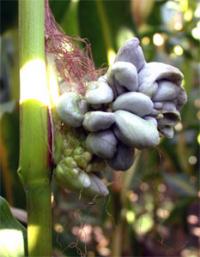
Maize as a fungal host: Ustilago maydis causes maize smut. An international research team working with biologists at the Max Planck Institute for Terrestrial Microbiology has now identified genes of the fungus implicated in the infection of the plant.
Credit: Christoph Basse It doesn't look appetizing: when Ustilago maydis attacks a maize plant, its cobs bear hideous tumours rather than crunchy niblets. So far, no effective means of combating the maize smut pathogen has been found. However, an international team has now made significant progress in the search for a solution. Led by researchers from the Max Planck Institute for Terrestrial Microbiology in Marburg, the scientists have analysed the U. maydis genome. Among the 7,000 genes of the fungus, they have found some with which the fungus lives at the expense of its host plant - without killing it. These genes probably also help the fungus to circumvent the plant’s defences. Researchers are now hoping to apply these findings to other fungi, which like Ustilago maydis depend on living plants (Nature, November 2, 2006).
| Full story | 0 Comments | 6322 views |

| Microarray | November 14, 2006 06:50 PM |
Researchers at the Johns Hopkins' High Throughput Biology Center have invented two new gene "chip" technologies that can be used to help identify otherwise elusive disease-causing mutations in the 97 percent of the genome long believed to be "junk."
| Full story | 0 Comments | 6118 views |
| Molecular & Cell Biology | November 14, 2006 05:50 PM |
When in an environment similar to that in which they exist naturally, proteins and multiprotein assemblies may demonstrate actions or dynamics different than those they exhibit when in the static form in which they are most often studied, said researchers at Baylor College of Medicine in a report in the current issue of the journal Structure.
| Full story | 0 Comments | 4795 views |

| Biotechnology | November 14, 2006 04:50 PM |
The emergency treatment of drug-resistant infections with targeted antibiotics is often delayed by the need to identify bacterial strains by growing them in culture first. At this week's AVS 53rd International Symposium & Exhibition in San Francisco, Michael Lochhead, a bioengineer at the Denver biotechnology company Accelr8, described a new lab-on-a-chip that can identify single bacterial cells for the most common cases of drug-resistant pneumonia, cutting down the wait from days to hours. The technology could also help in the development of new drugs.
| Full story | 0 Comments | 4809 views |

| Health & Medicine | November 14, 2006 04:27 PM |
Infants and adults who are blind due to a cloudy or damaged cornea are seeing some remarkable results thanks to a new version of an artificial implant that takes the place of the cornea, the clear covering of the eye that serves as our window on the world.
| Full story | 0 Comments | 5804 views |

| Environment | November 14, 2006 12:27 PM |
An increasing number of countries and regions are transitioning from deforestation to afforestation, raising hopes for a turning point for the world as a whole, according to researchers advancing a more sophisticated approach to measuring forest cover.
| Full story | 0 Comments | 8602 views |
| Molecular & Cell Biology | November 14, 2006 10:27 AM |
Scientists have found a new task managed by the antibody that's the workhorse of the human immune system: Inside cells, Immunoglobulin G (IgG) helps bring together the phagosomes that corral invading pathogens and the potent lysosomes that eventually kill off the germs.
| Full story | 0 Comments | 5207 views |

- In some genetic cases of microcephaly, stem cells fail to launch
- Yale team discovers how Zika virus causes fetal brain damage
- Scientists uncover the way a common cell enzyme alerts the body to invading bacteria
- Arctic gives clues on worst mass extinction of life
- Calcium channel blockers caught in the act at atomic level
Search Bio News Net
Free Biology Newsletter
- Flexibility That A.C.A. Lent to Work Force Is Threatened by...International Herald Tribune
- Bacteria Behind Legionnaires’ Disease Found at New York Police StationInternational Herald Tribune
- Prescription Price Crisis? 28 Million Americans See Spike in Drug...MSNBC.com: Health
- Seizing on Opioid Crisis, a Drug Maker Lobbies Hard for...International Herald Tribune
- Republicans are taking a big political risk on health careAP Health News
- Why We're So Divided Over Saving WolvesNational Geographic News