

Understanding what makes people crave the high of nicotine is a key to developing treatment for this highly addictive drug. And that understanding involves tracing the neural machinery by which nicotine switches on the brain's reward machinery.

| Microbiology | June 14, 2006 10:07 PM |
Bacteria in the soil can transform the most commonly used flame retardant compound in the United States into more toxic forms that could be harmful to humans, according to a new laboratory study published today on the Web site of the American Chemical Society journal, Environmental Science & Technology. The study is scheduled to appear in the July 15 print issue of the journal.
| Full story | 0 Comments | 5757 views |

| Biotechnology | June 14, 2006 09:08 PM |
The lead researcher for the team who - 10 years ago - created the cloned sheep "Dolly," will kick off the 2006 American Association of Pharmaceutical Scientists' (AAPS) National Biotechnology Conference in Boston, June 18-21. At the meeting, nearly two-thousand of the world's leading scientists will discuss a variety of critical issues affecting pharmaceutical biotechnology including Biogenerics, a field that is being hailed as the next revolution in healthcare.
| Full story | 0 Comments | 5157 views |
| Biotechnology | June 14, 2006 08:08 PM |
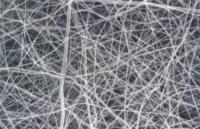
A scanning electron micrograph to illustrate the fibrous structure of the tube wall. The fibers are fewer than 500 nanometers in diameter, compared with the average hair shaft, which is 80,000-100,000 nanometers.Virginia Commonwealth University engineers and scientists have developed a new material that may one day help patients with damaged arteries regenerate new ones.
| Full story | 0 Comments | 6116 views |

| Biology | June 14, 2006 07:06 PM |
See the picture in the original press release
A motion-triggered camera trap set up in a remote jungle has captured the first-ever photo of a rhino in the wild on the island of Borneo, World Wildlife Fund and the Sabah Wildlife Department announced today.
| Full story | 0 Comments | 7455 views |

| Stem Cell Research | June 14, 2006 06:40 PM |
A specialist in stem cell biology at the University at Buffalo has received a $1.98 million grant from National Institutes of Health to investigate the potential of bone marrow-derived adult stem cells to treat the serious heart malfunction known as hibernating myocardium.
| Full story | 0 Comments | 5766 views |
| Stem Cell Research | June 14, 2006 06:09 PM |
Researchers at The Hospital for Sick Children (SickKids) and the University of Calgary have found that stem cells derived from adult skin can create neural cell types that can be transplanted into and function in mouse models of disease. This research is reported in the June 14, 2006 issue of The Journal of Neuroscience.
| Full story | 0 Comments | 6901 views |

| Environment | June 14, 2006 04:40 PM |
Standard methods of predicting air pollution don't take atmospheric chlorine into account, but the chemical could be responsible for 10 percent or more of daily ozone production in local air, research at UC Irvine has found.
| Full story | 0 Comments | 5844 views |

| Molecular & Cell Biology | June 14, 2006 02:11 PM |
Scientists have moved a step closer to understanding how breast cancer spreads to other parts of the body, thanks to research published this week.
| Full story | 0 Comments | 5866 views |

| Gene Therapy | June 14, 2006 12:55 PM |
Researchers at Rush University Medical Center, Chicago, and Ceregene Inc., San Diego, have successfully used gene therapy to preserve motor function and stop the anatomic, cellular changes that occur in the brains of mice with Huntington's disease (HD). This is the first study to demonstrate that, using this delivery method, symptom onset might be prevented in HD mice with this treatment.
| Full story | 0 Comments | 6924 views |
| Biology | June 14, 2006 10:40 AM |
A scientific expedition to a remote glacier field in Canada's High Arctic may help researchers unlock the secrets about the beginning of life and provide insights for future exploration of our solar system.
| Full story | 0 Comments | 4728 views |

- In some genetic cases of microcephaly, stem cells fail to launch
- Yale team discovers how Zika virus causes fetal brain damage
- Scientists uncover the way a common cell enzyme alerts the body to invading bacteria
- Arctic gives clues on worst mass extinction of life
- Calcium channel blockers caught in the act at atomic level
Search Bio News Net
Free Biology Newsletter
- Flexibility That A.C.A. Lent to Work Force Is Threatened by...International Herald Tribune
- Bacteria Behind Legionnaires’ Disease Found at New York Police StationInternational Herald Tribune
- Prescription Price Crisis? 28 Million Americans See Spike in Drug...MSNBC.com: Health
- Seizing on Opioid Crisis, a Drug Maker Lobbies Hard for...International Herald Tribune
- Republicans are taking a big political risk on health careAP Health News
- Why We're So Divided Over Saving WolvesNational Geographic News