

Researchers at the University of California, San Diego have developed what they call a "Smart Petri Dish" that could be used to rapidly screen new drugs for toxic interactions or identify cells in the early stages of cancer circulating through a patient's blood.

| Environment | June 13, 2006 10:11 PM |
Chile is currently the world's largest producer of farmed salmon and has a burgeoning mussel culture industry that is supplying a growing world market. However, the country's marine aquaculture sector is vulnerable to Harmful Algal Blooms, which occur when some algae species producing poisons bloom rapidly in water, causing physical or biochemical damage to fish and shellfish.
| Full story | 0 Comments | 5758 views |

| Biotechnology | June 13, 2006 09:11 PM |
Researchers at New York University have made chemical modifications to nanometer sized virus particles--a process that has the potential to improve magnetic resonance imaging (MRI) techniques. Their results are reported in the latest issue of Nano Letters.
| Full story | 0 Comments | 4633 views |

| Microbiology | June 13, 2006 08:49 PM |
Researchers studying mutually beneficial interactions between members of our vast community of friendly gut microorganisms have shown that two common organisms collude and collaborate to increase the amount of calories harvested from a class of carbohydrates found in food sweeteners.
| Full story | 0 Comments | 8247 views |
| Microbiology | June 13, 2006 07:11 PM |
Nations are preparing to stockpile vaccines against H5N1, the strain of influenza virus that experts fear could cause the next flu pandemic. But will these vaccines remain effective as the virus mutates? Researchers present good news in the July 15 issue of The Journal of Infectious Diseases, now available online.
| Full story | 0 Comments | 7808 views |

| Health & Medicine | June 13, 2006 06:55 PM |
Certain variants of a simple sugar ameliorate Alzheimer's-like disease in mice, according to a new study by Canadian researchers. Although the new studies are still in the early stages, the findings could lead to new therapies that prevent or delay the onset of Alzheimer's disease.
| Full story | 0 Comments | 8778 views |
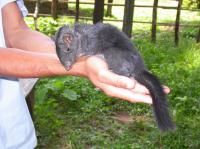
Laotian Rock RatThe first images of a live specimen of a small, furry animal once believed to have gone extinct more than 11 million years ago have been captured during a Southeast Asian expedition led by a retired Florida State University researcher.
| Full story | 0 Comments | 6467 views |

| Molecular & Cell Biology | June 13, 2006 05:25 PM |
Scientists at the U.S. Department of Energy's Brookhaven National Laboratory, the New York Structural Biology Center, and SGX Pharmaceuticals, Inc., have determined the atomic crystal structure and functional mechanism of an enzyme essential for eliminating unwanted, non-nutritional compounds such as drugs, industrial chemicals, and toxic compounds from the body. The detailed mechanism of action will help scientists understand how these compounds are eliminated and what goes wrong in cases where normal metabolism fails. The research will be published online the week of June 12, 2006, by the Proceedings of the National Academy of Sciences.
| Full story | 0 Comments | 6718 views |
| Molecular & Cell Biology | June 13, 2006 04:25 PM |
A pediatric research team has used commercially available gene chips to scrutinize all of a patient's chromosomes to identify small defects that cause genetic diseases. Because currently used genetic tests usually cannot detect these abnormalities, the new research may lead to more accurate diagnosis of congenital diseases, including puzzling disorders that lead to mental retardation.
| Full story | 0 Comments | 5968 views |
| Microbiology | June 13, 2006 03:25 PM |
Researchers at the University of Pennsylvania School of Medicine have discovered part of the reason why cold sores, caused by a herpes virus, come back again and again. The new study, published online last month in Nature, points to a small RNA molecule, called a microRNA (miRNA) as the culprit that keeps the latent virus-infected cell alive. These findings could one day lead to a new way to fight the virus and offers the first target for intervention in the latent infection.
| Full story | 0 Comments | 7071 views |
| Health & Medicine | June 13, 2006 02:25 PM |
Back when he was 20 years old in 1965, rock star Pete Townshend wrote the line "I hope I die before I get old" into a song, "My Generation" that launched his band, the Who, onto the rock 'n' roll scene.
| Full story | 0 Comments | 7139 views |

| Biology | June 13, 2006 01:25 PM |
Leptin, the hormone secreted by fat cells that plays an important role in food intake, has been described for the first time in a cold-blooded vertebrate, the South African clawed frog Xenopus.
| Full story | 0 Comments | 6303 views |
| Molecular & Cell Biology | June 13, 2006 12:36 PM |
Wings, spines, saber-like teeth---nature and the fossil record abound with examples of structures so useful they've evolved independently in a variety of animals. But scientists have debated whether examples of so-called adaptive, parallel evolution also can be found at the level of genes and proteins.
| Full story | 0 Comments | 6150 views |
| Molecular & Cell Biology | June 13, 2006 10:36 AM |
Although scientists have known for nearly 90 years that cancer cells commonly display altered sugar metabolism, the molecular significance of this phenomenon is not completely understood. Now, a new study published in the June issue of Cancer Cell reveals a functional connection between carbohydrate-driven energy production and tumor maintenance. Importantly, the results suggest that inhibition of a specific aspect of glucose metabolism may represent an attractive and potentially well-tolerated approach to interfering with tumor growth.
| Full story | 0 Comments | 6801 views |

- In some genetic cases of microcephaly, stem cells fail to launch
- Yale team discovers how Zika virus causes fetal brain damage
- Scientists uncover the way a common cell enzyme alerts the body to invading bacteria
- Arctic gives clues on worst mass extinction of life
- Calcium channel blockers caught in the act at atomic level
Search Bio News Net
Free Biology Newsletter
- Flexibility That A.C.A. Lent to Work Force Is Threatened by...International Herald Tribune
- Bacteria Behind Legionnaires’ Disease Found at New York Police StationInternational Herald Tribune
- Prescription Price Crisis? 28 Million Americans See Spike in Drug...MSNBC.com: Health
- Seizing on Opioid Crisis, a Drug Maker Lobbies Hard for...International Herald Tribune
- Republicans are taking a big political risk on health careAP Health News
- Why We're So Divided Over Saving WolvesNational Geographic News