

Scientists report that tumor cells display a dramatic reduction of cancer-causing genes when a newly discovered method is used to activate the expression of protective microRNAs in the cancer cell genome. The research, published in the June issue of Cancer Cell, demonstrates that agents known to regulate gene expression can also impact regulatory RNAs that may function as tumor suppressors in normal cells and proposes a novel strategy for treating human cancers.

| Molecular & Cell Biology | June 12, 2006 09:36 PM |
Researchers at Dana-Farber Cancer Institute report that a common "oncogene engine" – a small family of malfunctioning cell growth switches – drives several seemingly unrelated, lethal forms of cancer, including malignant melanoma. The finding suggests that it may be possible to attack these different cancers with the same therapy.
| Full story | 0 Comments | 7070 views |

| Biotechnology | June 12, 2006 08:36 PM |
A chemist at Washington University in St. Louis has developed a remarkable nanostructured material that can repel pests , sweeten the air, and some day might even be used as a timed drug delivery system –as a nasal spray, for instance.
| Full story | 0 Comments | 4612 views |

| Health & Medicine | June 12, 2006 07:35 PM |
Scientists at Joslin Diabetes Center have discovered that a surprisingly high percentage of people with type 1 diabetes (insulin-dependent) who have had the disease for 50 years or longer (The Joslin Medalists) may still have residual functioning, insulin-producing islet cells and/or islet cell antibodies. The findings will be presented June 12 at the American Diabetes Association (ADA) 66th Annual Scientific Sessions in Washington, D.C.
| Full story | 0 Comments | 4394 views |

| Biology | June 12, 2006 06:35 PM |
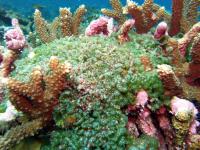
Coral (Acropora) from the Line Islands covered by bubble algae
(Dictyosphaeria)Bacteria and algae are combining to kill coral –– and human activities are compounding the problem.
| Full story | 0 Comments | 5838 views |

| Environment | June 12, 2006 05:35 PM |
Mention the word pollen to most people and it triggers thoughts of their battle against allergic reactions. However, a University of Alberta researcher has found an important spin-off for this fine yellow dust-like powder.
| Full story | 0 Comments | 5244 views |
| Biology | June 12, 2006 04:35 PM |
Biologists from Washington University in St. Louis and their collaborators from Taiwan have examined the DNA sequence family trees of rice varieties and have determined that the crop was domesticated independently at least twice in various Asian locales.
| Full story | 0 Comments | 5452 views |

- In some genetic cases of microcephaly, stem cells fail to launch
- Yale team discovers how Zika virus causes fetal brain damage
- Scientists uncover the way a common cell enzyme alerts the body to invading bacteria
- Arctic gives clues on worst mass extinction of life
- Calcium channel blockers caught in the act at atomic level
Search Bio News Net
Free Biology Newsletter
- Flexibility That A.C.A. Lent to Work Force Is Threatened by...International Herald Tribune
- Bacteria Behind Legionnaires’ Disease Found at New York Police StationInternational Herald Tribune
- Prescription Price Crisis? 28 Million Americans See Spike in Drug...MSNBC.com: Health
- Seizing on Opioid Crisis, a Drug Maker Lobbies Hard for...International Herald Tribune
- Republicans are taking a big political risk on health careAP Health News
- Why We're So Divided Over Saving WolvesNational Geographic News