

Jacqueline Kim Dale, Ph.D., formerly a Senior Research Associate at the Stowers Institute for Medical Research, and Olivier Pourquié, Ph.D., Stowers Institute Investigator and an investigator with the Howard Hughes Medical Institute, have demonstrated that the long-studied family of transcription factors called Snail is expressed in a cyclic fashion during the formation of the vertebral precursors in the mouse and chick embryo.

| Microbiology | March 6, 2006 09:47 PM |
Questions around the movement and population size changes of Kiwis, Tuatara and other New Zealand wildlife over the past hundred years have been continually studied by conservationists and scientists. It now seems the answers might all be found in the viruses that infect them.
| Full story | 0 Comments | 4186 views |

| Molecular & Cell Biology | March 6, 2006 08:47 PM |
The same set of genes responsible for establishing the bilateral body axes in animals as diverse as flies and frogs have been found to play an unexpected role in patterning an animal with a different body plan--a simple sea anemone.
| Full story | 0 Comments | 4792 views |

| Biology | March 6, 2006 07:47 PM |
Hatchery-reared steelhead trout show increased growth of some parts of the brain when small stones are scattered on the bottom of their tank, according to a new study by researchers at UC Davis. The brains of those young fish were closer to those of salmon reared in the wild, and the fish also showed behavior closer to wild than to hatchery-reared fish.
| Full story | 0 Comments | 7489 views |

| Health & Medicine | March 6, 2006 07:05 PM |
Australian snakes' venom could provide the next generation of human therapeutic drugs.
| Full story | 0 Comments | 8187 views |
| Molecular & Cell Biology | March 6, 2006 06:47 PM |
A study by researchers at New York University and the University of London offers additional evidence that mammals and fruit flies share a common genetic makeup that determines the function of their internal biological clocks.
| Full story | 0 Comments | 9538 views |
| Biology | March 6, 2006 05:47 PM |
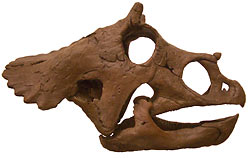
This cast of the Triceratops skull shows characteristics — a shortened face and big eyes — that have made babies lovable throughout the ages. The sprouting horns grow to three feet in the adult, while the scalloped edges of the frill, which can grow to seven feet across, become more wavy and develop scales. (Photo by Mark Goodwin, UC Berkeley Museum of Paleontology)With its big, hockey puck-sized eyes, shortened face and nubby horns, it was probably as cute as a button - at least to its mother, a three-horned dinosaur called Triceratops that could weigh as much as 10 tons and had one of the largest skulls of any land animal on the planet.
| Full story | 0 Comments | 13998 views |
| Molecular & Cell Biology | March 6, 2006 04:05 PM |
For neurons, overexcitement is deadly. To avoid this, brain cells must sop up unneeded neurotransmitters from the synapse through membrane-bound transporters. If these transporters fail, neurons and other brain cells get excited to death-- a phenomenon that may contribute to brain damage during stroke and Alzheimer's disease.
| Full story | 0 Comments | 5472 views |

| Biotechnology | March 6, 2006 01:05 PM |
Scientists at The University of Manchester have created a new type of 'bio-gel' which provides a pH neutral environment for culturing cells in 3D, as published in the journal Advanced Materials (March 2006).
| Full story | 0 Comments | 6348 views |
| Biotechnology | March 6, 2006 10:05 AM |
The wood shavings from sawmills can be used to produce an organic substrate for use in intensive crop growth in containers. Moreover, this substrate has the advantage that it can be recycled and is more economic than other, imported ones such as peat or coconut fibre.
| Full story | 0 Comments | 4842 views |

- In some genetic cases of microcephaly, stem cells fail to launch
- Yale team discovers how Zika virus causes fetal brain damage
- Scientists uncover the way a common cell enzyme alerts the body to invading bacteria
- Arctic gives clues on worst mass extinction of life
- Calcium channel blockers caught in the act at atomic level
Search Bio News Net
Free Biology Newsletter
- Flexibility That A.C.A. Lent to Work Force Is Threatened by...International Herald Tribune
- Bacteria Behind Legionnaires’ Disease Found at New York Police StationInternational Herald Tribune
- Prescription Price Crisis? 28 Million Americans See Spike in Drug...MSNBC.com: Health
- Seizing on Opioid Crisis, a Drug Maker Lobbies Hard for...International Herald Tribune
- Republicans are taking a big political risk on health careAP Health News
- Why We're So Divided Over Saving WolvesNational Geographic News