

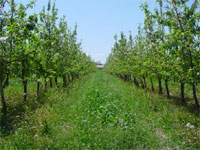
 Organic farming has long been touted as an environmentally friendly alternative to conventional agriculture. A new study in the Proceedings of the National Academy of Sciences (PNAS) provides strong evidence to support that claim.

| Environment | March 7, 2006 11:06 PM |
| Full story | 0 Comments | 4322 views |

| Biotechnology | March 7, 2006 10:10 PM |
Engineering the "Fc" region of monoclonal antibodies (mAbs) increases their toxicity to cancer cells, potentially improving the utility of targeted cancer therapies, according to research conducted at Xencor, which will be published in the March 14 print issue of the Proceedings of the National Academy of Sciences (PNAS).
| Full story | 0 Comments | 4804 views |

| Microbiology | March 7, 2006 09:09 PM |
Staph infections resistant to antibiotics, previously only associated with hospitalization or prior contact with the healthcare system, are now widespread in the community and coming home.
| Full story | 0 Comments | 5066 views |

| Biology | March 7, 2006 08:47 PM |
By stimulating the frontal cortex in adults, researchers have shown that this part of the brain is essential for understanding other people's actions.
| Full story | 0 Comments | 5497 views |
| Microbiology | March 7, 2006 07:47 PM |

Jan Amend sampling shallow marine vent fluids in 2005 at Ambitle Island, Papua, New Guinea.Curiosity about the microbial world drove Jan Amend, Ph.D., associate professor of earth and planetary sciences in Arts & Sciences at Washington University in St. Louis, to Vulcano Island, Italy, a shallow hydrothermal Shangri-la near Sicily.
| Full story | 0 Comments | 4894 views |
| Biology | March 7, 2006 06:47 PM |
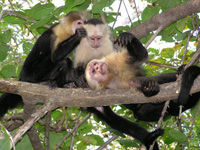 A 14 year behavioral and genetic study of a population of wild capuchin monkeys has shown that fathers almost never mate with their daughters, even though alpha males sire the majority of offspring produced by females unrelated to them. The findings suggest that psychological or other sophisticated behavioral barriers have evolved in this primate species to prevent inbreeding within individual populations.
| Full story | 0 Comments | 9861 views |
| Biology | March 7, 2006 12:47 PM |
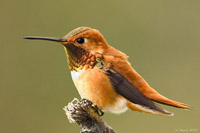
Photo Credit: Susan HealyBy observing rufous hummingbirds revisiting flowers that refill with nectar at regular intervals, researchers have found that these birds can remember when they last visited individual flowers. This so-called "interval timing" is an ability that has received much attention in the laboratory, where it has been shown that animals can learn to time one or two short intervals (on the order of seconds to 1½ hours). However, almost nothing had been known about whether animals in the wild can do this in the course of their normal behavior.
| Full story | 0 Comments | 5541 views |

| Molecular & Cell Biology | March 7, 2006 10:47 AM |
It has been well documented that, across human cultures and in most mammals, males are usually more aggressive and less nurturing than females. It's simple to blame male hormones, like testosterone, for male behavior such as aggression. But maybe it's in our genes, too.
| Full story | 0 Comments | 5249 views |

- In some genetic cases of microcephaly, stem cells fail to launch
- Yale team discovers how Zika virus causes fetal brain damage
- Scientists uncover the way a common cell enzyme alerts the body to invading bacteria
- Arctic gives clues on worst mass extinction of life
- Calcium channel blockers caught in the act at atomic level
Search Bio News Net
Free Biology Newsletter
- Flexibility That A.C.A. Lent to Work Force Is Threatened by...International Herald Tribune
- Bacteria Behind Legionnaires’ Disease Found at New York Police StationInternational Herald Tribune
- Prescription Price Crisis? 28 Million Americans See Spike in Drug...MSNBC.com: Health
- Seizing on Opioid Crisis, a Drug Maker Lobbies Hard for...International Herald Tribune
- Republicans are taking a big political risk on health careAP Health News
- Why We're So Divided Over Saving WolvesNational Geographic News