

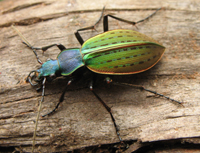
Ceroglossus ochsenii, a beetle in the family Carabidae, photographed near Cucao, Chile. Copyright 2006 David R. Maddison The Tree of Life is flourishing. The Web-based project, a massive collaboration among scientists from all over the world, is growing more "leaves" and "branches" all the time. The project is basically a genealogy of life on Earth coupled with information about the characteristics of individual species and groups of organisms.

| Bioinformatics | February 20, 2006 11:56 PM |
| Full story | 0 Comments | 6406 views |

| Environment | February 20, 2006 10:55 PM |
The search for El Dorado in the Amazonian rainforest might not have yielded pots of gold, but it has led to unearthing a different type of gold mine: some of the globe's richest soil that can transform poor soil into highly fertile ground.
| Full story | 1 Comment | 9291 views |
| Bioinformatics | February 20, 2006 09:56 PM |
Editor: As a microarray analyst, I can attest that this kind of tool is totally invaluable. When you try to understand the role of a regulated gene / protein and it has 55 synonyms, manual Pubmed queries get out of hand pretty quickly...
A little over one year after the original research paper was published in Bioinformatics, PharmaDM is pleased to announce immediate availability of its new GPSDB, the Gene and Protein Synonyms DataBase.
| Full story | 0 Comments | 5681 views |

| Molecular & Cell Biology | February 20, 2006 08:56 PM |
UCLA scientists have discovered that a sex gene responsible for making embryos male and forming the testes is also produced by the brain region targeted by Parkinson's disease. Published in the Feb. 21 edition of Current Biology, the new research may explain why more men than women develop the degenerative disorder, which afflicts roughly 1 million Americans.
| Full story | 0 Comments | 5174 views |
| Environment | February 20, 2006 07:55 PM |
Leading scientists, physicians, and veterinarians are uncovering new links between land-based pollution and diseases in marine mammals, with implications for human health.
| Full story | 0 Comments | 7697 views |

| Microbiology | February 20, 2006 06:56 PM |
Researchers at the University of California, San Diego (UCSD) School of Medicine have discovered that so-called flesh-eating "Strep" bacteria use a specific enzyme to break free of the body's immune system, a finding which could potentially lead to new treatments for serious infections in human patients.
| Full story | 0 Comments | 13140 views |

| Biology | February 20, 2006 06:55 PM |
Forget the textbook story about tool use and language sparking the dramatic evolutionary growth of the human brain. Instead, imagine ancient hominid children chasing frogs. Not for fun, but for food.
| Full story | 0 Comments | 7107 views |
| Biology | February 20, 2006 06:55 PM |
The late, famed evolutionary biologist Ernst Mayr's theory of genetic revolution , introduced in 1954, remains controversial to this day and has many detractors.
| Full story | 0 Comments | 4453 views |

- In some genetic cases of microcephaly, stem cells fail to launch
- Yale team discovers how Zika virus causes fetal brain damage
- Scientists uncover the way a common cell enzyme alerts the body to invading bacteria
- Arctic gives clues on worst mass extinction of life
- Calcium channel blockers caught in the act at atomic level
Search Bio News Net
Free Biology Newsletter
- Flexibility That A.C.A. Lent to Work Force Is Threatened by...International Herald Tribune
- Bacteria Behind Legionnaires’ Disease Found at New York Police StationInternational Herald Tribune
- Prescription Price Crisis? 28 Million Americans See Spike in Drug...MSNBC.com: Health
- Seizing on Opioid Crisis, a Drug Maker Lobbies Hard for...International Herald Tribune
- Republicans are taking a big political risk on health careAP Health News
- Why We're So Divided Over Saving WolvesNational Geographic News