


In the past few weeks, the dreaded H5N1 bird flu spread from Asia to the UK. Should we really be scared, or is it just media propaganda, popular because it 'sells'? Is it really a new phenomenon that will lead to the next influenza pandemic, or its a normal process that were investigating for the first time? Discuss!

| Health & Medicine | October 31, 2005 06:09 PM |
Breastfeeding does not raise the risk of mother-to-child transmission of hepatitis C virus (HCV), according to two new studies published in the December 1 issue of The Journal of Infectious Diseases, now available online.
| Full story | 0 Comments | 6432 views |

| Biotechnology | October 31, 2005 06:09 PM |
Virginia Tech's starting running back Cedric Humes was able to play against Boston College despite a broken arm (the ulna bone) thanks, in part, to a prototype composite brace designed for him by Virginia Tech engineers.
| Full story | 0 Comments | 7528 views |

| Microbiology | October 31, 2005 06:09 PM |
In the event of an influenza pandemic, the world's vaccine manufacturers will be in a race against time to forestall calamity. But now, thanks to a new technique to more efficiently produce the disarmed viruses that are the seed stock for making flu vaccine in large quantities, life-saving inoculations may be available more readily than before. The work is especially important as governments worldwide prepare for a predicted pandemic of avian influenza.
| Full story | 0 Comments | 5529 views |

| Biology | October 31, 2005 06:08 PM |
What would you call an alien if you encountered it on the street tomorrow? What if that alien didn't come from another world but rather was created in a laboratory right here on Earth and functioned differently from other Earth life?
| Full story | 0 Comments | 5285 views |
| Biology | October 31, 2005 06:08 PM |
Visual information can be processed unconsciously when the area of the brain that records what the eye sees is temporarily shut down, according to research at Rice University in Houston.
| Full story | 0 Comments | 5517 views |

| AIDS & HIV | October 31, 2005 06:08 PM |
A molecule consisting of two "cages" of metallic atoms bound to carbon has shown great promise in preliminary tests of becoming a new weapon in the anti-HIV arsenal, researchers at UT Southwestern Medical Center report. The molecule - called metallacarborane - and its variants appear to fight HIV protease, an enzyme critical in the virus' life cycle. Protease inhibitors are some of the key drugs used to fight HIV/AIDS, but they have side effects, and viruses can develop resistance to them.
| Full story | 0 Comments | 5691 views |
| Microbiology | October 31, 2005 06:08 PM |
Updated data from a study on a promising new vaccine against a pre-cancerous cervical virus shows superior efficacy in preventing cervical pre-cancers and non-invasive cervical cancer, according to a study presented today during the American Association for Cancer Research's 4th Annual Frontiers in Cancer Prevention Research meeting in Baltimore.
| Full story | 0 Comments | 6968 views |
| AIDS & HIV | October 31, 2005 06:08 PM |
Research with female monkeys at the Tulane National Primate Research Center has for the first time shown that three different anti-viral agents in a vaginal gel protect the animals against an HIV-like virus. The research suggests that a microbicide using compounds that inhibit the processes by which HIV attaches to and enters target cells could potentially provide a safe, effective and practical way to prevent HIV transmission in women, according to study investigators. The study, published online October 30 in the journal Nature was funded principally by the National Institute of Allergy and Infectious Diseases (NIAID) of the National Institutes of Health.
| Full story | 0 Comments | 5216 views |

| Molecular & Cell Biology | October 31, 2005 06:08 PM |
A mutated plant that seems to return from the dead may hold the secret to how some flora protect their progeny during yield-limiting drought and other stresses, according to Purdue University scientists whose study of the plant led to discovery of a gene.
| Full story | 0 Comments | 6150 views |
| Molecular & Cell Biology | October 31, 2005 06:07 PM |
A new study of genetic changes in bacteria may ultimately help drug makers stay a step ahead of disease-causing bacteria that can become resistant to antibiotics.
| Full story | 0 Comments | 5885 views |
| Biology | October 30, 2005 07:31 PM |
First-ever images of living human retinas have yielded a surprise about how we perceive our world. Researchers at the University of Rochester have found that the number of color-sensitive cones in the human retina differs dramatically among people--by up to 40 times--yet people appear to perceive colors the same way. The findings, on the cover of this week's journal Neuroscience, strongly suggest that our perception of color is controlled much more by our brains than by our eyes.
| Full story | 0 Comments | 7135 views |
| Biology | October 29, 2005 10:06 PM |
The brain is a "time machine," assert Duke neuroscientists Catalin Buhusi and Warren Meck. And understanding how the brain tracks time is essential to understanding all its functions. The brain's internal clocks coordinate a vast array of activities from communicating, to orchestrating movement, to getting food, they said.
| Full story | 0 Comments | 5099 views |
| Health & Medicine | October 29, 2005 10:06 PM |
Hunger in American households has risen by 43 percent over the last five years, according to an analysis of US Department of Agriculture (USDA) data released today. The analysis, completed by the Center on Hunger and Poverty at Brandeis University, shows that more than 7 million people have joined the ranks of the hungry since 1999.
| Full story | 0 Comments | 5532 views |
| Biology | October 29, 2005 10:06 PM |
Picky female frogs in a tiny rainforest outpost of Australia have driven the evolution of a new species in 8,000 years or less, according to scientists from the University of Queensland, the University of California, Berkeley, and the Queensland Parks and Wildlife Service.
| Full story | 0 Comments | 5903 views |
| Microbiology | October 29, 2005 10:06 PM |
Researchers at the University of Pennsylvania have demonstrated that morphine withdrawal complicates hepatitis C by suppressing IFN-alpha-mediated immunity and enhancing virus replication. The paper by Wang et al., Morphine withdrawal enhances hepatitis C virus (HCV) replicon expression, appears in the November issue of The American Journal of Pathology and is accompanied by a commentary.
| Full story | 0 Comments | 6320 views |
| Microbiology | October 29, 2005 10:06 PM |
Vanderbilt University Medical Center is enrolling volunteers in a study to test a new vaccine that targets avian flu, the first such vaccine against the virus. The Vanderbilt trial, led by Kathryn Edwards, M.D., will test the new vaccine in nearly 100 individuals 65 years of age and over. It is the second phase of anational study led by the National Institute of Allergy and Infectious Diseases.
| Full story | 0 Comments | 6872 views |
| Biotechnology | October 29, 2005 10:06 PM |
Copying the ideas of others is usually frowned upon, but when it comes to the work of Mother Nature, scientists are finding they can use nature as a template.
| Full story | 0 Comments | 4883 views |
| Health & Medicine | October 29, 2005 10:05 PM |
The National Programme on Substance Abuse Deaths (np-SAD) based at the International Centre for Drug Policy, St George's, University of London, has found that there has been a decline in the number of drug-related deaths occurring, from 1,487 in 2003 to 1,372 in 2004, a drop of eight per cent. The report published today contains information on drug-related deaths for the year 2004 reported by Coroners and Procurators Fiscal in the UK and Islands (Guernsey, Jersey and Isle of Man). The figures for 2004 do not include information for Northern Ireland.
| Full story | 0 Comments | 6427 views |
| Biology | October 28, 2005 08:32 PM |
A group of Belgian researchers has determined that a pregnant woman's ability to metabolize fats is determined not only by her genes but by her baby's genes as well. The details of their findings appear in the November issue of the Journal of Lipid Research, an American Society for Biochemistry and Molecular Biology journal.
| Full story | 0 Comments | 7902 views |
| Microbiology | October 28, 2005 07:32 PM |
A new study has found wild-type measles virus in tissues from patients who died of a fatal brain infection, providing evidence against the notion that the strain of virus in the measles vaccine caused the infection. The study, in the November 15 issue of The Journal of Infectious Diseases, now available online, also concludes that vaccination against measles could prevent many more cases of the disease, known as subacute sclerosing panencephalitis, or SSPE, than previously thought.
| Full story | 0 Comments | 7403 views |
| AIDS & HIV | October 28, 2005 07:32 PM |
Religious institutions serving New York City's Asian immigrants are not educating their congregations about HIV prevention and healthcare, in part because some leaders hold stigma and fear about the disease, according to a new study by The New York Academy of Medicine in the upcoming issue of the international journal AIDS Education and Prevention. This special issue devoted to Asians/Pacific Islanders and HIV is being published this week.
| Full story | 0 Comments | 5415 views |

| Bioinformatics | October 28, 2005 07:32 PM |
Faster computation of haplotypes provides insight into genetic basis of human diseaseHigh-throughput sequencing of an individual's DNA yields a map of genetic variation which can give clues to the genetic underpinning of human disease. The current technologies collect genotypes, or information from the individual's two chromosomes. Yet many scientists believe that drilling down to the variations between individuals' DNA at the level of each chromosome -- so-called haplotypes -- will permit more accurate study of genetic differences and their consequences for medical research and the study of evolution.
| Full story | 0 Comments | 5717 views |
| Health & Medicine | October 28, 2005 07:32 PM |
Scientists at the University of Michigan Medical School, in collaboration with researchers at Harvard's Brigham and Women's Hospital, have discovered a recurring pattern of scrambled chromosomes and abnormal gene activity that occurs only in prostate cancer.
| Full story | 0 Comments | 5934 views |
| Molecular & Cell Biology | October 28, 2005 07:32 PM |
Scientists are one step closer to unraveling the complex mechanisms in the brain that regulate body weight. Working with mice -- whose appetites are controlled by systems very similar to those in humans -- they have identified a specific type of neuron that is essential for feeding behavior. Without these neurons, adult mice stop eating and undergo rapid weight loss.
| Full story | 0 Comments | 5263 views |
| Biotechnology | October 28, 2005 07:31 PM |
Researchers at Purdue University have taken a step toward developing a new type of ultra-sensitive medical imaging technique that works by shining a laser through the skin to detect tiny gold nanorods injected into the bloodstream.
| Full story | 0 Comments | 5346 views |
| Molecular & Cell Biology | October 27, 2005 07:32 PM |
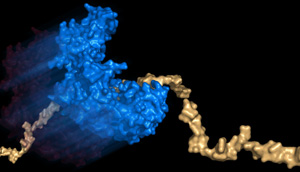
A helicase (blue) moves rapidly on a highly flexible DNA track. Such movement may prevent the accumulation of toxic proteins on the DNA. Graphic courtesy Taekjip HaResearchers studying how proteins called helicases travel along strands of DNA have found that when the proteins hit an obstacle they snap back to where they began, repeating the process over and over, possibly playing a preventative role in keeping the genome intact.
| Full story | 0 Comments | 6107 views |

| Stem Cell Research | October 27, 2005 07:32 PM |
Left ventricular function and exercise capacity increased, while the area of heart muscle damage shrank, in 18 patients given infusions of their own bone marrow stem cells up to eight years after a heart attack, according to a new study in the Nov. 1, 2005, issue of the Journal of the American College of Cardiology.
| Full story | 0 Comments | 13463 views |
| Biotechnology | October 27, 2005 07:32 PM |
In follow-on work to last year's groundbreaking toxicological study on water-soluble buckyballs, researchers at Rice University's Center for Biological and Environmental Nanotechnology (CBEN) find that water-soluble carbon nanotubes are significantly less toxic to begin with. Moreover, the research finds that nanotubes, like buckyballs, can be rendered nontoxic with minor chemical modifications.
| Full story | 0 Comments | 6539 views |
| Molecular & Cell Biology | October 27, 2005 07:32 PM |
Researchers at Stanford University have created a larger-than-normal DNA molecule that is copied almost as efficiently as natural DNA. The findings, reported in the Oct. 25 online edition of the Proceedings of the National Academy of Sciences (PNAS), may reveal new insights into how genetic mutations-tiny mistakes that occur during DNA replication-arise. The discovery was made in the laboratory of Eric Kool, a professor of chemistry at Stanford and co-author of the PNAS study.
| Full story | 0 Comments | 7216 views |
| Biology | October 27, 2005 07:31 PM |
Scientists have identified the gene responsible for controlling a first key step in the creation of new life, according to new research published in the journal Nature tomorrow (Thursday 27 October 2005).
| Full story | 0 Comments | 5985 views |
| Bioinformatics | October 27, 2005 07:31 PM |
The International HapMap Project was initiated with the primary goal of facilitating medical studies and understanding the genomic basis for human diseases. To coordinate with the journal Nature's publication describing the HapMap, the journal Genome Research is announcing a special issue entitled "Human Genome Variation," which is entirely devoted to studies using these data to provide insight into human biology and disease.
| Full story | 0 Comments | 5844 views |
| Biology | October 27, 2005 07:31 PM |
Scientists from the Wildlife Conservation Society (WCS) and their Russian colleagues from the Russian Far East recently fitted three wild 40-day-old Siberian tiger cubs with tiny radio-collars, marking the youngest wild tigers to be tracked by scientists.
| Full story | 0 Comments | 8697 views |
| Biology | October 27, 2005 07:31 PM |
Conference addresses western medicine & society's embrace of meditation, press meeting with Dalai Lama, Hopkins Medical Dean Edward Miller, and Georgetown University Professor Aviad Haramati at 8am on Nov. 8
| Full story | 0 Comments | 7376 views |
| Microbiology | October 26, 2005 07:54 PM |
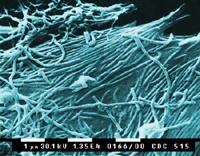
Repeated outbreaks of the Zaire strain of the Ebola virus (Ebola virions pictured above) in central Africa were caused by a recent spread of the virus, rather than by a long-persistent strain at each site. (Photo: Walsh et al.)Over the past ten years, separate outbreaks of the deadly Zaire strain of Ebola virus (ZEBOV) have killed hundreds of humans and tens of thousands of great apes in Gabon and the Republic of Congo--which harbor roughly 80% of the last remaining wild gorilla and chimpanzee populations. In a new study, Peter Walsh, Roman Biek, and Leslie Real combined genetic data with information on the timing and location of past ZEBOV outbreaks to support the hypothesis that a "consistently moving wave of ZEBOV infection" recently spread to outbreak sites in Gabon and Congo.
| Full story | 0 Comments | 8243 views |
| Microbiology | October 26, 2005 05:54 PM |
A doctoral student's research brings lessons and insight to a looming pandemic
| Full story | 0 Comments | 5924 views |

| Gene Therapy | October 26, 2005 05:54 PM |
University of Pittsburgh investigators have for the first time used gene therapy to successfully treat heart failure and other degenerative muscle problems in an animal model that is genetically susceptible to a human muscular dystrophy. Reporting in the Oct. 25 edition of the journal Circulation, the authors say that this is the first successful attempt to deliver a therapeutic gene throughout the body.
| Full story | 0 Comments | 12217 views |
| Biotechnology | October 26, 2005 05:54 PM |
Researchers at North Carolina State University are looking deep under water for clues on how to redesign plants for life deep in outer space.
| Full story | 0 Comments | 6810 views |
| Biology | October 26, 2005 05:54 PM |
Nature's finesse revealed in quality surveillance systemWith their latest discovery, researchers have significantly advanced the understanding of how human cells protect themselves from constant and potentially destructive changes in gene expression. According to an article published in this month's Nature Structural & Molecular Biology, the research is important because the protection itself can contribute to disease, and the ability to side-step it may lead to new treatments for hundreds of genetic disorders.
| Full story | 0 Comments | 6005 views |

- In some genetic cases of microcephaly, stem cells fail to launch
- Yale team discovers how Zika virus causes fetal brain damage
- Scientists uncover the way a common cell enzyme alerts the body to invading bacteria
- Arctic gives clues on worst mass extinction of life
- Calcium channel blockers caught in the act at atomic level
Search Bio News Net
Free Biology Newsletter
- Flexibility That A.C.A. Lent to Work Force Is Threatened by...International Herald Tribune
- Bacteria Behind Legionnaires’ Disease Found at New York Police StationInternational Herald Tribune
- Prescription Price Crisis? 28 Million Americans See Spike in Drug...MSNBC.com: Health
- Seizing on Opioid Crisis, a Drug Maker Lobbies Hard for...International Herald Tribune
- Republicans are taking a big political risk on health careAP Health News
- Why We're So Divided Over Saving WolvesNational Geographic News