Biology News Net
RSS 2.0 Feed
General
GeneralAugust 31, 2005 11:07 PM

Thanks to the Katrina hurricane, we had a couple of thunderstorms here yesterday (even if we're far, far away north from where it happened, it always produce interesting climatic 'side effects' up here) which seem to have knocked out my cable modem, so I couldn't post news until... now. I condensed only the best from today and yesterday (~ 20 posts in a day would have been a bit much), so enjoy!

- Millions of bacterial species revealed underfoot
- Scientists probe anti-ageing gene
- Researchers Find That Carbon Dioxide Does Not Boost Forest Growth
- Apes 'extinct in a generation'
- Coral 'little damaged by tsunami'
- First convincing chimp fossil discovered
- Parasites brainwash grasshoppers into death dive

0 Comments 6121 views
Biology

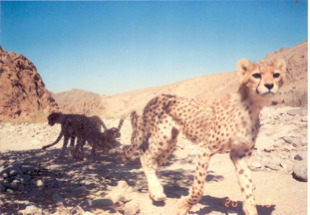
5cheetah2_resize.jpg
A family of five Asiatic cheetahs (four cubs and their mother) photographed by a remote camera trap in Iran's Dar-e Anjir Wildlife Refuge. The New York-based Wildlife Conservation Society and Iran's Department of Environment are collaborating on a conservation project in this region to safegurd the remaining population of these extremely rare cats. I.R.Iran DOE/CACP/WCS/ UNDP-GEF
Wildlife Conservation Society (WCS) scientists, working in conjunction with Iran’s Department of Environment (DOE) in an isolated region in the Dar-e Anjir Wildlife Refuge, recently discovered that a remote camera set out to survey wildlife had photographed an entire family of extremely rare Asiatic cheetahs. The pictures show an adult female and her four youngsters resting in the shade of a tree, marking the largest-known group of these rare cats ever photographed in Asia.

Bioinformatics

A study comparing the genomes of both humans and chimpanzees has found that much of the genetic difference between the two species came about in events called segmental duplications, in which segments of genetic code are copied many times in the genome. The study appears as a companion article to the draft sequence of the chimpanzee genome published in the Sept. 1 issue of the journal Nature.

Biotechnology

Results showed that the microbes in about a half a liter of rumen fluid - fermented, liquefied feed extracted from the rumen, the largest chamber of a cow's stomach - produced about 600 millivolts of electricity. That's about half the voltage needed to run one rechargeable AA-sized battery, said Ann Christy, a study co-author and an associate professor of food, agricultural and biological engineering at Ohio State University.

Environment

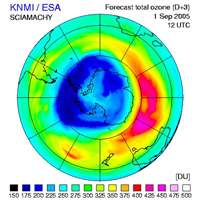
esa083005_1sm.jpg
Ozone forecast for 1 September
This season's Antarctic ozone hole has swollen to an area of ten million square kilometres from mid-August - approximately the same size as Europe and still expanding. It is expected to reach maximum extent during September, and ESA satellites are vital for monitoring its development.

Biology

Experts call for $30 million action plan to save mankind's closest relatives

A combination of natural and man-made threats is killing gorillas and chimpanzees in Central Africa, and experts say $30 million is needed for special programs to save some of mankind's closest relatives from disappearing.

Biotechnology

Altered protein could help deliver drugs and shape the growth of engineered tissueCollagen often pops up in beauty products and supermodel lips. But by mating collagen with a molecular hitchhiker, materials scientists at Johns Hopkins hope to create some important medical advances. The researchers have found a simple new way to modify collagen, paving the way for better infection-fighting bandages and a treatment to block the formation of unwanted scar tissue. In addition, tissue engineers may be able to use modified collagen in the lab to help control the formation of tiny new blood vessels that can be used to promote the integration of tissue implants in patients.

Microbiology

An unusual type of antibiotic being developed by chemists at Notre Dame University shows promise in defeating deadly "superbugs" - highly drug-resistant staph bacteria that are an increasing source of hospital-based infections. The novel antibiotics, which could some day save lives, were described today at the 230th national meeting of the American Chemical Society, the world's largest scientific society.

Biology

Though humans may never match the tracking ability of dogs, we apparently have the ability to sniff out and locate odors, according to a new study by scientists from the University of California, Berkeley.

Molecular & Cell Biology

A group of Montreal researchers has discovered that GCN2, a protein in cells that inhibits the conversion of new information into long-term memory, may be a master regulator of the switch from short-term to long-term memory. Their paper Translational control of hippocampal synaptic plasticity and memory by the eIF2a kinase GCN2, which was published in the August 25th issue of the journal Nature, provides the first genetic evidence that protein synthesis is critical for the regulation of memory formation.

Health & Medicine

Severely restricting calories over decades may add a few years to a human life span, but will not enable humans to live to 125 and beyond, as many have speculated, evolutionary biologists report.