

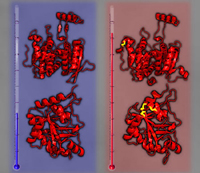
Thermophilic bacteria can thrive in extreme heat because their proteins have an abundance of disulfides (yellow, above), covalent bonds between sulfur atoms that improve stability and likely boost heat-tolerance. (Yeates et al.)Warm-blooded creatures maintain a relatively stable body temperature that cannot tolerate the stress of intense heat (or cold). When it's too hot proteins destabilize and degrade--in some cases, with fatal results. But some bacterial and archaeal organisms appear to defy nature (as we think of it) by flourishing in extremely high temperatures. The archaeal microbe Pyrobaculum aerophilum, for example--originally found in a boiling marine water hole in Italy--thrives at ~100 °C (212 °C).

| Microbiology | August 23, 2005 09:06 PM |
| Full story | 0 Comments | 8170 views |

| Gene Therapy | August 23, 2005 09:01 PM |
Vector improved in two ways creates a sustained, partial correction to bleeding problems in mice
A virus that typically infects insects could help with the development of gene therapy treatment for Hemophilia A, a condition in which even a bump on the knee can cause serious internal bleeding in people.
| Full story | 0 Comments | 7711 views |

| Stem Cell Research | August 23, 2005 08:35 PM |
Researchers have developed a new technique for creating human embryonic stem cells by fusing adult somatic cells with embryonic stem cells. The fusion causes the adult cells to undergo genetic reprogramming, which results in cells that have the developmental characteristics of human embryonic stem cells.
| Full story | 0 Comments | 4498 views |

| Biology | August 23, 2005 08:05 PM |
Duke University Medical Center neurobiologists have pinpointed circuitry in the brains of monkeys that assesses the level of risk in a given action. Their findings -- gained from experiments in which they gave the monkeys a chance to gamble to receive juice rewards -- could give insights into why humans compulsively engage in risky behaviors, including gambling, unsafe sex, drug use and overeating.
| Full story | 0 Comments | 6347 views |
| Biology | August 23, 2005 07:06 PM |
Like humans, other animals are faced with everyday obstacles in their physical environments and must engage appropriate decision-making and motor skills to deal with them. Navigating these obstacles can involve highly complex events in mammals and other vertebrates, but in new work, researchers have employed an ingenious obstacle-based system for studying the control and structure of goal-oriented motor programs in the fruit fly Drosophila.
| Full story | 0 Comments | 4629 views |

| Molecular & Cell Biology | August 23, 2005 06:36 PM |
Important messages require accurate transmission. Big genes are especially challenging because they combine many coding segments (exons) that lie between long stretches of non-coding elements (introns). During processing, introns are snipped out and exons pasted together to form a template for proteins called messenger RNA (mRNA). Mistakes in RNA processing can reduce the expression of a functional protein or, worse, produce an abnormal protein that interferes with normal cell behavior. But just how a cell's molecular machinery eliminates long introns without making errors has puzzled scientists for years.
| Full story | 0 Comments | 4782 views |
| Microbiology | August 23, 2005 06:26 PM |
Protein thought to promote lymphoma by merely preventing cancer cells from dying appears to actively promote cancer cell growth
A protein previously thought to merely hinder the activity of a key cellular protein linked to cancer cell death, now appears to mimic the cellular signaling of that protein; potentially leading to the development of lymphoma. The findings, published in the Aug. 22 online edition of Proceedings of the National Academy of Sciences (PNAS), demonstrate that a viral protein associated with human herpesvirus 8, or HHV8, may help to cause lymphoma by activating a key pathway involved in the production of lymphocytes, a common cell type found in lymphoid tissue that divide over and over and eventually develop into lymphoma.
| Full story | 0 Comments | 4130 views |

| Biotechnology | August 23, 2005 06:06 PM |
Imagine this: A tiny, fast switch that uses water droplets to create adhesive bonds almost as strong as aluminum by borrowing a mechanism found in palm beetles.
| Full story | 0 Comments | 5696 views |

- In some genetic cases of microcephaly, stem cells fail to launch
- Yale team discovers how Zika virus causes fetal brain damage
- Scientists uncover the way a common cell enzyme alerts the body to invading bacteria
- Arctic gives clues on worst mass extinction of life
- Calcium channel blockers caught in the act at atomic level
Search Bio News Net
Free Biology Newsletter
- Flexibility That A.C.A. Lent to Work Force Is Threatened by...International Herald Tribune
- Bacteria Behind Legionnaires’ Disease Found at New York Police StationInternational Herald Tribune
- Prescription Price Crisis? 28 Million Americans See Spike in Drug...MSNBC.com: Health
- Seizing on Opioid Crisis, a Drug Maker Lobbies Hard for...International Herald Tribune
- Republicans are taking a big political risk on health careAP Health News
- Why We're So Divided Over Saving WolvesNational Geographic News