Biology News Net
RSS 2.0 Feed
Environment

fm-Fossils-in-hand052505_SM.jpg
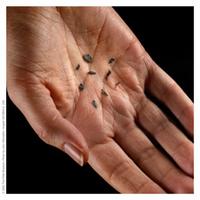
Nine tiny fossil leaves of conifers and extinct seed ferns from Båga Formation, Denmark, used to reconstruct the carbon dioxide levels in the atmosphere about 183 million years ago. The fossil leaves, which were extracted from rock by washing the rocks in acids, are more resistant than rock to acid.
Photo by John Weinstein; courtesy of The Field Museum
Studying climate change is incredibly complex, yet retracing climate change and the causes behind those changes is the only way to understand the effects of burning massive amounts of fossil fuels today.

Over the course of geological time, the amount of carbon trapped in land and the oceans has waxed and waned. So has the amount of carbon dioxide in the atmosphere. These fluctuations correlate closely with changes in global temperatures. Therefore, studying the flow of carbon between land, water and atmosphere through geological ages can shed light on issues surrounding today's global warming.

New research described in the May 26 issue of Nature provides some missing pieces in the puzzle depicting the global carbon cycle over geological time. During what geologists call "oceanic anoxic events," it has long been suggested that a large amount of the greenhouse gas carbon dioxide is removed from the atmosphere by millions of microscopic organisms that dwell in the oceans. They do this by trapping carbon in their bodies. When they die, their bodies rain down to the ocean depths and are buried by sediment, locking away the trapped carbon from the atmosphere for million of years.

Molecular & Cell Biology

Researchers from the National Institutes of Health have discovered the critical sequence of events by which insulin stimulates the entry of glucose into fat cells.

The study, appearing in the May 9 Journal of Cell Biology, was conducted by researchers from the National Institute of Child Health and Human Development and the National Institute of Diabetes and Digestive and Kidney Diseases.

It's a cloudless July afternoon in Etosha National Park in northern Namibia, and ecologist Caitlin O'Connell-Rodwell is scanning the horizon for elephants. "It's so fantastic here," she says. "We're constantly seeing elephants, rhinos, zebras, ostriches--it's the Garden of Eden."

A research associate in the Stanford University School of Medicine, O'Connell-Rodwell has come to one of Africa's premiere wildlife sanctuaries to explore the mysterious and complex world of elephant communication. She and her colleagues are part of a scientific revolution that began nearly two decades ago with the stunning revelation that elephants communicate over long distances using low-pitched sounds that are barely audible to humans.

Microbiology

050525210646.jpg
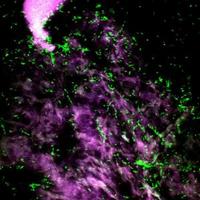
Microscopic fluorescent green Campylobacter cells on chicken skin. (Photo by Anna Bates)
Reducing the pathogenic bacterium Campylobacter on poultry farms and in processing plants begins with finding its sources, one of which is the birds' lungs, Agricultural Research Service (ARS) scientists report.

Microbiologists Mark Berrang and Richard Meinersmann and animal physiologist Richard J. Buhr at the ARS Richard B. Russell Agricultural Research Center in Athens, Ga., studied Campylobacter before and after chicken carcasses were scalded to remove feathers, an integral step in poultry processing.

Biotechnology

The risk of receiving blood contaminated with variant Creutzfeldt-Jakob (vCJD) prions may no longer be a concern for the thousands of people who require a transfusion. Pall Corporation (NYSE: PLL) announced today the Council of Europe (CE) marking of its Leukotrap® Affinity Prion Reduction Filter System. It is the first and only technology that removes infectious prions that may be the causative agent of vCJD from red cells, the most commonly transfused blood component. Variant CJD, a fatal neurodegenerative disease, is the human form of Bovine Spongiform Encephalopathy (BSE), also known as Mad Cow Disease. The CE mark means the new prion reduction filter meets pan-European essential requirements for safety of medical devices.

Biology

What does it take to fathom a proverb – catch the figurative meaning of "an apple doesn't fall far from the tree"?

According to research led by V. S. Ramachandran, director of the Center for Brain and Cognition at the University of California, San Diego, a region of the brain known as the angular gyrus is probably at least partly responsible for the human ability to understand metaphor.

Biology

Researchers from the Howard Hughes Medical Institute have succeeded in mapping the unique patterns of neural activity produced by a wide range of odors, including vanilla, skunk, fish, urine, musk, and chocolate. Revealing these distinct – but often overlapping – patterns of neural activity represents a significant step in understanding how the brain translates complex signals from odorant receptors in the nose into odor perception in the brain, the researchers said.

Microarray

Researchers at Genpathway, Inc. and Baylor College of Medicine in Houston have applied a new suite of integrated transcription-based assays to identify novel genes important in breast cancer. The newly discovered genes were identified as a result of being directly regulated by a coactivator shown previously to be a critical regulator in breast cancer.

Environment

Editor : See pictures of "Eel city" and 3D reconstruction of the volcano on their webpage.

A team of scientists, led by researchers at Scripps Institution of Oceanography at the University of California, San Diego, has discovered an active underwater volcano near the Samoan Island chain.

During a research cruise to study the Samoan hot spot, scientists uncovered a submarine volcano growing in the summit crater of another larger underwater volcano, Vailulu'u. Researchers explored the unique biological community surrounding the eruption site, and were amazed to find an "Eel City," a community of hundreds of slithering eels.

Stem Cell Research

New research from University of North Carolina at Chapel Hill shows how a protein may be crucial to the regulation of genes in embryonic stem cells. The protein, called "eed," is needed for an essential chemical modification of many genes. Embryos cannot survive without the modification. The findings appear in the May 24 issue of the journal Current Biology.

Molecular & Cell Biology

When genes are deleted on a particular section of chromosome 11, the result is an aggressive form of the childhood cancer neuroblastoma. A new study suggests that detecting this genetic deletion during the initial evaluation of children with neuroblastoma may indicate to physicians that they should recommend a more aggressive regimen of chemotherapy to fight the cancer.