


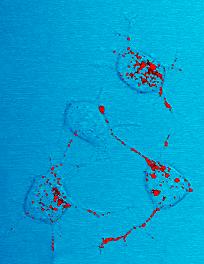
Prion trafficking in nerve cells. Prions branded with a fluorescent dye (red) were added to nerve cells taken from mice. The prions initially were in the form of large clumps on the cell, but over time the clumps were broken into smaller units and transported along wire-like nerve cell projections.Editor : Don't miss out the cool movie of proteins moving from neuron to neuron.
Scientists for the first time have watched agents of brain-wasting diseases, called transmissible spongiform encephalopathies (TSE), as they invade a nerve cell and then travel along wire-like circuits to points of contact with other cells. These findings will help scientists better understand TSE diseases and may lead to ways to prevent or minimize their effects. TSE, or prion, diseases include scrapie in sheep and goats; chronic wasting disease in deer and elk; mad cow disease in cattle; and Creutzfeldt-Jacob disease in humans.
Under the direction of Byron Caughey, Ph.D., at the Rocky Mountain Laboratories (RML), and Marco Prado, Ph.D., at the University of Minas Gerais in Belo Horizonte, Brazil, the team performed the research in laboratory cultures using a rodent-adapted form of scrapie protein and cells taken from the central nervous system of mouse and hamster brains. The proteins were first "branded" with fluorescent dyes so they could be easily tracked.


