
Biology News Net
RSS 2.0 Feed
Biotechnology

1102.jpg
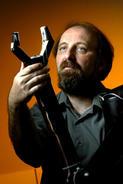
Miguel Nicolelis, professor of neurobiology and co-director of the Center for Neuroengineering, with robot arm. Credits : Duke University Photography
Monkeys that learn to use their brain signals to control a robotic arm are not just learning to manipulate an external device, Duke University Medical Center neurobiologists have found. Rather, their brain structures are adapting to treat the arm as if it were their own appendage.

The finding has profound implications both for understanding the extraordinary adaptability of the primate brain and for the potential clinical success of brain-operated devices to give the handicapped the ability to control their environment, said the researchers.

Led by neurobiologist Miguel Nicolelis of Duke's Center for Neuroengineering, the researchers published their findings in the May 11, 2005, issue of the Journal of Neuroscience. Lead author on the paper was Mikhail Lebedev in Nicolelis's laboratory. Other coauthors were Jose Carmena, Joseph O'Doherty, Miriam Zacksenhouse, Craig Henriquez and Jose Principe. The work was supported by the Defense Advanced Research Projects Agency, the James S. McDonnel Foundation, the National Institutes of Health, the National Science Foundation and the Christopher Reeve Paralysis Foundation.

Health & Medicine

As Yemen geared up for an end-of-month nationwide campaign to immunize all children under 5 against a fast-moving paralytic poliovirus outbreak, the United Nations Children's Fund (UNICEF) said it was shipping in 6 million doses of polio vaccine.

In addition, 10 experts from the World Health Organization (WHO) are working with national coordinators and helping to train vaccinators and supervisors, it said.

Yemen reported 41 confirmed cases today, up from 22 late last month, UNICEF said.

Health & Medicine

Research leading to the discovery of streptomycin – the first effective pharmaceutical treatment for tuberculosis – will be designated a National Historic Chemical Landmark at Rutgers University in a special ceremony in New Brunswick, New Jersey, on May 24. The American Chemical Society, the world's largest scientific society, sponsors the landmarks program.

Health & Medicine

A comprehensive system of vaccine development in the U.S. resulted in a reduction of 87 to more than 99 percent in illness from ten vaccine-preventable diseases during the twentieth century. These dramatic successes should not be taken for granted, however, as the vaccine system now faces numerous challenges in manufacturing and development, according to a review article in the May/June issue of Health Affairs.

Environment

Mark Hebblewhite can look at specific climate statistics from the north Pacific Ocean and tell you how the elk are doing in Banff National Park. The University of Alberta doctoral student is the first researcher to show a correlation between the North Pacific Oscillation (NPO) and a mammal population.

Molecular & Cell Biology

A gene that senses fat in the liver can modulate the consequences of eating a high-fat, Western diet, new research published in the May issue of Cell Metabolism reveals.

Mice with an excess of liver X receptor (LXRa), when fed a diet high in fat, remained free from the high cholesterol and blood vessel plaques exhibited by animals with the normal complement of receptors. Remarkably, in mice fed a normal, balanced diet, the excess receptors worsened blood lipid levels, the researchers reported.

Molecular & Cell Biology

A healthy metabolism requires a healthy dose of fat, suggests a new study published in the May issue of Cell Metabolism. Fats taken in directly from the diet or generated from sugars spark a cascade of gene activity in the liver necessary for healthy blood levels of sugar, cholesterol, and other fats, according to the researchers.

Bioinformatics

A computer scientist at Washington University in St. Louis has applied software that he has developed to the genome of a worm and has found 150 genes that were missed by previous genome analysis methods. Moreover, using the software, he and his colleagues have developed predictions for the existence of a whopping 1119 more genes.