

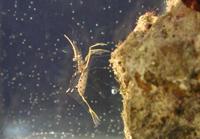
Photo Credit: Justine BeckerUsing underwater field observations in conjunction with behavioral experiments, researchers have discovered that a small crustacean, the yellow-beaked cleaner shrimp, performs a specialized dance that affects the behavior of large, predatory client fish. This signaling represents shrimp-to-fish communication that allows both hungry cleaner shrimp and parasite-laden client fish to benefit from a non-predatory, "cleaning" interaction.

| Biology | April 25, 2005 06:47 PM |
| Full story | 0 Comments | 6994 views |
| Biology | April 25, 2005 06:44 PM |
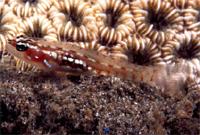
Photo credit: J. E. RandallIn a finding that broadens our understanding of the limits of animal "life history"--the life events that characterize a species's reproduction and survival strategy--researchers at James Cook University in Australia have discovered that the record for the shortest life span for a vertebrate animal is held by a tiny coral-reef fish. Living a maximum of just 59 days, the coral-reef pygmy goby Eviota sigillata leads a complex and hectic life.
| Full story | 1 Comment | 12160 views |
| Biology | April 25, 2005 06:41 PM |
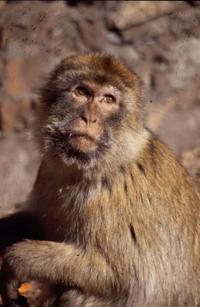
A Gibraltar macaque Photo by Robert D. Martin, Courtesy of The Field MuseumAfter decades of speculation, the origin of Gibraltar's famous Barbary macaques has been determined.
The only free-ranging monkeys in all of Europe, Gibraltar's 200 or so semi-wild macaques enjoy the run of the hillsides in this British territory – much to the delight of millions of tourists, as well as to the chagrin of some officials responsible for their management.
There were not always, however, this many macaques on Gibraltar, which serves as a gateway to the Mediterranean Sea. In 1942, after the population dwindled to almost nothing, British Prime Minister Winston Churchill ordered that their numbers be replenished due to a traditional belief that Britain would lose Gibraltar if the macaques there ever died out.
The clandestine move was taken to bolster Britain's morale during World War II. Ever since, scientists have wondered exactly where the macaques came from.
| Full story | 1 Comment | 7029 views |
| Biology | April 25, 2005 06:39 PM |
A newly discovered pathway by which cells protect themselves from a toxic byproduct of photosynthesis may hold important implications for bioenergy sources, human and plant disease, and agricultural yields, a team of University of Wisconsin-Madison bacteriologists announced Monday in the Proceedings of the National Academy of Sciences.
| Full story | 0 Comments | 5684 views |

| Microbiology | April 25, 2005 06:37 PM |
When the tick-borne bacterium that causes Lyme disease lacks a specific protein that responds to an incoming meal of blood, it is unable to be transmitted from the tick to a new animal host, researchers at UT Southwestern Medical Center have found.
| Full story | 0 Comments | 5101 views |

| Microarray | April 25, 2005 06:36 PM |
ExonHit Therapeutics, today announced the grant of a major patent, US # 6,881,571, by the United States Patent and Trademark Office on microarray products allowing the specific detection of mRNAs produced by alternative splicing, covering microarrays optimised for the discovery of alternative RNA splicing events. The patent protects the probe configuration of a unique set of five oligonucleotides for the detection of each splice variant. There are many applications for this patent, including drug discovery, diagnostics, and compound screenings for efficacy or toxicity as well as screening patients for potential efficacy of therapeutics.
| Full story | 0 Comments | 5130 views |
| Microarray | April 25, 2005 06:34 PM |
Caliper Life Sciences, Inc. (Nasdaq: CALP) and Affymetrix, Inc. (Nasdaq: AFFX) today announced that Caliper has issued Affymetrix a non-exclusive license to use a portion of Caliper's microfluidics patent estate with Affymetrix' GeneChip(R) microarray technologies. The license extends to the manufacture and sale of GeneChip brand products in all areas of application, including research, diagnostics and applied genomics applications. In exchange for the license, Affymetrix will pay upfront licensing fees and royalties on future products covered under the agreement. Further financial details related to the agreement were not disclosed.
| Full story | 0 Comments | 6795 views |

| Bioinformatics | April 25, 2005 06:32 PM |
For decades, scientists have been studying how external information gets transmitted from outside of cells to the control centers inside them that trigger particular responses. But cell signaling networks are so complex that mapping them has been a slow, arduous process.
| Full story | 0 Comments | 4130 views |

- In some genetic cases of microcephaly, stem cells fail to launch
- Yale team discovers how Zika virus causes fetal brain damage
- Scientists uncover the way a common cell enzyme alerts the body to invading bacteria
- Arctic gives clues on worst mass extinction of life
- Calcium channel blockers caught in the act at atomic level
Search Bio News Net
Free Biology Newsletter
- Flexibility That A.C.A. Lent to Work Force Is Threatened by...International Herald Tribune
- Bacteria Behind Legionnaires’ Disease Found at New York Police StationInternational Herald Tribune
- Prescription Price Crisis? 28 Million Americans See Spike in Drug...MSNBC.com: Health
- Seizing on Opioid Crisis, a Drug Maker Lobbies Hard for...International Herald Tribune
- Republicans are taking a big political risk on health careAP Health News
- Why We're So Divided Over Saving WolvesNational Geographic News