


CRISPR-Cas9 is the go-to technique for knocking out genes in human cell lines to discover what the genes do, but the efficiency with which it disables genes can vary immensely.

| Health & Medicine | August 17, 2016 06:43 PM |
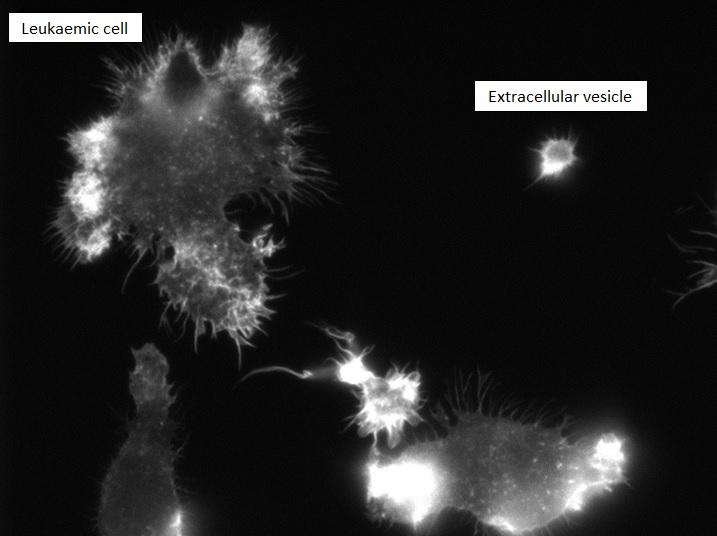
This image shows the presence of an extracellular vesicle. Researchers at The University of Manchester have unlocked the potential of a new test which could revolutionise the way doctors diagnose and monitor a common childhood Leukaemia.
| Full story | 0 Comments | 10133 views |

| Molecular & Cell Biology | August 17, 2016 06:43 PM |
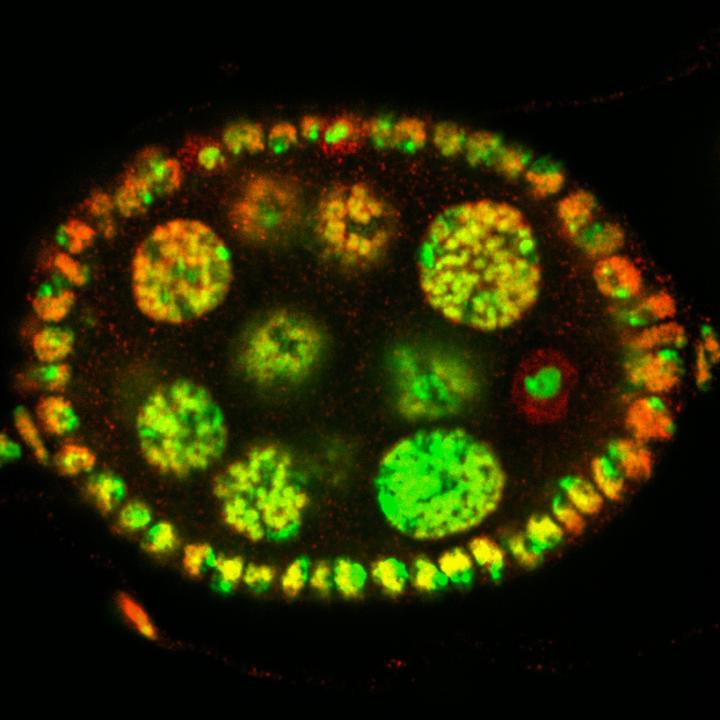
Ovarian follicle of fruit fly, with chromosomes stained in green and dKDM5 protein stained in red. At the start of reproductive life an ovary contains, on average, several thousands of immature ovules in a resting state that can last for several decades. But how does each resting ovule know that it is time to prepare for ovulation? In a study published in the latest issue of Nature Communications*, researchers at Instituto Gulbenkian de Ciencia (IGC; Portugal), at University of Algarve (Portugal), and at University at Albany (USA) discovered in the fruit fly a molecular "alarm clock" that tells resting ovules when is the right time to wake up. Defects in this alarm clock result in female fertility problems.
| Full story | 0 Comments | 19393 views |

- In some genetic cases of microcephaly, stem cells fail to launch
- Yale team discovers how Zika virus causes fetal brain damage
- Scientists uncover the way a common cell enzyme alerts the body to invading bacteria
- Arctic gives clues on worst mass extinction of life
- Calcium channel blockers caught in the act at atomic level
Search Bio News Net
Free Biology Newsletter
- Flexibility That A.C.A. Lent to Work Force Is Threatened by...International Herald Tribune
- Bacteria Behind Legionnaires’ Disease Found at New York Police StationInternational Herald Tribune
- Prescription Price Crisis? 28 Million Americans See Spike in Drug...MSNBC.com: Health
- Seizing on Opioid Crisis, a Drug Maker Lobbies Hard for...International Herald Tribune
- Republicans are taking a big political risk on health careAP Health News
- Why We're So Divided Over Saving WolvesNational Geographic News