

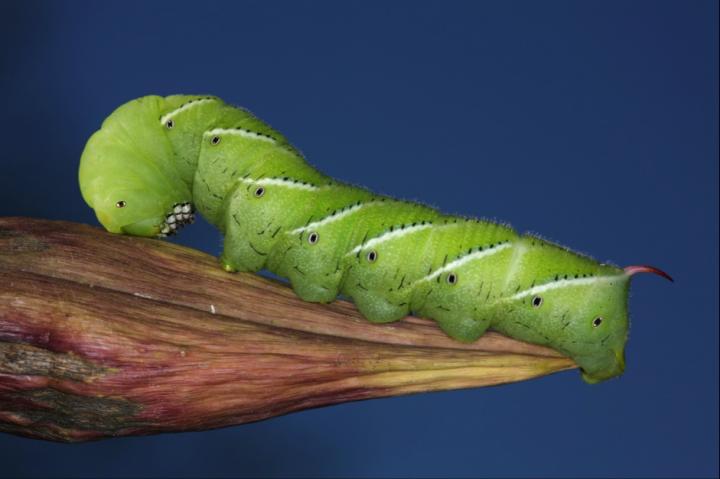
Manduca sexta caterpillars can grow up to 10 cm long making them ideal for laboratory experiments to investigate their biochemistry and physiology. "Whooo ... are ... you?" asked the hookah-smoking caterpillar of Alice, in Wonderland. Asking the question of the caterpillar instead, an international team of scientists have published their findings from the sequencing, annotation, and exploration of the genome of the tobacco hornworm moth. The project involved 114 scientists from 50 research institutions worldwide, including from the SIB Swiss Institute of Bioinformatics and the University of Geneva (UNIGE). This remarkable moth and strikingly beautiful and very large caterpillar are known by the Latin name, Manduca sexta, but also as the tobacco hornworm, Carolina sphinx moth, goliath worm, or 'Le sphinx du tabac'. The giant caterpillars are a favourite childhood pet, but they are considered serious agricultural pests as they feed voraciously on tobacco, potato, tomato, and pepper plants. The large size of the caterpillars means that this moth has become one of the most important model species for studying insect physiology, biochemistry, and molecular biology, and sequencing its genome opens many new research avenues.

| Bioinformatics | August 15, 2016 06:29 PM |
| Full story | 0 Comments | 17267 views |

| Biotechnology | August 15, 2016 06:29 PM |

The legions of nanorobotic agents are actually composed of more than 100 million flagellated bacteria Researchers from Polytechnique Montréal, Université de Montréal and McGill University have just achieved a spectacular breakthrough in cancer research. They have developed new nanorobotic agents capable of navigating through the bloodstream to administer a drug with precision by specifically targeting the active cancerous cells of tumours. This way of injecting medication ensures the optimal targeting of a tumour and avoids jeopardizing the integrity of organs and surrounding healthy tissues. As a result, the drug dosage that is highly toxic for the human organism could be significantly reduced.
| Full story | 0 Comments | 15806 views |
| Biotechnology | August 15, 2016 06:29 PM |
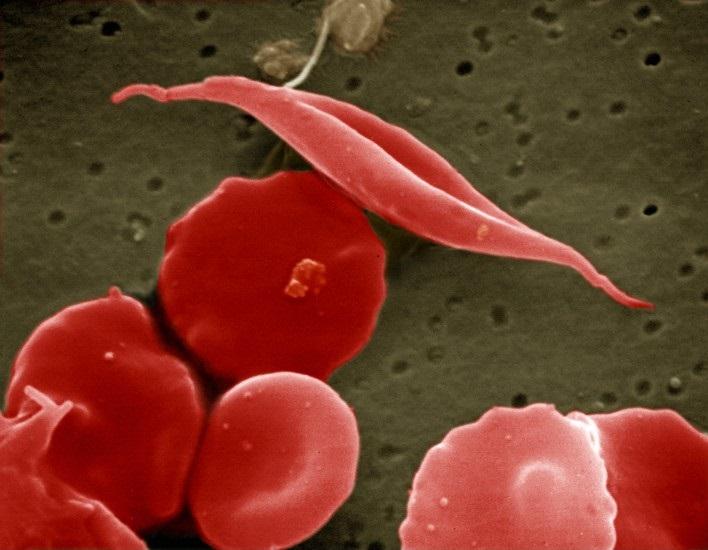
This is a scanning electron micrograph of sickled and other red blood cells. An international team of scientists led by researchers at St. Jude Children's Research Hospital has found a way to use CRISPR gene editing to help fix sickle cell disease and beta-thalassemia in blood cells isolated from patients. The study, which appears online today in Nature Medicine, provides proof-of-principle for a new approach to treat common blood disorders by genome editing.
| Full story | 0 Comments | 17004 views |

- In some genetic cases of microcephaly, stem cells fail to launch
- Yale team discovers how Zika virus causes fetal brain damage
- Scientists uncover the way a common cell enzyme alerts the body to invading bacteria
- Arctic gives clues on worst mass extinction of life
- Calcium channel blockers caught in the act at atomic level
Search Bio News Net
Free Biology Newsletter
- Flexibility That A.C.A. Lent to Work Force Is Threatened by...International Herald Tribune
- Bacteria Behind Legionnaires’ Disease Found at New York Police StationInternational Herald Tribune
- Prescription Price Crisis? 28 Million Americans See Spike in Drug...MSNBC.com: Health
- Seizing on Opioid Crisis, a Drug Maker Lobbies Hard for...International Herald Tribune
- Republicans are taking a big political risk on health careAP Health News
- Why We're So Divided Over Saving WolvesNational Geographic News