

Decades after the genomics revolution, half of known eukaryote lineages still remain unstudied at the genomic level--with the field displaying a research bias against 'less popular', but potentially genetically rich, single-cell organisms.

| Molecular & Cell Biology | April 30, 2014 07:02 PM |
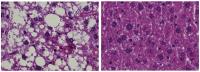
This is a fatty liver with SIRT7. The microscope images show the liver tissue of control animals (left) and mice that lack the SIRT7 gene magnified by a factor of... The long-term consumption of too much high-energy and high-fat food leads to overweight. Behind this trivial statement lies the extremely complex regulation of lipid metabolism. Together with colleagues from Japan, scientists from the Max Planck Institute for Heart and Lung Research in Bad Nauheim have now discovered that the Sirt7 gene plays a central role in energy metabolism. Despite consuming high-fat food, genetically modified mice that lack the gene maintain their normal weight.
| Full story | 0 Comments | 10387 views |

| Biotechnology | April 30, 2014 07:02 PM |
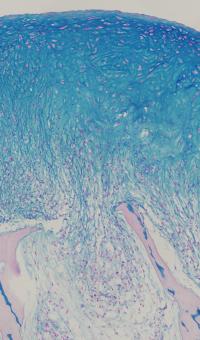
This is a full section of a tissue construct with cartilage at the top and bone substrate underneath. Researchers at Columbia Engineering announced today that they have successfully grown fully functional human cartilage in vitro from human stem cells derived from bone marrow tissue. Their study, which demonstrates new ways to better mimic the enormous complexity of tissue development, regeneration, and disease, is published in the April 28 Early Online edition of Proceedings of the National Academy of Sciences (PNAS).
| Full story | 0 Comments | 10292 views |

| Stem Cell Research | April 30, 2014 07:02 PM |
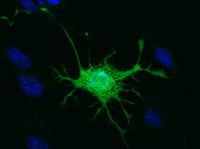
This is the distinct neuronal-like appearance of a mouse-derived dental pulp stem cell following the induction process. University of Adelaide researchers have discovered that stem cells taken from teeth can grow to resemble brain cells, suggesting they could one day be used in the brain as a therapy for stroke.
| Full story | 0 Comments | 11667 views |
| Molecular & Cell Biology | April 28, 2014 06:55 PM |
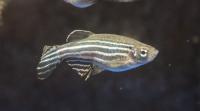
The zebrafish is used as a model organism for research into the embryonic development of vertebrates. Early embryonic development of vertebrates is controlled by the genes and their "grammar". Decoding this grammar might help understand the formation of abnormalities or cancer or develop new medical drugs. For the first time, it is now found by a study that various mechanisms of transcribing DNA into RNA exist during gene expression in the different development phases of zebrafish. This study is presented by KIT researchers in the journal "Nature".
| Full story | 0 Comments | 9366 views |
| Biotechnology | April 28, 2014 06:55 PM |
A next-generation genome editing system developed by Massachusetts General Hospital (MGH) investigators substantially decreases the risk of producing unwanted, off-target gene mutations. In a paper receiving online publication in Nature Biotechnology, the researchers report a new CRISPR-based RNA-guided nuclease technology that uses two guide RNAs, significantly reducing the chance of cutting through DNA strands at mismatched sites.
| Full story | 0 Comments | 7619 views |

| Health & Medicine | April 24, 2014 07:09 PM |
Using frozen stool from healthy, unrelated donors was safe and effective in treating patients with serious, relapsing diarrhea caused by Clostridium difficile, according to a new pilot study published in Clinical Infectious Diseases and available online. Known as fecal microbiota transplantation, the treatment was equally effective whether given via a colonoscope or a nasogastric tube. The findings suggest approaches that may make this promising treatment more readily available to patients.
| Full story | 0 Comments | 6247 views |

| Bioinformatics | April 24, 2014 07:09 PM |

This is a golden eagle. Purdue and West Virginia University researchers are the first to sequence the genome of the golden eagle, providing a bird's-eye view of eagle features that could lead to more effective conservation strategies.
| Full story | 0 Comments | 9386 views |
| Bioinformatics | April 24, 2014 07:09 PM |
A new study from investigators with the Autism Genome Project, the world's largest research project on identifying genes associated with risk for autism, has found that the comprehensive use of copy number variant (CNV) genetic testing offers an important tool in individualized diagnosis and treatment of autism.
| Full story | 0 Comments | 9507 views |
| Bioinformatics | April 24, 2014 07:09 PM |
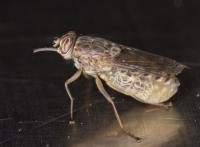
This is an image of tsetse fly. An international team of researchers led by the Yale School of Public Health has successfully sequenced the genetic code of the tsetse fly, opening the door to scientific breakthroughs that could reduce or end the scourge of African sleeping sickness in sub-Saharan Africa. The study is published in the journal Science.
| Full story | 0 Comments | 6692 views |
| Molecular & Cell Biology | April 22, 2014 05:58 PM |
Scientists from the Florida campus of The Scripps Research Institute (TSRI) have identified a protein complex that plays a critical but previously unknown role in learning and memory formation.
| Full story | 0 Comments | 9654 views |
| Bioinformatics | April 22, 2014 05:58 PM |
Using fish bred at Washington State University, an international team of researchers has mapped the genetic profile of the rainbow trout, a versatile salmonid whose relatively recent genetic history opens a window into how vertebrates evolve.
| Full story | 0 Comments | 6077 views |
| Bioinformatics | April 22, 2014 05:58 PM |
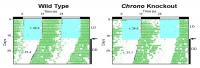
Mice are nocturnal. When both wild type and Chrono knockout mice are kept in an environment with 12 hours of light (blue) and 12 hours of dark (white).They align their... Over the last few decades researchers have characterized a set of clock genes that drive daily rhythms of physiology and behavior in all types of species, from flies to humans. Over 15 mammalian clock proteins have been identified, but researchers surmise there are more. A team from the Perelman School of Medicine at the University of Pennsylvania wondered if big-data approaches could find them.
| Full story | 0 Comments | 6017 views |

| Biology | April 17, 2014 07:39 PM |
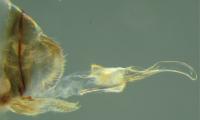
This shows the female penis of N. aurora. Researchers reporting in the Cell Press journal Current Biology on April 17 have discovered little-known cave insects with rather novel sex lives. The Brazilian insects, which represent four distinct but related species in the genus Neotrogla, are the first example of an animal with sex-reversed genitalia.
| Full story | 0 Comments | 10068 views |
| Molecular & Cell Biology | April 17, 2014 07:38 PM |
Scientists have uncovered a new way the immune system may fight cancers and viral infections. The finding could aid efforts to use immune cells to treat illness.
| Full story | 0 Comments | 8438 views |
| Molecular & Cell Biology | April 16, 2014 07:07 PM |
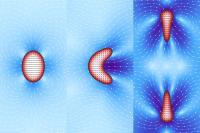
This shows active droplets. Droplets of filamentous material enclosed in a lipid membrane: these are the models of a "simplified" cell used by the SISSA physicists Luca Giomi and Antonio DeSimone, who simulated the spontaneous emergence of cell motility and division - that is, features of living material - in inanimate "objects". The research is one of the cover stories of the April 10th online issue of the journal Physical Review Letters.
| Full story | 0 Comments | 7160 views |
| Molecular & Cell Biology | April 16, 2014 07:07 PM |
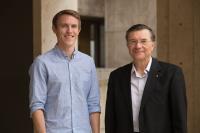
Here are Cian O'Donnell and Terry Sejnowski. Scientists at the Salk Institute have created a new model of memory that explains how neurons retain select memories a few hours after an event.
| Full story | 0 Comments | 8412 views |
| Molecular & Cell Biology | April 15, 2014 06:14 PM |
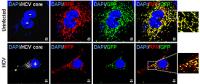
Mitochondria in hepatitis C-infected cells (bottom row) are self-destructing. The self-annihilation process explains the persistance and virulence of the virus in human liver cells. Researchers at the University of California, San Diego School of Medicine have identified a mechanism that explains why people with the hepatitis C virus get liver disease and why the virus is able to persist in the body for so long.
| Full story | 0 Comments | 9745 views |
| Health & Medicine | April 15, 2014 06:14 PM |
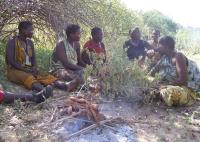
This shows Hadza women roasting tubers. The gut microbiota is responsible for many aspects of human health and nutrition, but most studies have focused on "western" populations. An international collaboration of researchers, including researchers of the Max Planck Institute for Evolutionary Anthropology in Leipzig, Germany, has for the first time analysed the gut microbiota of a modern hunter-gatherer community, the Hadza of Tanzania. The results of this work show that Hadza harbour a unique microbial profile with features yet unseen in any other human group, supporting the notion that Hadza gut bacteria play an essential role in adaptation to a foraging subsistence pattern. The study further shows how the intestinal flora may have helped our ancestors adapt and survive during the Paleolithic
| Full story | 0 Comments | 7011 views |
| Molecular & Cell Biology | April 14, 2014 07:22 PM |
Researchers have found a major piece of genetic evidence that confirms the role of a group of virus-fighting genes in cancer development.
| Full story | 0 Comments | 13275 views |
| Health & Medicine | April 14, 2014 07:22 PM |
Scientists found that the molecule, called microRNA 135b, is a vital 'worker' employed by several important cancer genes to drive the growth of bowel cancers.
| Full story | 0 Comments | 7615 views |
| Bioinformatics | April 11, 2014 07:52 PM |
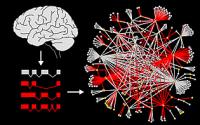
Splicing variants (red) of autism genes were cloned from the brain and screened for interactions. The image on the right represents the network of interactions. A team of researchers from the University of California, San Diego School of Medicine and the Center for Cancer Systems Biology (CCSB) at the Dana-Farber Cancer Institute has uncovered a new aspect of autism, revealing that proteins involved in autism interact with many more partners than previously known. These interactions had not been detected earlier because they involve alternatively spliced forms of autism genes found in the brain.
| Full story | 0 Comments | 6797 views |
| Biology | April 11, 2014 07:52 PM |
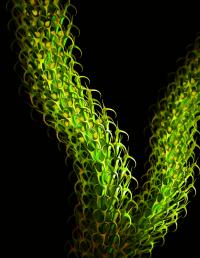
The 375 million-year-old fossil lycopod Leclercqia scolopendra, described and beautifully rendered by UC Berkeley graduate student Jeffrey Benca. Jeff Benca is an admitted über-geek when it comes to prehistoric plants, so it was no surprise that, when he submitted a paper describing a new species of long-extinct lycopod for publication, he ditched the standard line drawing and insisted on a detailed and beautifully rendered color reconstruction of the plant. This piece earned the cover of March's centennial issue of the American Journal of Botany.
| Full story | 0 Comments | 8703 views |
| Biology | April 10, 2014 05:44 PM |
New research from scientists at the University of Massachusetts Medical School shows that fruit flies are secretly harboring the biochemistry needed to glow in the dark —otherwise known as bioluminescence.
| Full story | 0 Comments | 8447 views |
| Molecular & Cell Biology | April 10, 2014 05:44 PM |
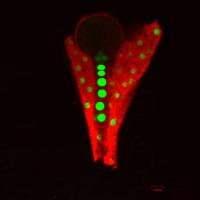
This is a confocal laser scanning microcope image of an early embryo with surrounding placental endosperm cells. A new generation of high yield plants could be created following a fundamental change in our understanding of how plants develop.
| Full story | 0 Comments | 7012 views |
| Biology | April 10, 2014 05:44 PM |
Stunning images of a 305-million-year-old harvestman fossil reveal ancestors of the modern-day arachnids had two sets of eyes rather than one.
| Full story | 0 Comments | 6238 views |

| Environment | April 9, 2014 06:20 PM |
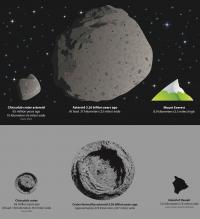
A graphical representation of the size of the asteroid thought to have killed the dinosaurs, and the crater it created, compared to an asteroid thought to have hit the Earth... Picture this: A massive asteroid almost as wide as Rhode Island and about three to five times larger than the rock thought to have wiped out the dinosaurs slams into Earth. The collision punches a crater into the planet's crust that's nearly 500 kilometers (about 300 miles) across: greater than the distance from Washington, D.C. to New York City, and up to two and a half times larger in diameter than the hole formed by the dinosaur-killing asteroid. Seismic waves bigger than any recorded earthquakes shake the planet for about half an hour at any one location – about six times longer than the huge earthquake that struck Japan three years ago. The impact also sets off tsunamis many times deeper than the one that followed the Japanese quake.
| Full story | 0 Comments | 6988 views |
| Environment | April 9, 2014 06:20 PM |

Logistics were extremely challenging because Liberia's infrastructure was almost completely destroyed during the civil war and because of the remoteness of some of the survey locations. When Liberia enters the news it is usually in the context of civil war, economic crisis, poverty or a disease outbreak such as the recent emergence of Ebola in West Africa. Liberia's status as a biodiversity hotspot and the fact that it is home to some of the last viable and threatened wildlife populations in West Africa has received little media attention in the past. This is partly because the many years of violent conflict in Liberia, from 1989 to 1997 and from 2002 to 2003, thwarted efforts of biologists to conduct biological surveys. An international research team, including scientists of the Max Planck Institute for Evolutionary Anthropology in Leipzig, Germany, has now counted chimpanzees and other large mammals living in Liberia. The census revealed that this country is home to 7000 chimpanzees and therefore to the second largest population of the Western subspecies of chimpanzees. As Liberia has released large areas for deforestation, the local decision-makers can now use the results of this study in order to protect the chimpanzees more effectively.
| Full story | 0 Comments | 5578 views |
| Health & Medicine | April 8, 2014 05:58 PM |
Four young men who have been paralyzed for years achieved groundbreaking progress — moving their legs — as a result of epidural electrical stimulation of the spinal cord, an international team of life scientists reports today in the medical journal Brain.
| Full story | 0 Comments | 7267 views |
| Molecular & Cell Biology | April 8, 2014 05:58 PM |
Synthetic genetic circuitry created by researchers at Rice University is helping them see, for the first time, how to regulate cell mechanisms that degrade the misfolded proteins implicated in Parkinson's, Huntington's and other diseases.
| Full story | 0 Comments | 5892 views |
| Biology | April 7, 2014 06:34 PM |
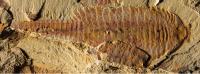
This image shows the dorsal view of Fuxianhuia protensa. An international team of researchers from the University of Arizona, China and the United Kingdom has discovered the earliest known cardiovascular system, and the first to clearly show a sophisticated system complete with heart and blood vessels, in fossilized remains of an extinct marine creature that lived over half a billion years ago. The finding sheds new light on the evolution of body organization in the animal kingdom and shows that even the earliest creatures had internal organizational systems that strongly resemble those found in their modern descendants.
| Full story | 0 Comments | 7968 views |
| Health & Medicine | April 7, 2014 06:34 PM |
The St. Jude Children's Research Hospital-Washington University Pediatric Cancer Genome Project has identified new mutations in pediatric brain tumors known as high-grade gliomas (HGGs), which most often occur in the youngest patients. The research appears today as an advance online publication in the scientific journal Nature Genetics.
| Full story | 0 Comments | 6949 views |
| Biotechnology | April 3, 2014 03:57 PM |
Using magnetically controlled nanoparticles to force tumour cells to 'self-destruct' sounds like science fiction, but could be a future part of cancer treatment, according to research from Lund University in Sweden.
| Full story | 0 Comments | 13142 views |
| Health & Medicine | April 3, 2014 03:57 PM |
The St. Jude Children's Research Hospital—Washington University Pediatric Cancer Genome Project found mutations in the tumor suppressor gene TP53 in 90 percent of osteosarcomas, suggesting the alteration plays a key role early in development of the bone cancer. The research was published today online ahead of print in the journal Cell Reports.
| Full story | 0 Comments | 7511 views |
| Health & Medicine | April 1, 2014 05:13 PM |
It's not a hair-brained idea: A new research report appearing in the April 2014 issue of The FASEB Journal explains why people with a rare balding condition called "atrichia with papular lesions" lose their hair, and it identifies a strategy for reversing this hair loss. Specifically the report shows for the first time that the "human hairless gene" imparts an essential role in hair biology by regulating a subset of other hair genes. This newly discovered molecular function likely explains why mutations in the hairless gene contribute to the pathogenesis of atrichia with papular lesions. In addition, this gene also has also been shown to function as a tumor suppressor gene in the skin, raising hope for developing new approaches in the treatment of skin disorders and/or some cancers.
| Full story | 0 Comments | 7989 views |
| Biology | April 1, 2014 05:13 PM |
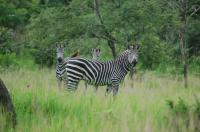
UC Davis scientists have learned why zebras, like these plains zebras in Katavi National Park, Tanzania, have stripes. Why zebras have black and white stripes is a question that has intrigued scientists and spectators for centuries. A research team led by the University of California, Davis, has now examined this riddle systematically. Their answer is published April 1 in the online journal Nature Communications.
| Full story | 0 Comments | 12674 views |

- In some genetic cases of microcephaly, stem cells fail to launch
- Yale team discovers how Zika virus causes fetal brain damage
- Scientists uncover the way a common cell enzyme alerts the body to invading bacteria
- Arctic gives clues on worst mass extinction of life
- Calcium channel blockers caught in the act at atomic level
Search Bio News Net
Free Biology Newsletter
- Flexibility That A.C.A. Lent to Work Force Is Threatened by...International Herald Tribune
- Bacteria Behind Legionnaires’ Disease Found at New York Police StationInternational Herald Tribune
- Prescription Price Crisis? 28 Million Americans See Spike in Drug...MSNBC.com: Health
- Seizing on Opioid Crisis, a Drug Maker Lobbies Hard for...International Herald Tribune
- Republicans are taking a big political risk on health careAP Health News
- Why We're So Divided Over Saving WolvesNational Geographic News