

Although the standard approach to acute appendicitis is to remove the appendix, a study at the Sahlgrenska Academy, University of Gothenburg, Sweden, reveals that treatment with antibiotics can be just as effective in many cases.

| Biology | September 26, 2012 07:06 PM |
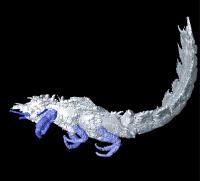
This shows the spiney-type insect. Writing in the journal PLoS One, the scientists have used a high resolution form of CT scanning to reconstruct two 305-million year old juvenile insects. Without the pioneering approach to imaging, these tiny insects – which are three-dimensional holes in a rock – would have been impossible to study.
| Full story | 0 Comments | 11326 views |
| Biology | September 26, 2012 07:06 PM |
Ants that are held as slaves in nests of other ant species damage their oppressors through acts of sabotage. Ant researcher Professor Dr. Susanne Foitzik of Johannes Gutenberg University Mainz (JGU) in Germany first observed this "slave rebellion" phenomenon in 2009. According to the latest findings, however, this behavior now appears to be a widespread characteristic that is not limited to isolated occurrences. In fact, in three different populations in the U.S. states of West Virginia, New York, and Ohio, enslaved Temnothorax longispinosus workers have been observed to neglect and kill the offspring of their Protomognathus americanus slavemakers rather than care for them. As a result, an average of only 45 percent of the parasite's offspring survived. This presumably reduces the strength of the parasites in the area and thereby increases the chances of survival for the neighboring colonies populated by the slave ants' relatives.
| Full story | 0 Comments | 10212 views |

| Stem Cell Research | September 25, 2012 06:14 PM |
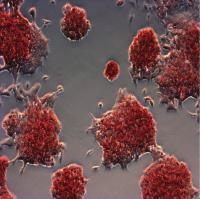
Induced pluripotent stem cells generated using a kinase inhibitor. The process researchers use to generate induced pluripotent stem cells (iPSCs)—a special type of stem cell that can be made in the lab from any type of adult cell—is time consuming and inefficient. To speed things up, researchers at Sanford-Burnham Medical Research Institute (Sanford-Burnham) turned to kinase inhibitors. These chemical compounds block the activity of kinases, enzymes responsible for many aspects of cellular communication, survival, and growth. As they outline in a paper published September 25 in Nature Communications, the team found several kinase inhibitors that, when added to starter cells, help generate many more iPSCs than the standard method. This new capability will likely speed up research in many fields, better enabling scientists around the world to study human disease and develop new treatments.
| Full story | 0 Comments | 12309 views |
| Stem Cell Research | September 25, 2012 06:14 PM |
In a study to investigate how transplanted islet cells can differentiate and mature into insulin-producing pancreatic cells, a team of Japanese researchers found that using a specific set of transcription factors (proteins that bind to specific DNA sequences) could be transduced into mouse pancreatic stem cells (mPSCs) using Sendai virus (SeV), a mouse influenza virus, as a carrier, or vector. The study is published in a recent issue of Cell Medicine [3(1)], now freely available on-line at: http://www.ingentaconnect.com/content/cog/cm.
| Full story | 0 Comments | 7630 views |

| Molecular & Cell Biology | September 25, 2012 06:14 PM |
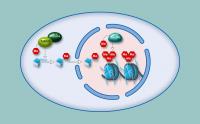
Methylation of histones within heterochromatin: The enzymes Prdm3 and Prdm16 attach a methyl group to histone H3. In the cell nucleus, Suv39h attaches two further methyl groups. To fit the two-meter long DNA molecule into a cell nucleus that is only a few thousandths of a millimetre in size, long sections of the DNA must be strongly compacted. Epigenetic marks maintain these sections, known as heterochromatin. Scientists of the Max Planck Institute of Immunobiology and Epigenetics in Freiburg have now discovered two further mechanisms necessary for the formation of heterochromatin. The research group, led by Thomas Jenuwein, describes two novel enzymes, Prdm3 and Prdm16, which attach a methyl group to a particular packaging protein of the DNA. These epigenetic marks assure that heterochromatin, and with it the structure of the cell nucleus, remain intact. Moreover, in an additional study they have determined that transcription factors bind within heterochromatin and repress the output of non-coding RNA. In contrast to less densely compacted regions known as euchromatin, in which the transcription factors accumulate at specific sites, the binding sites of transcription factors in heterochromatin are much more randomly distributed.
| Full story | 0 Comments | 7797 views |

| Environment | September 24, 2012 06:18 PM |
Satellite measurement of sea surface temperatures has yielded clear evidence of major changes taking place in the waters of Australia's Great Barrier Reef over the past 25 years, marine scientists have found.
| Full story | 0 Comments | 10343 views |

| Microbiology | September 24, 2012 06:18 PM |

A drill core from the 2.5 billion-year-old Mount McRae Shale formation in Western Australia, which originally was fine-grained ocean sediment, shows high concentrations of sulfide and molybdenum. That supports the... There is evidence that some microbial life had migrated from the Earth's oceans to land by 2.75 billion years ago, though many scientists believe such land-based life was limited because the ozone layer that shields against ultraviolet radiation did not form until hundreds of millions years later.
| Full story | 0 Comments | 10814 views |
| Environment | September 20, 2012 05:59 PM |
A study at the Universitat Rovira i Virgili and the Catalan Institute of Human Paleoecology and Social Evolution (IPHES) reveals that humans from the Upper Palaeolithic Age recycled their stone artefacts to be put to other uses. The study is based on burnt artefacts found in the Molí del Salt site in Tarragona, Spain.
| Full story | 0 Comments | 12178 views |
| Molecular & Cell Biology | September 20, 2012 05:59 PM |
In any living organism, all cells have the same DNA, but each cell's identity is defined by the combination of genes that are turned on or off, any given moment in time. In animals, this cellular memory is erased between generations, so that the new egg has no memory and, as such, has the potential to become any type of cell. In flowering plants, on the contrary, cellular memory passes from generation to generation, with potentially harmful implications for the development of new plants. In the latest issue of the journal Cell*, scientists from Instituto Gulbenkian de Ciência (IGC), in Portugal, and Cold Spring Harbor Laboratory (CSHL), in the USA, describe a novel mechanism whereby potentially mutagenic sequences of mobile DNA are silenced in the pollen grain and in seeds, thus avoiding damage to new plants.
| Full story | 0 Comments | 11698 views |
| Environment | September 19, 2012 07:22 PM |
Researchers at Oregon State University for the first time have confirmed some of the mechanisms by which overfishing and nitrate pollution can help destroy coral reefs – it appears they allow an overgrowth of algae that can bring with it unwanted pathogens, choke off oxygen and disrupt helpful bacteria.
| Full story | 0 Comments | 9885 views |

| Bioinformatics | September 19, 2012 07:22 PM |
An international research team, led by Institute of Oceanology of Chinese Academy of Sciences and BGI, has completed the sequencing, assembly and analysis of Pacific oyster (Crassostrea gigas) genome—the first mollusk genome to be sequenced—that will help to fill a void in our understanding of the species-rich but poorly explored mollusc family. The study, published online today in Nature, reveals the unique adaptations of oysters to highly stressful environment and the complexity mechanism of shell formation.
| Full story | 0 Comments | 7682 views |

| AIDS & HIV | September 19, 2012 07:22 PM |
One of the big mysteries of AIDS is why some HIV-positive people take more than a decade to progress to full-blown AIDS, if they progress at all.
| Full story | 0 Comments | 10542 views |

| Health & Medicine | September 18, 2012 05:18 PM |
The causes of chronic fatigue syndrome (CFS) have long eluded scientists. In 2009, a paper in the journal Science linked the syndrome—sometimes called myalgic encephalomyelitis (ME)—to infection with a mouse retrovirus called XMRV (xenotropic murine leukemia virus (MLV)-related virus). Given that affected patients often have symptoms consistent with a chronic infection, this viral connection seemed plausible, and the findings were celebrated as a major achievement for a complex disease that afflicts nearly 1 million in the U.S. Another study in early 2010 published in Proceedings of the National Academy of Sciences detected murine retrovirus-like sequences (designated pMLV: polytropic MLV) in CFS/ME patients, which provided further support for a viral theory.
| Full story | 0 Comments | 7460 views |
| Health & Medicine | September 18, 2012 05:18 PM |
Twenty minutes of daily, vigorous physical activity over just three months can reduce a child's risk of diabetes as well as his total body fat - including dangerous, deep abdominal fat – but 40 minutes works even better, researchers report.
| Full story | 0 Comments | 11284 views |
| Biology | September 17, 2012 07:01 PM |

Nurse bees generally remain in the hive to feed and take care of the queen and her larvae. Johns Hopkins scientists report what is believed to be the first evidence that complex, reversible behavioral patterns in bees – and presumably other animals – are linked to reversible chemical tags on genes.
| Full story | 0 Comments | 12574 views |
| Environment | September 17, 2012 07:01 PM |
Only under a scenario with strong action on mitigating greenhouse-gas emissions and the assumption that corals can adapt at extremely rapid rates, could two thirds of them be safe, shows a study now published in Nature Climate Change. Otherwise all coral reefs are expected to be subject to severe degradation.
| Full story | 0 Comments | 7968 views |
| Molecular & Cell Biology | September 17, 2012 07:01 PM |
Chemists at UC San Diego have developed a method that for the first time provides scientists the ability to attach chemical probes onto proteins and subsequently remove them in a repeatable cycle.
| Full story | 0 Comments | 8678 views |
| Stem Cell Research | September 13, 2012 05:43 PM |
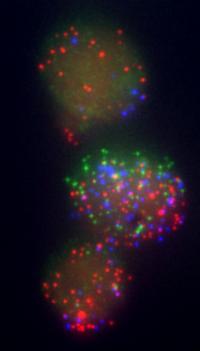
In this image of mouse embryonic fibroblasts undergoing reprogramming, each colored dot represents messenger RNA associated with a specific gene that is active in cells being reprogrammed. Red dots represent... Several years ago, biologists discovered that regular body cells can be reprogrammed into pluripotent stem cells — cells with the ability to become any other type of cell. Such cells hold great promise for treating many human diseases.
| Full story | 0 Comments | 11536 views |
| Health & Medicine | September 13, 2012 05:43 PM |
Men with divorced parents are significantly more likely to suffer a stroke than men from intact families, shows a new study from the University of Toronto.
| Full story | 0 Comments | 11884 views |
| Health & Medicine | September 12, 2012 03:08 PM |
Using newly available genetic sequencing scientists discovered cells infected with prions (the infectious agent responsible for these diseases) release particles which contain easily recognized 'signature genes'.
| Full story | 0 Comments | 9257 views |
| Biology | September 12, 2012 03:08 PM |
The ageing process has its roots deep within the cells and molecules that make up our bodies. Experts have previously identified the molecular pathway that react to cell damage and stems the cell's ability to divide, known as cell senescence.
| Full story | 0 Comments | 15179 views |
| Health & Medicine | September 12, 2012 03:08 PM |
Menachem Shoham, PhD, associate professor of biochemistry at Case Western Reserve University School of Medicine, has discovered novel antivirulence drugs that, without killing the bacteria, render Methicillin Resistant Staphylococcus Aureus (MRSA) and Streptococcus pyogenes, commonly referred to as strep, harmless by preventing the production of toxins that cause disease. The promising discovery was presented this week at the Interscience Conference on Antimicrobial Agents and Chemotherapy in San Francisco.
| Full story | 0 Comments | 8605 views |
| Bioinformatics | September 10, 2012 04:47 PM |
Since the sequencing of the human genome in 2001, all our genes – around 20,000 in total – have been identified. But much is still unknown – for instance where and when each is active. Next to each gene sits a short DNA segment, and the activity of this regulatory segment determines whether the gene will be turned on, where and how strongly. These short regulatory segments are as – if not more – important than the genes, themselves. Indeed, 90% of the mutations that cause disease occur in these regulatory areas. They are responsible for the proper development of tissues and organs, determining, for instance, that eye cells – and only eye cells – contain light receptors, while only pancreatic cells function to produce insulin. Clearly, a deeper understanding of this regulatory system – its mechanisms and possibilities for malfunction – may lead to advances in biomedical research, especially in developing targeted therapies for individual patients.
| Full story | 0 Comments | 8139 views |
| Molecular & Cell Biology | September 10, 2012 04:47 PM |
Scientists at Mount Sinai School of Medicine have discovered a subpopulation of cells that display cancer stem cell properties and resistance to chemotherapy, and participate in tumor progression. This breakthrough could lead to the development of new tests for early cancer diagnosis, prognostic tests, and innovative therapeutic strategies, as reported in Cancer Cell.
| Full story | 0 Comments | 11811 views |
| Bioinformatics | September 6, 2012 03:57 PM |
The GENCODE Consortium expects the human genome has twice as many genes than previously thought, many of which might have a role in cellular control and could be important in human disease. This remarkable discovery comes from the GENCODE Consortium, which has done a painstaking and skilled review of available data on gene activity.
| Full story | 0 Comments | 10946 views |
| Biology | September 6, 2012 03:57 PM |
Crabs living half-a-mile down in the ocean, beyond the reach of sunlight, have a sort of color vision combining sensitivity to blue and ultraviolet light. Their detection of shorter wavelengths may give the crabs a way to ensure they grab food, not poison.
| Full story | 0 Comments | 14120 views |
| Biology | September 4, 2012 07:27 PM |
Released en masse, sterile Mexican fruit flies can undermine a wild population of the fruit-damaging pests so that fewer applications of insecticide are needed. But the irradiation used to sterilize the flies weakens them, hindering their ability to outcompete wild-type males for female mates.
| Full story | 0 Comments | 10179 views |
| Health & Medicine | September 4, 2012 07:27 PM |
Reconstructing the spread of killer diseases such as tuberculosis (TB) from person to person using DNA sequencing quickly identifies the origin and movement of pathogens. This approach is directly informing public health strategies to control infectious disease outbreaks, says a scientist speaking at the Society for General Microbiology's Autumn Conference at the University of Warwick.
| Full story | 0 Comments | 9635 views |
| Health & Medicine | September 3, 2012 06:21 PM |
People whose blood sugar is on the high end of the normal range may be at greater risk of brain shrinkage that occurs with aging and diseases such as dementia, according to new research published in the September 4, 2012, print issue of Neurology®, the medical journal of the American Academy of Neurology.
| Full story | 0 Comments | 13960 views |
| Environment | September 3, 2012 06:21 PM |
A new study, by scientists from the Universities of York, Glasgow and Leeds, involving analysis of fossil and geological records going back 540 million years, suggests that biodiversity on Earth generally increases as the planet warms.
| Full story | 0 Comments | 9738 views |

- In some genetic cases of microcephaly, stem cells fail to launch
- Yale team discovers how Zika virus causes fetal brain damage
- Scientists uncover the way a common cell enzyme alerts the body to invading bacteria
- Arctic gives clues on worst mass extinction of life
- Calcium channel blockers caught in the act at atomic level
Search Bio News Net
Free Biology Newsletter
- Flexibility That A.C.A. Lent to Work Force Is Threatened by...International Herald Tribune
- Bacteria Behind Legionnaires’ Disease Found at New York Police StationInternational Herald Tribune
- Prescription Price Crisis? 28 Million Americans See Spike in Drug...MSNBC.com: Health
- Seizing on Opioid Crisis, a Drug Maker Lobbies Hard for...International Herald Tribune
- Republicans are taking a big political risk on health careAP Health News
- Why We're So Divided Over Saving WolvesNational Geographic News