


By harnessing quantum dots—tiny light-emitting semiconductor particles a few billionths of a meter across—researchers at the University of Washington (UW) have developed a new and vastly more targeted way to stimulate neurons in the brain. Being able to switch neurons on and off and monitor how they communicate with one another is crucial for understanding—and, ultimately, treating—a host of brain disorders, including Parkinson's disease, Alzheimer's, and even psychiatric disorders such as severe depression. The research was published today in the Optical Society's (OSA (http://www.osa.org)) open-access journal Biomedical Optics Express (http://www.opticsinfobase.org/boe).

| Molecular & Cell Biology | February 8, 2012 04:44 PM |
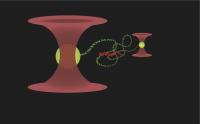
This graphic shows DNA strung between two beads, which are held in position by laser. It's been more than 50 years since James Watson and Francis Crick showed that DNA is a double helix of two strands that complement each other. But how does a short piece of DNA find its match, out of the millions of 'letters' in even a small genome? New work by researchers at the University of California, Davis, handling and observing single molecules of DNA, shows how it's done. The results are published online Feb. 8 by the journal Nature.
| Full story | 0 Comments | 12495 views |

| Bioinformatics | February 8, 2012 04:44 PM |
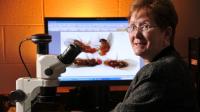
Dr. Trudy Mackay and an international team of researchers provide the holy grail of fruit fly genetics -- a reference panel of genetic variation in 192 fruit fly lines. Scientists searching for the genomics version of the holy grail – more insight into predicting how an animal's genes affect physical or behavioral traits – now have a reference manual that should speed gene discoveries in everything from pest control to personalized medicine.
| Full story | 0 Comments | 6040 views |

- In some genetic cases of microcephaly, stem cells fail to launch
- Yale team discovers how Zika virus causes fetal brain damage
- Scientists uncover the way a common cell enzyme alerts the body to invading bacteria
- Arctic gives clues on worst mass extinction of life
- Calcium channel blockers caught in the act at atomic level
Search Bio News Net
Free Biology Newsletter
- Flexibility That A.C.A. Lent to Work Force Is Threatened by...International Herald Tribune
- Bacteria Behind Legionnaires’ Disease Found at New York Police StationInternational Herald Tribune
- Prescription Price Crisis? 28 Million Americans See Spike in Drug...MSNBC.com: Health
- Seizing on Opioid Crisis, a Drug Maker Lobbies Hard for...International Herald Tribune
- Republicans are taking a big political risk on health careAP Health News
- Why We're So Divided Over Saving WolvesNational Geographic News