


In battles against chronic infections, the body's key immune cells often become exhausted and ineffective. Researchers at The Wistar Institute have found a way to restore vigor to these killer T cells by blocking a key receptor on their surface, findings that may advance the development of new therapies for diseases such as HIV, hepatitis B and C, and cancer.

| Biotechnology | September 15, 2008 06:35 PM |
Researchers at the Medical College of Wisconsin in Milwaukee have a pending patent on a new synthetic form of a protein involved in certain types of cancers and immune system diseases.
| Full story | 0 Comments | 6167 views |

| Bioinformatics | September 15, 2008 06:35 PM |
Researchers sequencing the DNA of blue-green algae found a linear chromosome harboring genes important for producing biofuels. Simultaneously analyzing the complement of proteins revealed more genes on the linear and the typical circular chromosomes then they'd have found with DNA sequencing alone.
| Full story | 0 Comments | 5648 views |
| Biotechnology | September 15, 2008 06:35 PM |
Nanoparticles filled with a drug that targets two genes that trigger melanoma could offer a potential cure for this deadly disease, according to cancer researchers. The treatment, administered through an ultrasound device, demonstrates a safer and more effective way of targeting cancer-causing genes in cancer cells without harming normal tissue.
| Full story | 0 Comments | 6555 views |

| Gene Therapy | September 15, 2008 01:03 PM |
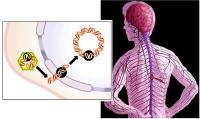
The gene transfer vector (left) is injected into the skin in the area of pain (red line, right). From the skin, the vector is carried into sensory nerves and releases the inhibitory neurotransmitter locally in the spinal cord (red oval). Credit: University of Michigan This week, University of Michigan scientists will begin a phase 1 clinical trial for the treatment of cancer-related pain, using a novel gene transfer vector injected into the skin to deliver a pain-relieving gene to the nervous system.
| Full story | 0 Comments | 11036 views |

| Microbiology | September 15, 2008 01:03 PM |
A new study suggests that bacteria-infecting viruses – called phages – can make collective decisions about whether to kill host cells immediately after infection or enter a latent state to remain within the host cell.
| Full story | 0 Comments | 7200 views |

| Biology | September 15, 2008 01:03 PM |
The low timbre and enticing vibrations of a deep voice have long been considered a key element of male attractiveness. Now it seems that it's not just human females that appreciate a husky vocalisation.
| Full story | 0 Comments | 7675 views |

| Stem Cell Research | September 15, 2008 01:03 PM |
Researchers have shown that immune-defense cells influenced by embryonic stem cell-derived cells can help prevent the rejection of hearts transplanted into mice, all without the use of immunosuppressive drugs.
| Full story | 0 Comments | 7780 views |
| Biotechnology | September 15, 2008 01:03 PM |
Selenium has been referred to as an "essential toxin" due to the fact that it shows only a marginal line between the nutritious requirement and toxic effects upon exposure. The steep dose response curve due to bioaccumulation effects have lead to the characterization of selenium as a "time bomb" that can be fused by exceeding a narrow threshold concentration in ecosystems through anthropogenic activities. Ironically, an estimated 0.5 to 1 billion people worldwide suffer from selenium deficiency, whereas areas of toxicity can be separated from selenium deficient areas by only 20 km.
| Full story | 0 Comments | 7550 views |
| Biology | September 15, 2008 01:03 PM |

According to the study, the decline of pollinators would have main effects on three main crop categories (following FAO terminology); fruits and vegetable were especially affected with a loss estimated at €50 billion each, followed by edible oilseed crops with €39 billion. Credit: Photo: André Künzelmann/UFZ Avignon/Halle(Saale). INRA and CNRS French scientists and a UFZ German scientist found that the worldwide economic value of the pollination service provided by insect pollinators, bees mainly, was €153 billion in 2005 for the main crops that feed the world. This figure amounted to 9.5% of the total value of the world agricultural food production. The study also determined that pollinator disappearance would translate into a consumer surplus loss estimated between €190 to €310 billion. The results of this study on the economic valuation of the vulnerability of world agriculture confronted with pollinator decline are published in the journal "ECOLOGICAL ECONOMICS".
| Full story | 0 Comments | 5334 views |

| Health & Medicine | September 15, 2008 01:03 PM |
Scientists at Sunnybrook Research Institute (SRI) are developing and commercializing a promising novel therapy for the treatment of prostate cancer that may offer patients a faster and more precise treatment than existing clinical alternatives, with fewer side effects.
| Full story | 0 Comments | 5073 views |
| Health & Medicine | September 15, 2008 01:03 PM |
An investigational drug that combats ovarian cancer by inhibiting the formation of new blood vessels has shown promise in a phase II trial, according to a presentation at the 33rd Congress of the European Society for Medical Oncology (ESMO) in Stockholm.
| Full story | 0 Comments | 8427 views |
| Biology | September 15, 2008 01:23 AM |
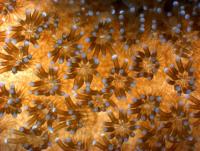
Polyps of the symbiotic coral Stylophora pistillata. Researchers have uncovered a gene in corals that responds to day/night cycles, which provides some tantalizing clues into how symbiotic corals work together with their plankton partners.
| Full story | 0 Comments | 7474 views |
| Biotechnology | September 15, 2008 01:23 AM |
Investigators at the Translational Genomics Research Institute (TGen) today announced a faster and less expensive way for scientists to find which genes might affect human health.
| Full story | 0 Comments | 6843 views |

- In some genetic cases of microcephaly, stem cells fail to launch
- Yale team discovers how Zika virus causes fetal brain damage
- Scientists uncover the way a common cell enzyme alerts the body to invading bacteria
- Arctic gives clues on worst mass extinction of life
- Calcium channel blockers caught in the act at atomic level
Search Bio News Net
Free Biology Newsletter
- Flexibility That A.C.A. Lent to Work Force Is Threatened by...International Herald Tribune
- Bacteria Behind Legionnaires’ Disease Found at New York Police StationInternational Herald Tribune
- Prescription Price Crisis? 28 Million Americans See Spike in Drug...MSNBC.com: Health
- Seizing on Opioid Crisis, a Drug Maker Lobbies Hard for...International Herald Tribune
- Republicans are taking a big political risk on health careAP Health News
- Why We're So Divided Over Saving WolvesNational Geographic News