

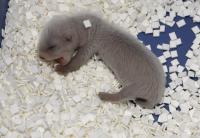
A two-week-old black-footed ferret is pictured in its nesting box at the National Zoo's Conservation and Research Center in Front Royal, Va. on July 3, 2008. The kit was born on June 21 to a two-year-old mother and a father who had died in 2000. National Zoo reproductive scientists inseminated the female with frozen black-footed ferret semen stored in their genome resource bank -- a frozen repository of sperm and eggs of a variety of endangered species. Credit: Mehgan Murphy, Smithsonian’s National Zoo Two black-footed ferrets at the Smithsonian's National Zoo have each given birth to a kit that was sired by males who died in 1999 and 2000. These endangered ferrets—part of a multi-institutional breeding and reintroduction program—were artificially inseminated in May with frozen semen from the two deceased males, each giving birth to a kit on June 20 and 21 respectively. The sperm samples were collected and frozen in 1997 and 1998. Successful inseminations with frozen semen are extremely rare—until now only three black-footed ferret kits have been born from this method.

| Biology | September 2, 2008 12:18 PM |
| Full story | 0 Comments | 7944 views |

| Biotechnology | September 2, 2008 12:18 PM |
The best place to seek novel compounds for pharmaceutical drugs, alternative energy sources, and a host of industrial applications, is within natural systems that have evolved over millions of years. Scientists now realise that the precise molecular arrangements within natural pathways in organisms have been highly tuned for specific processes and provide both compounds that can be exploited directly and vital information over how to synthesise new products by mimicking biochemical processes. The bright future for research and development around such natural products was discussed recently at a conference organised by the European Science Foundaton (ESF), and the European Cooperation in the field of Scientific and Technical Research (COST).
| Full story | 0 Comments | 6094 views |

| Microbiology | September 2, 2008 12:18 PM |
Parents expect to pass on their eye or hair color, their knobby knees or their big feet to their children through their genes. But they don't expect to pass on viruses through those same genes.
| Full story | 0 Comments | 9408 views |

| Bioinformatics | September 2, 2008 12:18 PM |
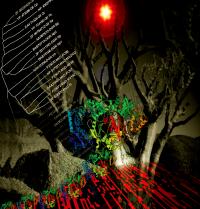
The baobab tree represents one of the most ancient species of life on the planet. In our paper, we investigate ancient and highly divergent proteins, called retro-elements, whose evolutionary histories hold keys to uncovering the origins of life. Our research demonstrates that phylogenetic profiles generated using the Gestalt Domain Detection Algorithm-Basic Local Alignment Tool provide an independent method for estimating the evolutionary histories of retroelements. Credit: Randen Patterson and Damian van Rossum, Penn State Scientists at Penn State have developed a new computational method that they say will help them to understand how life began on Earth. The team's method has the potential to trace the evolutionary histories of proteins all the way back to either cells or viruses, thus settling the debate once and for all over which of these life forms came first. "We have just begun to tap the potential power of this method," said Randen Patterson, a Penn State assistant professor of biology and one of the project's leaders. "We believe, if it is possible at all, that it is within our grasp to determine whether viruses evolved from cells or vice-versa."
| Full story | 0 Comments | 8421 views |
| Biology | September 2, 2008 12:18 PM |
Although most people imagine wolves chasing deer and other hoofed animals, new research suggests that, when they can, wolves actually prefer fishing to hunting. The study, published today in the open access journal BMC Ecology, shows that when salmon is available, wolves will reduce deer hunting activity and instead focus on seafood.
| Full story | 0 Comments | 6820 views |

| Molecular & Cell Biology | September 2, 2008 12:18 PM |
A study of Crohn's disease and ulcerative colitis in children has identified a gene that influences whether children get these diseases early in life, and points to a potential new target for treatment.
| Full story | 0 Comments | 7182 views |

- In some genetic cases of microcephaly, stem cells fail to launch
- Yale team discovers how Zika virus causes fetal brain damage
- Scientists uncover the way a common cell enzyme alerts the body to invading bacteria
- Arctic gives clues on worst mass extinction of life
- Calcium channel blockers caught in the act at atomic level
Search Bio News Net
Free Biology Newsletter
- Flexibility That A.C.A. Lent to Work Force Is Threatened by...International Herald Tribune
- Bacteria Behind Legionnaires’ Disease Found at New York Police StationInternational Herald Tribune
- Prescription Price Crisis? 28 Million Americans See Spike in Drug...MSNBC.com: Health
- Seizing on Opioid Crisis, a Drug Maker Lobbies Hard for...International Herald Tribune
- Republicans are taking a big political risk on health careAP Health News
- Why We're So Divided Over Saving WolvesNational Geographic News