

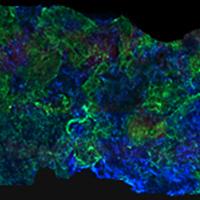
A microscopic image of a 10 mm collagen scaffold containing a uniform distribution of skin cells (blue) seeded on top of a 3-D polylysine gradient (green). Engineers at Georgia Tech have used skin cells to create artificial bones that mimic the ability of natural bone to blend into other tissues such as tendons or ligaments. The artificial bones display a gradual change from bone to softer tissue rather than the sudden shift of previously developed artificial tissue, providing better integration with the body and allowing them to handle weight more successfully. The research appears in the August 26, 2008, edition of the Proceedings of the National Academy of Sciences.

| Biotechnology | August 30, 2008 11:34 AM |
| Full story | 0 Comments | 9955 views |

| Molecular & Cell Biology | August 30, 2008 11:34 AM |
Cells become cancerous mainly because they lose control of their growth. To better understand how this happens, a new study at Ohio State University's Comprehensive Cancer Center looks at four genes that help regulate cell growth in embryos and that contribute to cancer in adults.
| Full story | 0 Comments | 6684 views |

| Biology | August 30, 2008 11:34 AM |
The American Academy of Otolaryngology – Head and Neck Surgery Foundation (AAO-HNSF) will issue the first comprehensive clinical guidelines to help health care practitioners identify patients with cerumen (commonly referred to as earwax) impaction. The guidelines emphasize evidence-based management of cerumen impaction by clinicians, and inform patients of the purpose of ear wax in hearing health.
| Full story | 0 Comments | 7612 views |

| Microbiology | August 30, 2008 11:34 AM |
Scientists funded by the Wellcome Trust are to examine what is preventing the H5N1 avian influenza virus from causing a human pandemic and what mutations are required to realise its deadly potential. The research could hold the key to early identification of a potential influenza pandemic, and to developing drugs and a vaccine.
| Full story | 0 Comments | 6729 views |

| Stem Cell Research | August 30, 2008 11:34 AM |
Johns Hopkins researchers have discovered the earliest form of human blood stem cells and deciphered the mechanism by which these embryonic stem cells replicate and grow. They also found a surprising biological marker that pinpoints these stem cells, which serve as the progenitors for red blood cells and lymphocytes.
| Full story | 0 Comments | 7334 views |
| Biotechnology | August 30, 2008 11:34 AM |
Scientists at the California Institute of Technology (Caltech) have developed a simple process for mass producing molecular tubes of identical--and precisely programmable--circumferences. The technological feat may allow the use of the molecular tubes in a number of nanotechnology applications.
| Full story | 0 Comments | 7079 views |
| Biology | August 30, 2008 11:34 AM |
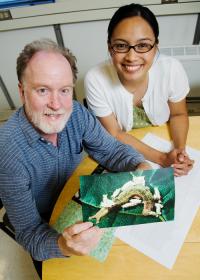
U. of I. entomology professor James Whitfield and doctoral student Josephine Rodriguez led the taxonomic part of a multi-disciplinary study of microgastrine wasps. A tiny wasp that lays its eggs under the skin of unwitting caterpillars belongs to one of the most diverse groups of insects on Earth. Now researchers report that its diversity is even higher than previously thought.
| Full story | 0 Comments | 7772 views |

- In some genetic cases of microcephaly, stem cells fail to launch
- Yale team discovers how Zika virus causes fetal brain damage
- Scientists uncover the way a common cell enzyme alerts the body to invading bacteria
- Arctic gives clues on worst mass extinction of life
- Calcium channel blockers caught in the act at atomic level
Search Bio News Net
Free Biology Newsletter
- Flexibility That A.C.A. Lent to Work Force Is Threatened by...International Herald Tribune
- Bacteria Behind Legionnaires’ Disease Found at New York Police StationInternational Herald Tribune
- Prescription Price Crisis? 28 Million Americans See Spike in Drug...MSNBC.com: Health
- Seizing on Opioid Crisis, a Drug Maker Lobbies Hard for...International Herald Tribune
- Republicans are taking a big political risk on health careAP Health News
- Why We're So Divided Over Saving WolvesNational Geographic News