

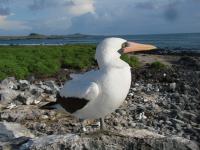
An adult Nazca booby looks over the colony. The Nazca booby, a Galápagos Island seabird, emerges from its shell ready to kill its brother or sister. Wake Forest University biologists and their colleagues have linked the murderous behavior to high levels of testosterone and other male hormones found in the hatchlings.

| Biology | June 18, 2008 06:08 PM |
| Full story | 0 Comments | 6437 views |

| Molecular & Cell Biology | June 18, 2008 06:08 PM |
The Stowers Institute's Pourquié Lab has shed light on the mechanism causing animals to develop the appropriate number of vertebrae.
| Full story | 0 Comments | 6205 views |

| Environment | June 18, 2008 06:08 PM |
Nitrogen is essential to all life on Earth, and the processes by which it cycles through the environment may determine how ecosystems respond to global warming. But certain aspects of the nitrogen cycle in temperate and tropical forests have puzzled scientists, defying, in a sense, the laws of supply and demand. Trees capable of extracting nitrogen directly from the atmosphere often thrive where it is readily available in the soil, but not where it is in short supply. Now scientists from the Carnegie Institution have explained the paradox by recognizing the role of two other factors: temperature and the abundance of another key element, phosphorous.
| Full story | 0 Comments | 6640 views |

| Health & Medicine | June 18, 2008 06:08 PM |
A new study reveals dysmenorrhea, a condition that causes extremely painful menstrual periods affecting millions of women each year, can be reduced naturally by taking Pycnogenol (pic-noj-en-all), pine bark extract from the French maritime pine tree. The multi-center field study, published in the Journal of Reproductive Medicine, shows women with dysmenorrhea who supplemented with Pycnogenol experienced less pain and required less pain medications during menstruation.
| Full story | 0 Comments | 6795 views |
| Biology | June 18, 2008 06:08 PM |
Apes can plan for their future needs just as we humans can – by using self-control and imagining future events. Mathias and Helena Osvath's research, from Lunds University Cognitive Science in Sweden, is the first to provide conclusive evidence of advanced planning capacities in non-human species. Their findings are published online this week in Springer's journal, Animal Cognition.
| Full story | 0 Comments | 6983 views |

| Bioinformatics | June 18, 2008 06:08 PM |
The Australian Minister for Innovation, Industry, Science and Research, Senator the Hon Kim Carr, said – at the BIO 2008 International Convention in San Diego, California – that the team was expected to sequence the moth's genome in about four months.
| Full story | 0 Comments | 5695 views |
| Biology | June 18, 2008 06:08 PM |
Some migratory songbirds figure out the best place to live by eavesdropping on the singing of others that successfully have had baby birds – a communication and behavioral trait so strong that researchers playing recorded songs induced them to nest in places they otherwise would have avoided.
| Full story | 0 Comments | 5018 views |
| Bioinformatics | June 18, 2008 06:08 PM |
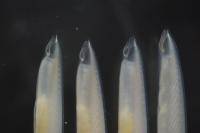
The marine invertebrate known as the lancelet, or amphioxus, has tentacle-like strands called oral cirri that strain phytoplankton out of the water. The newly sequenced genome of a dainty, quill-like sea creature called a lancelet provides the best evidence yet that vertebrates evolved over the past 550 million years through a four-fold duplication of the genes of more primitive ancestors.
| Full story | 0 Comments | 6946 views |

- In some genetic cases of microcephaly, stem cells fail to launch
- Yale team discovers how Zika virus causes fetal brain damage
- Scientists uncover the way a common cell enzyme alerts the body to invading bacteria
- Arctic gives clues on worst mass extinction of life
- Calcium channel blockers caught in the act at atomic level
Search Bio News Net
Free Biology Newsletter
- Flexibility That A.C.A. Lent to Work Force Is Threatened by...International Herald Tribune
- Bacteria Behind Legionnaires’ Disease Found at New York Police StationInternational Herald Tribune
- Prescription Price Crisis? 28 Million Americans See Spike in Drug...MSNBC.com: Health
- Seizing on Opioid Crisis, a Drug Maker Lobbies Hard for...International Herald Tribune
- Republicans are taking a big political risk on health careAP Health News
- Why We're So Divided Over Saving WolvesNational Geographic News