

A compound found in grape seed extract reduces plaque formation and resulting cognitive impairment in an animal model of Alzheimer's disease, new research shows. The study appears in the June 18 issue of The Journal of Neuroscience.

| Health & Medicine | June 17, 2008 08:28 PM |
A great deal of attention has been paid to the use of growth hormone (hGH) by elite athletes and a few vocal entertainers. But underlying this tip of the iceberg is a $2 billion dollar a year business, likely involving hundreds of thousands of regular people, and promoted by anti-aging and age-management clinics and compounding pharmacies who aggressively market and sell growth hormone with the claim that it has anti-aging or athletic enhancing properties. Since their previous article in the Journal of the American Medical Association (JAMA) in 2005 on the clinical and legal aspects of growth hormone for anti-aging, in which researchers from Boston University School of Medicine, Boston Medical Center and the University of Illinois at Chicago alerted the medical community and lay public to the deceptive mass marketing and illegal distribution of growth hormone for anti-aging and athletic enhancement, the authors provide new evidence demonstrating that these deceptive and dangerous activities have grown worse.
| Full story | 0 Comments | 6334 views |
| Health & Medicine | June 17, 2008 08:28 PM |
A new study released today offers a potential predictive technique to anticipate how individuals might behave during a psychotic episode. The study, in the June 18 issue of The Journal of Neuroscience, related the brain activity of healthy participants to how they behaved after exposure to ketamine (a psychosis-inducing drug that mimics schizophrenia symptoms). The findings help explain why schizophrenia symptoms vary greatly from person to person and may ultimately help personalize diagnosis and intervention.
| Full story | 0 Comments | 6399 views |

| Molecular & Cell Biology | June 17, 2008 08:28 PM |
A group of steroids found in female mouse urine goes straight to the male mouse's head, according to researchers at Washington University School of Medicine in St. Louis. They found the compounds activate nerve cells in the male mouse's nose with unprecedented effectiveness.
| Full story | 0 Comments | 5846 views |
| Molecular & Cell Biology | June 17, 2008 08:28 PM |
Gene mutations that make cells cancerous can sometimes also make them more sensitive to chemotherapy. A new study led by cancer researchers at Ohio State University shows that a mutation present in some cases of acute leukemia makes the disease more susceptible to high doses of a particular anticancer drug.
| Full story | 0 Comments | 8907 views |

| Microbiology | June 17, 2008 08:28 PM |
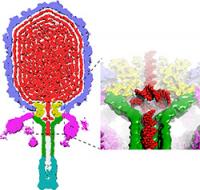
A donut-shaped twist, or toroid, of DNA (shown in red) wedges the viral genome tightly within the protein envelope of the bacteriophage. A novel twist of DNA may keep viral genes tightly wound within a capsule, waiting for ejection into a host, a high-resolution analysis of its structure has revealed.
| Full story | 0 Comments | 6946 views |
| Health & Medicine | June 17, 2008 08:28 PM |
By 2025, the wait to see a doctor could get a lot longer if the current number of students training to be primary care physicians doesn't increase soon, according to a new University of Missouri study. Jack Colwill, professor emeritus of family and community medicine in the MU School of Medicine, and his research team found that the U.S. could face a shortage of up to 44,000 family physicians and general internists in less than 20 years, due to a skewed compensation system that rewards specialists increasingly more than primary care practitioners. The researchers are more optimistic about the future supply of general pediatricians.
| Full story | 0 Comments | 6673 views |
| Molecular & Cell Biology | June 17, 2008 08:28 PM |
Infectious proteins known as prions have been identified as the cause of "mad cow" disease (BSE). The culprits are "incorrectly folded" proteins that can "infect" healthy proteins. The molecular bases for such prion diseases are not yet fully understood. Why are some proteins infectious while others are not? A team headed by Beat Meier (ETH Zurich, Switzerland) and Raimon Sabat¨¦ (University of Bordeaux, France) has examined two different forms of a prion-forming protein domain by means of NMR spectroscopy. In the journal Angewandte Chemie, the researchers report that the infectious and non-infectious forms differ markedly in their molecular structure.
| Full story | 0 Comments | 6522 views |

- In some genetic cases of microcephaly, stem cells fail to launch
- Yale team discovers how Zika virus causes fetal brain damage
- Scientists uncover the way a common cell enzyme alerts the body to invading bacteria
- Arctic gives clues on worst mass extinction of life
- Calcium channel blockers caught in the act at atomic level
Search Bio News Net
Free Biology Newsletter
- Flexibility That A.C.A. Lent to Work Force Is Threatened by...International Herald Tribune
- Bacteria Behind Legionnaires’ Disease Found at New York Police StationInternational Herald Tribune
- Prescription Price Crisis? 28 Million Americans See Spike in Drug...MSNBC.com: Health
- Seizing on Opioid Crisis, a Drug Maker Lobbies Hard for...International Herald Tribune
- Republicans are taking a big political risk on health careAP Health News
- Why We're So Divided Over Saving WolvesNational Geographic News