

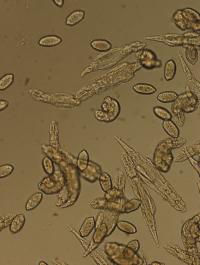
A laboratory culture of the bdelloid rotifer Adineta vaga. Rotifers may be able to incorporate DNA from other species into their genomes during the desiccation and rehydration phases of their life cycle. Credit: Eugene Gladyshev Where do you get your genes? If you are an animal, you inherit them from your parents at the moment of conception, and that's about it. No later incorporation of environmental DNA for you, unless you become host to a parasite or an endosymbiont that somehow transfers bits of its genome into yours (which is a rarely documented event).

| Microbiology | May 29, 2008 04:46 PM |
| Full story | 0 Comments | 9903 views |

| Molecular & Cell Biology | May 29, 2008 04:46 PM |
In 1999, when Dr. Huda Zoghbi and her Baylor College of Medicine colleagues identified a mutation of the gene MeCP2 as the culprit in Rett syndrome, a neurodevelopmental disorder, the discovery was only the prelude to understanding a symphony of neurological missteps.
| Full story | 0 Comments | 6736 views |

| Biology | May 29, 2008 04:46 PM |
Somewhere in the murky past, between four and seven million years ago, a hungry common ancestor of today’s primates, including humans, did something novel. While temporarily standing on its rear feet to reach a piece of fruit, this protohominid spotted another juicy morsel in a nearby shrub and began shuffling toward it instead of dropping on all fours, crawling to the shrub and standing again.
| Full story | 0 Comments | 8522 views |

| Environment | May 29, 2008 04:46 PM |
In this week’s issue of Science, a team of researchers from the United States and Sweden report on a newly identified factor that controls the natural input of new nitrogen into boreal forest ecosystems. Nitrogen is the primary nutrient that dictates productivity (and thus carbon consumption) in boreal forests. In pristine boreal ecosystems, most new nitrogen enters the forest through cyanobacteria living on the shoots of feather mosses, which grows in dense cushions on the forest floor. These bacteria convert nitrogen from the atmosphere to a form that can be used by other living organisms, a process referred to as “nitrogen-fixation.” The researchers showed that this natural fertilization process appears to be partially controlled by trees and shrubs that sit above the feather mosses.
| Full story | 0 Comments | 7874 views |
| Biology | May 29, 2008 04:46 PM |
Long viewed as straitlaced spinsters, sexless freshwater invertebrate animals known as bdelloid rotifers may actually be far more promiscuous than anyone had imagined: Scientists at Harvard University have found that the genomes of these common creatures are chock-full of DNA from plants, fungi, bacteria, and animals.
| Full story | 0 Comments | 8231 views |

| Bioinformatics | May 29, 2008 04:46 PM |
A new HIV data browser developed by the University of California, Santa Cruz, and the nonprofit organization Global Solutions for Infectious Diseases (GSID) will give researchers access to a wealth of data collected during clinical trials of an AIDS vaccine. Although the vaccine did not succeed in preventing infections, the clinical trial generated a huge amount of valuable data for researchers studying how the virus evolves and causes new infections.
| Full story | 0 Comments | 6922 views |
| Molecular & Cell Biology | May 29, 2008 04:46 PM |
By studying heat-loving microbes, two research teams have gained new insight into how seemingly small differences in a single protein involved in DNA transcription and repair can lead to strikingly different genetic disorders in humans.
| Full story | 0 Comments | 6858 views |

| Biotechnology | May 29, 2008 04:46 PM |
In Germany alone, about three million – mostly elderly – patients suffer from poorly healing large-area wounds caused by complaints such as diabetes, burns or bedsores. The wounds can be treated with conventional collagen dressings or polylactic acid dressings, but the success rate is not as good as it should be.
| Full story | 0 Comments | 12860 views |
| Molecular & Cell Biology | May 29, 2008 04:46 PM |
The common fruit fly circling your week-old peach has helped scientists zero in on a protein critical to the insect's eggshell formation.
| Full story | 0 Comments | 6270 views |

- In some genetic cases of microcephaly, stem cells fail to launch
- Yale team discovers how Zika virus causes fetal brain damage
- Scientists uncover the way a common cell enzyme alerts the body to invading bacteria
- Arctic gives clues on worst mass extinction of life
- Calcium channel blockers caught in the act at atomic level
Search Bio News Net
Free Biology Newsletter
- Flexibility That A.C.A. Lent to Work Force Is Threatened by...International Herald Tribune
- Bacteria Behind Legionnaires’ Disease Found at New York Police StationInternational Herald Tribune
- Prescription Price Crisis? 28 Million Americans See Spike in Drug...MSNBC.com: Health
- Seizing on Opioid Crisis, a Drug Maker Lobbies Hard for...International Herald Tribune
- Republicans are taking a big political risk on health careAP Health News
- Why We're So Divided Over Saving WolvesNational Geographic News