


It has been reported for the first time in Germany that healthy ovarian tissue has been taken from a non-pregnant woman with cancer and then re-implanted after cancer therapy. The patient is now 32 years old and could become pregnant as a result. This case is described by Ralf Dittrich and his colleagues from Erlangen University Hospital in the current issue of Deutsches Ärzteblatt International (Dtsch Arztebl Int 2008; 105[15]: 274-8).

| Biotechnology | April 23, 2008 10:27 PM |
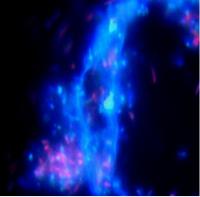
A photosynthetic cyanobacterium with chlorophyll (red) and the cellulose material (blue) it produced. A newly created microbe produces cellulose that can be turned into ethanol and other biofuels, report scientists from The University of Texas at Austin who say the microbe could provide a significant portion of the nation’s transportation fuel if production can be scaled up.
| Full story | 0 Comments | 9219 views |

| Biology | April 23, 2008 09:27 PM |
Dutch ecologist Roxina Soler and her colleagues have discovered that subterranean and aboveground herbivorous insects can communicate with each other by using plants as telephones. Subterranean insects issue chemical warning signals via the leaves of the plant. This way, aboveground insects are alerted that the plant is already ‘occupied’.
| Full story | 0 Comments | 13571 views |

| Molecular & Cell Biology | April 23, 2008 08:27 PM |
In a collaborative effort, researchers from Boston University School of Medicine (BUSM) have discovered that deletions or mutations within the TFAP2A gene (Activating Enhancer-Binding Protein) result in the distinctive clefting disorder Branchio-Oculo-Facial syndrome (BOFS). This rare disorder is characterized by specific skin anomalies involving the neck and behind the ear, eye abnormalities, a typical facial appearance, and frequently cleft lip and palate. The study currently appears on-line in the April 17th issue of the American Journal of Human Genetics.
| Full story | 0 Comments | 6163 views |
| Biology | April 23, 2008 07:27 PM |
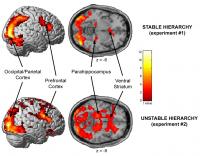
Brain activity was much higher in key brain centers when participants viewed a superior player in an unstable social hierarchy -- when participants had the possibility of upward mobility. Human imaging studies have for the first time identified brain circuitry associated with social status, according to researchers at the National Institute of Mental Health (NIMH) of the National Institutes of Health. They found that different brain areas are activated when a person moves up or down in a pecking order – or simply views perceived social superiors or inferiors. Circuitry activated by important events responded to a potential change in hierarchical status as much as it did to winning money.
| Full story | 0 Comments | 7201 views |
| Biology | April 23, 2008 06:27 PM |
Our ability to remember the objects, places and people within our environment is essential for everyday life, although the importance of this is only fully appreciated when recognition memory beings to fail, as in Alzheimer’s disease.
| Full story | 0 Comments | 10294 views |
| Molecular & Cell Biology | April 23, 2008 05:27 PM |
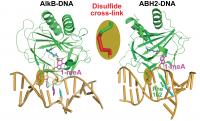
University of Chicago scientists determined the molecular structures of the bacterial AlkB protein and its corresponding human protein, ABH2, shown here chemically cross-linked with strands of DNA. These proteins repair... A team of University of Chicago scientists has shown how two proteins locate and repair damaged genetic material inside cells.
| Full story | 0 Comments | 8631 views |

| Stem Cell Research | April 23, 2008 04:27 PM |
Dutch researchers at University Medical Center Utrecht and the Hubrecht Institute have succeeded in growing large numbers of stem cells from adult human hearts into new heart muscle cells. A breakthrough in stem cell research. Until now, it was necessary to use embryonic stem cells to make this happen. The findings are published in the latest issue of the journal Stem Cell Research.
| Full story | 0 Comments | 9622 views |

| Bioinformatics | April 23, 2008 04:27 PM |
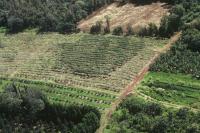
The papaya ringspot virus (PRSV) interferes with the plant's ability to photosynthesize. The transgenic papaya at the center of this field (darker, rectangular patch of green) are surrounded by non-transgenic... A broad collaboration of research institutions in the U.S. and China has produced a first draft of the papaya genome. This draft, which spells out more than 90 percent of the plant’s gene coding sequence, sheds new light on the evolution of flowering plants. And because it involves a genetically modified plant, the newly sequenced papaya genome offers the most detailed picture yet of the genetic changes that make the plant resistant to the papaya ringspot virus.
| Full story | 0 Comments | 8856 views |

- In some genetic cases of microcephaly, stem cells fail to launch
- Yale team discovers how Zika virus causes fetal brain damage
- Scientists uncover the way a common cell enzyme alerts the body to invading bacteria
- Arctic gives clues on worst mass extinction of life
- Calcium channel blockers caught in the act at atomic level
Search Bio News Net
Free Biology Newsletter
- Flexibility That A.C.A. Lent to Work Force Is Threatened by...International Herald Tribune
- Bacteria Behind Legionnaires’ Disease Found at New York Police StationInternational Herald Tribune
- Prescription Price Crisis? 28 Million Americans See Spike in Drug...MSNBC.com: Health
- Seizing on Opioid Crisis, a Drug Maker Lobbies Hard for...International Herald Tribune
- Republicans are taking a big political risk on health careAP Health News
- Why We're So Divided Over Saving WolvesNational Geographic News