

Already several seconds before we consciously make a decision its outcome can be predicted from unconscious activity in the brain. This is shown in a study by scientists from the Max Planck Institute for Human Cognitive and Brain Sciences in Leipzig, in collaboration with the Charite University Hospital and the Bernstein Center for Computational Neuroscience in Berlin. The researchers from the group of Professor John-Dylan Haynes used a brain scanner to investigate what happens in the human brain just before a decision is made. "Many processes in the brain occur automatically and without involvement of our consciousness. This prevents our mind from being overloaded by simple routine tasks. But when it comes to decisions we tend to assume they are made by our conscious mind. This is questioned by our current findings." (Nature Neuroscience, April 13th 2008)

| Environment | April 14, 2008 10:40 PM |
There is no question that Al Gore’s 2006 documentary An Inconvenient Truth is a powerful example of how scientific knowledge can be communicated to a lay audience. What is up for debate is whether it accurately presents the scientific argument that global warming is caused by human activities. Climate change experts express their opinions on the scientific validity of the film’s claims in articles just published online in Springer’s journal, GeoJournal.
| Full story | 0 Comments | 7788 views |

| Biology | April 14, 2008 10:40 PM |
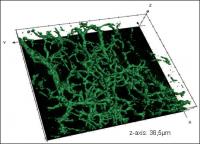
Three-dimensional reconstruction of a vascular system made of human endothelial cells in mice 20 days after injection of the spheroids. Image taken with a confocal microscope, stained green. The formation of new blood vessels, or angiogenesis, is an Achilles’ heel of tumor growth, because tumors depend on the supply of oxygen and nutrients for survival. Therefore, for some years now substances called angiogenesis inhibitors have been used in cancer treatment to suppress this process. In order to advance this new research field, a team of researchers headed by Professor Hellmut Augustin has developed a method to create a complex human vascular system in mice, which stays functional even after several months.
| Full story | 0 Comments | 5229 views |

| Health & Medicine | April 14, 2008 09:40 PM |
Using a rodent model of epilepsy, researchers found one of the body’s own neurotransmitters released during seizures, glutamate, turns on a signaling pathway in the brain that increases production of a protein that could reduce medication entry into the brain. Researchers say this may explain why approximately 30 percent of patients with epilepsy do not respond to antiepileptic medications. The study, conducted by researchers at the National Institute of Environmental Health Sciences (NIEHS), part of the National Institutes of Health, and the University of Minnesota College of Pharmacy and Medical School, in collaboration with Heidrun Potschka’s laboratory at Ludwig-Maximilians-University in Munich, Germany, is available online and will appear in the May 2008, issue of Molecular Pharmacology.
| Full story | 0 Comments | 6728 views |

| Microarray | April 14, 2008 09:40 PM |
The nature vs. nurture debate is familiar to most people, and modern conclusions usually predict a balance between the two. A new paper published this week in the open-access journal PLoS Biology shows that there is a similar balance between the genes we inherit—nature—and the environment—nurture—in determining thousands of traits in yeast. As we approach the age of personal genomics, in which each of us knows something about the genetic variations we carry, it is important to understand how genes and the environment interact in order to draw medically sound conclusions from the information available—e.g. whether exercise can reduce risks that are increased because of a genetic predisposition towards a certain illness.
| Full story | 0 Comments | 11065 views |
| Biology | April 14, 2008 08:40 PM |
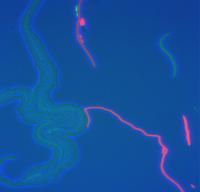
Using fluorescent microscopy, researchers document the predator-prey interaction. The predator cells, shown in green, have caused a prey cell, shown in red, to commit suicide. The elongation and separation of the prey cell is proof of its demise. The hunter-versus-hunted phenomenon exemplified by a pack of lionesses chasing down a lonely gazelle has been recreated in a Petri dish with lowly bacteria.
| Full story | 0 Comments | 7101 views |
| Microarray | April 14, 2008 08:40 PM |
DNA samples from 120,000 people are to be analysed in a £30 million follow up to last year's Wellcome Trust Case Control Consortium (WTCCC), the largest ever study of the genetics behind common diseases. The seven-fold increase in the number of samples to be analysed will allow researchers to look at a 25 diseases as well as studying the genetics of learning in children and individuals' responses to statins.
| Full story | 0 Comments | 11545 views |
| Health & Medicine | April 14, 2008 07:40 PM |
Sleeping sickness creates a metabolic 'fingerprint' in the blood and urine, which could enable a new test to be developed to diagnose the disease, according to new research published today in the journal Proceedings of the National Academy of Sciences.
| Full story | 0 Comments | 7668 views |

| Microbiology | April 14, 2008 07:40 PM |
An international group of American and Turkish research scientists, led by Sea Lane Biotechnologies, has created the first comprehensive monoclonal antibody libraries against avian influenza (H5N1) using samples from survivors of the 2005/2006 "bird flu" outbreak in Turkey. These antibody libraries hold the promise for developing a therapy that could stop a pandemic in its tracks and provide treatment to those infected, as well as potentially pointing the way towards the development of a universal flu vaccine. The expanded treatment and containment options offered by Sea Lane’s antibody libraries could help provide healthcare officials, researchers, and governments with unprecedented resources to combat this serious global health threat.
| Full story | 0 Comments | 6269 views |

| Bioinformatics | April 14, 2008 06:40 PM |
The availability of new genome sequencing technology has prompted a Virginia Tech plant scientist to test an intriguing hypothesis about how agriculture’s early beginnings may have impacted the evolution of plant pathogens.
| Full story | 0 Comments | 6621 views |

| Molecular & Cell Biology | April 14, 2008 05:40 PM |
Researchers at the Stanford University School of Medicine have uncovered the first clues about the ancient origins of a mother's intricate lifeline to her unborn baby, the placenta, which delivers oxygen and nutrients critical to the baby's health.
| Full story | 0 Comments | 5026 views |

- In some genetic cases of microcephaly, stem cells fail to launch
- Yale team discovers how Zika virus causes fetal brain damage
- Scientists uncover the way a common cell enzyme alerts the body to invading bacteria
- Arctic gives clues on worst mass extinction of life
- Calcium channel blockers caught in the act at atomic level
Search Bio News Net
Free Biology Newsletter
- Flexibility That A.C.A. Lent to Work Force Is Threatened by...International Herald Tribune
- Bacteria Behind Legionnaires’ Disease Found at New York Police StationInternational Herald Tribune
- Prescription Price Crisis? 28 Million Americans See Spike in Drug...MSNBC.com: Health
- Seizing on Opioid Crisis, a Drug Maker Lobbies Hard for...International Herald Tribune
- Republicans are taking a big political risk on health careAP Health News
- Why We're So Divided Over Saving WolvesNational Geographic News