


A new study shows that 'silver spoon' factors of more food and warmer temperatures can later help newborn female squirrels produce more litters themselves. As the saying goes, some people are born with silver spoons in their mouths. The same goes for at least one species of the animal world, according to research done in part by the University of Alberta.

| Biology | April 4, 2008 09:21 PM |
| Full story | 0 Comments | 6452 views |

| Biotechnology | April 4, 2008 09:21 PM |
A major new partnership between the public and private sectors was made official here this week (3-4 April) with an aim to increase rice production across Asia via the accelerated development and introduction of hybrid rice technologies. The innovative new effort to increase rice production – and support for rice research – comes at a crucial time for Asia as the region struggles to deal with near record rice prices caused by stagnating yields.
| Full story | 0 Comments | 7611 views |

| Health & Medicine | April 4, 2008 09:21 PM |
Young children who lead inactive lifestyles are five-to-six times more likely to be at serious risk of heart disease, with that degree of danger emerging as early as their teenage years, according to a new study by researchers at the University of North Carolina at Chapel Hill.
| Full story | 0 Comments | 7627 views |

| Molecular & Cell Biology | April 4, 2008 09:21 PM |
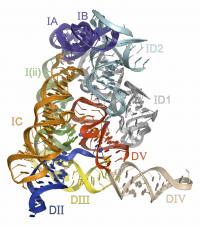
Ribbon reconstruction view of the crystal structure of an RNA group II intron -- red domain is the active site. Recent research at Yale provided a glimpse of the ancient mechanism that helped diversify our genomes; it illuminated a relationship between gene processing in humans and the most primitive organisms by creating the first crystal structure of a crucial self-splicing region of RNA.
| Full story | 0 Comments | 6548 views |
| Biology | April 4, 2008 06:14 PM |
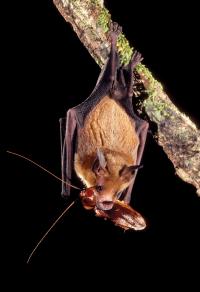
A big-eared bat of the genus Micronycteris. Bats of this genus are found in Mexican coffee plantations, where they glean insects from foliage and help limit pest populations If you get a chance to sip some shade-grown Mexican organic coffee, please pause a moment to thank the bats that helped make it possible.
| Full story | 0 Comments | 6065 views |

| Environment | April 4, 2008 04:14 PM |
You know that green scum creeping across the surface of your local public water reservoir" Or maybe it’s choking out a favorite fishing spot or livestock watering hole. It’s probably cyanobacteria – blue-green algae – and, according to a paper in the April 4 issue of the journal Science, it relishes the weather extremes that accompany global warming.
| Full story | 0 Comments | 6640 views |
| Biology | April 4, 2008 02:14 PM |
Enormous numbers of migratory moths that fly high above our heads throughout the night aren’t at the mercy of the winds that propel them toward their final destinations, researchers report online on April 3rd in Current Biology, a publication of Cell Press. Rather, they rely on sophisticated behaviors to control their flight direction, and to speed their long-distance journeys into areas suitable for the next generation of moths.
| Full story | 0 Comments | 5693 views |
| Biology | April 4, 2008 12:14 PM |
Preliminary results from DNA analysis of wolverine scat samples collected on the Tahoe National Forest do not match those of historic California wolverine populations, according to U.S. Forest Service scientists.
| Full story | 0 Comments | 6442 views |
| Biology | April 4, 2008 10:14 AM |

Spot-billed pelicans have increased by 400 percent since conservation measures have been enacted in Cambodia's Prek Toal. According to a report released today by the Wildlife Conservation Society (WCS), several species of rare waterbirds from Cambodia’s famed Tonle Sap region have staged remarkable comebacks, thanks to a project involving a single team of park rangers to provide 24-hour protection to breeding colonies. The project pioneered a novel approach: employing former hunters and egg collectors to protect and monitor the colonies, thereby guaranteeing the active involvement of local communities in the initiative.
| Full story | 0 Comments | 5596 views |

- In some genetic cases of microcephaly, stem cells fail to launch
- Yale team discovers how Zika virus causes fetal brain damage
- Scientists uncover the way a common cell enzyme alerts the body to invading bacteria
- Arctic gives clues on worst mass extinction of life
- Calcium channel blockers caught in the act at atomic level
Search Bio News Net
Free Biology Newsletter
- Flexibility That A.C.A. Lent to Work Force Is Threatened by...International Herald Tribune
- Bacteria Behind Legionnaires’ Disease Found at New York Police StationInternational Herald Tribune
- Prescription Price Crisis? 28 Million Americans See Spike in Drug...MSNBC.com: Health
- Seizing on Opioid Crisis, a Drug Maker Lobbies Hard for...International Herald Tribune
- Republicans are taking a big political risk on health careAP Health News
- Why We're So Divided Over Saving WolvesNational Geographic News