

A new study by researchers at UC Davis shows how our very short-term "working memory," which allows the brain to stitch together sensory information, operates. The system retains a limited number of high-resolution images for a few seconds, rather than a wider range of fuzzier impressions.

| Molecular & Cell Biology | April 3, 2008 10:14 PM |
A biological process taught to every pupil studying science at high school has just become a little more complicated thanks to a new discovery published today.
| Full story | 0 Comments | 11380 views |
| Molecular & Cell Biology | April 3, 2008 09:14 PM |
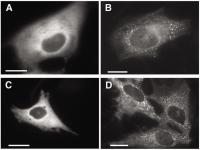
In these microscopic images of cells, the white areas indicate the presence of enzymes. The enzymes in images A and C are distributed throughout the cytoplasm because these cells were grown in the presence of purines. In contrast, the enzymes in images B and D occur in small clusters because these cells were grown in the absence of purines. Credit: Penn State Penn State scientists are the first to observe in living cells a key step in the creation of adenine and guanine, two of the four building blocks that comprise DNA. Also called purines, the two building blocks are essential for cell replication. The findings, which will be published in the 4 April 2008 issue of the journal Science, could lead to new cancer treatments that prevent cancer cells from replicating by interfering with their abilities to make purines.
| Full story | 0 Comments | 5909 views |

| Biology | April 3, 2008 08:14 PM |
Dog owners, who have noticed that their four-legged friend seem equally delighted to see them after five minutes away as five hours, may wonder if animals can tell when time passes. Newly published research from The University of Western Ontario in London, Canada may bring us closer to answering that very question.
| Full story | 0 Comments | 6034 views |

| AIDS & HIV | April 3, 2008 07:14 PM |
A phase 1 clinical trial to test a novel HIV/AIDS vaccine has begun at Brigham and Women’s Hospital (BWH). This new vaccine aims to overcome the problem of preexisting immunity to common vaccine vectors, which is thought to be a major problem in the developing world.
| Full story | 0 Comments | 7080 views |
| Biology | April 3, 2008 06:14 PM |
A recent study indicates that wild salmon may account for just 10 percent of California's fall-run chinook salmon population, while the vast majority of the fish come from hatcheries. The findings are especially troubling in light of the disastrous decline in the population this year, which will probably force the closure of the 2008 season for commercial and recreational salmon fishing.
| Full story | 0 Comments | 6257 views |
| Molecular & Cell Biology | April 3, 2008 02:05 PM |
A research team from the Virginia Bioinformatics Institute at Virginia Tech has identified an enormous superfamily of pathogen genes involved in the infection of plants. The Avh superfamily comprises genes found in the plant pathogens Phytophthora ramorum and Phytophthora sojae. The pathogen genes produce effector proteins that manipulate how plant cells work in such a way as to make the plant hosts more susceptible to infection. The results suggest that a single gene from a common ancestor of the both pathogen species has spawned hundreds of very different, fast-evolving genes that encode for these highly damaging effector proteins.
| Full story | 0 Comments | 7573 views |

| Health & Medicine | April 3, 2008 12:05 PM |
COULD you strengthen bones and speed up recovery after fractures and breaks simply by removing some bone marrow with a syringe?
| Full story | 0 Comments | 9456 views |

| Biotechnology | April 3, 2008 10:05 AM |
A spinal cord injury often leads to permanent paralysis and loss of sensation below the site of the injury because the damaged nerve fibers can't regenerate. The nerve fibers or axons have the capacity to grow again, but don’t because they're blocked by scar tissue that develops around the injury.
| Full story | 0 Comments | 8432 views |

- In some genetic cases of microcephaly, stem cells fail to launch
- Yale team discovers how Zika virus causes fetal brain damage
- Scientists uncover the way a common cell enzyme alerts the body to invading bacteria
- Arctic gives clues on worst mass extinction of life
- Calcium channel blockers caught in the act at atomic level
Search Bio News Net
Free Biology Newsletter
- Flexibility That A.C.A. Lent to Work Force Is Threatened by...International Herald Tribune
- Bacteria Behind Legionnaires’ Disease Found at New York Police StationInternational Herald Tribune
- Prescription Price Crisis? 28 Million Americans See Spike in Drug...MSNBC.com: Health
- Seizing on Opioid Crisis, a Drug Maker Lobbies Hard for...International Herald Tribune
- Republicans are taking a big political risk on health careAP Health News
- Why We're So Divided Over Saving WolvesNational Geographic News