

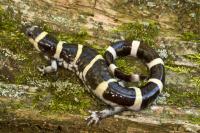
The Ringed Salamander (Ambystoma annulatum) is a species unique to the Ozarks. The number of amphibians drastically decreases in forest areas that are clearcut, according to previous studies. A University of Missouri researcher, however, has found that some animals may not be dying. Instead, the Mizzou biologist said some animals may be moving away (possibly to return later) or retreating underground. The finding could have major implications for both the timber industry and the survival of amphibians.

| Biology | March 11, 2008 09:01 PM |
| Full story | 0 Comments | 7127 views |
| Biology | March 11, 2008 08:01 PM |
The strongest creature in the world, the Hercules Beetle, has a colour-changing trick that scientists have long sought to understand. Research published today, Tuesday, 11 March, in the New Journal of Physics, details an investigation into the structure of the specie’s peculiar protective shell which could aid design of ‘intelligent materials’.
| Full story | 0 Comments | 8062 views |
| Biology | March 11, 2008 07:01 PM |
Far from being a model of social co-operation, the ant world is riddled with cheating and corruption – and it goes all the way to the top, according to scientists from the Universities of Leeds and Copenhagen.
| Full story | 0 Comments | 7056 views |
| Biology | March 11, 2008 06:01 PM |
There’s new evidence supporting the idea that bigger brains are better. A study of a tropical wasp suggests that the brainpower required to be dominant drives brain capacity.
| Full story | 0 Comments | 6794 views |

| Molecular & Cell Biology | March 11, 2008 05:01 PM |
A startling discovery by scientists at the Carnegie Institution puts a new twist on photosynthesis, arguably the most important biological process on Earth. Photosynthesis by plants, algae, and some bacteria supports nearly all living things by producing food from sunlight, and in the process these organisms release oxygen and absorb carbon dioxide. But two studies by Arthur Grossman and colleagues reported in Biochimica et Biophysica Acta and Limnology and Oceanography suggest that certain marine microorganisms have evolved a way to break the rules—they get a significant proportion of their energy without a net release of oxygen or uptake of carbon dioxide. This discovery impacts not only scientists’ basic understanding of photosynthesis, but importantly, it may also impact how microorganisms in the oceans affect rising levels of atmospheric carbon dioxide.
| Full story | 0 Comments | 22014 views |
| Molecular & Cell Biology | March 11, 2008 04:01 PM |
Biologists at the U.S. Department of Energy's Brookhaven National Laboratory, Stony Brook University, and the University of Wurzburg, Germany, have deciphered the structure of a large protein complex responsible for adding sugar molecules to newly formed proteins - a process essential to many proteins' functions. The structure offers insight into the molecular "sugar-coating" mechanism, and may help scientists better understand a variety of diseases that result when the process goes awry. The research will appear in the March 12, 2008, issue of the journal Structure.
| Full story | 0 Comments | 7759 views |

| Bioinformatics | March 11, 2008 12:09 AM |
By using computer simulations and modeling, an international group of researchers including scientists from the Virginia Bioinformatics Institute (VBI) at Virginia Tech’s Network Dynamics and Simulation Science Laboratory (NDSSL) have determined how a pandemic influenza outbreak might travel through a city similar in size to Chicago, Ill. This information helped them to determine the preferred intervention strategy to contain a potential flu pandemic, including what people should do to decrease the likelihood of disease transmission.
| Full story | 0 Comments | 7587 views |

| Biotechnology | March 11, 2008 12:09 AM |
A researcher at the National University at San Diego has taken a mathematical approach to a biological problem - how to design a portable DNA detector. Writing in the International Journal of Nanotechnology, he describes a mathematical simulation to show how a new type of nanoscale transistor might be coupled to a DNA sensor system to produce a characteristic signal for specific DNA fragments in a sample.
| Full story | 0 Comments | 7361 views |
| Biology | March 11, 2008 12:09 AM |
An international group of researchers has found evidence for the earliest transport use of the donkey and the early phases of donkey domestication, suggesting the process of domestication may have been slower and less linear than previously thought.
| Full story | 0 Comments | 5294 views |
| Biotechnology | March 11, 2008 12:09 AM |
University of Maryland research that started with bacteria from the Chesapeake Bay has led to a process that may be able to convert large volumes of all kinds of plant products, from leftover brewer’s mash to paper trash, into ethanol and other biofuel alternatives to gasoline.
| Full story | 0 Comments | 7851 views |
| Molecular & Cell Biology | March 11, 2008 12:09 AM |
Cells are coded with several programs for self-destruction. Many cells die peacefully. Others cause a ruckus on their way out.
| Full story | 0 Comments | 5598 views |
Goldfish in an aquarium are able to dash after food flakes at mealtime, reaching them before they sink or are eaten by other fish. Researchers at MIT recently proved that marine bacteria, the smallest creatures in the ocean, behave in a similar fashion at mealtime, using their swimming skills to reach tiny food patches that appear randomly in the ocean blue.
| Full story | 0 Comments | 5899 views |
| Biology | March 11, 2008 12:09 AM |
Since the reporting of the so-called “hobbit” fossil from the island of Flores in Indonesia, debate has raged as to whether these remains are of modern humans (Homo sapiens), reduced, for some reason, in stature, or whether they represent a new species, Homo floresiensis. Reporting in this week’s PLoS ONE in a study funded by the National Geographic Society Mission Programs, Lee Berger and colleagues from the University of the Witwatersrand, Rutgers University and Duke University, describe the fossils of small-bodied humans from the Micronesian island of Palau. These people inhabited the island between 1400 and 3000 years ago and share some – although not all – features with the H. floresiensis specimens.
| Full story | 0 Comments | 9468 views |

| Microbiology | March 11, 2008 12:09 AM |
When space shuttle Endeavor blasts off on March 11, some tiny ‘astronauts’ will piggyback onboard an experimental payload from Arizona State University’s Biodesign Institute.
| Full story | 0 Comments | 5399 views |
| Biology | March 11, 2008 12:09 AM |
When exotic species invade new territory, they often present a major threat to the other plants and animals living there—that much is clear. But researchers writing in the March 11th issue of Current Biology, a publication of Cell Press, now show that, in addition to their destructive tendencies, invasive species can also have a surprisingly “creative” side.
| Full story | 0 Comments | 4392 views |
| Biology | March 11, 2008 12:09 AM |
Researchers have made what they say is the first experimental demonstration that a primate other than humans conveys meaning by combining distinct alarm calls in particular ways. The study appears in the March 11th issue of Current Biology, a publication of Cell Press.
| Full story | 0 Comments | 4658 views |

- In some genetic cases of microcephaly, stem cells fail to launch
- Yale team discovers how Zika virus causes fetal brain damage
- Scientists uncover the way a common cell enzyme alerts the body to invading bacteria
- Arctic gives clues on worst mass extinction of life
- Calcium channel blockers caught in the act at atomic level
Search Bio News Net
Free Biology Newsletter
- Flexibility That A.C.A. Lent to Work Force Is Threatened by...International Herald Tribune
- Bacteria Behind Legionnaires’ Disease Found at New York Police StationInternational Herald Tribune
- Prescription Price Crisis? 28 Million Americans See Spike in Drug...MSNBC.com: Health
- Seizing on Opioid Crisis, a Drug Maker Lobbies Hard for...International Herald Tribune
- Republicans are taking a big political risk on health careAP Health News
- Why We're So Divided Over Saving WolvesNational Geographic News