


A new technique that combines bone marrow removal and injection of a hormone helps promote rapid formation of new bone at targeted locations in the body, it was reported by Yale School of Medicine this month in Tissue Engineering.

| Microbiology | February 14, 2008 10:35 PM |
One of the ways we defend ourselves against bacterial foes is to “hide” their food, particularly the metals they crave. A multi-disciplinary team led by Vanderbilt University investigators has now discovered that a protein inside certain immune system cells blocks the growth of “staph” bacteria by sopping up manganese and zinc.
| Full story | 0 Comments | 6937 views |

| Bioinformatics | February 14, 2008 09:35 PM |
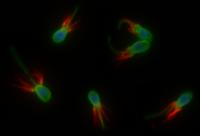
Choanoflagellates are aquatic microbial eukaryotes that are distinguished by an apical flagellum (green), which is used for swimming and feeding, surrounded by a collar of microvilli or tentacles (red) against which bacterial prey are trapped. The nucleus is highlighted in blue. Credit: Nicole King laboratory, UC Berkeley The newly sequenced genome of a one-celled, planktonic marine organism, reported today (Thursday, Feb. 14) in the journal Nature, is already telling scientists about the evolutionary changes that accompanied the jump from one-celled life forms to multicellular animals like ourselves.
| Full story | 0 Comments | 8417 views |

| Molecular & Cell Biology | February 14, 2008 08:35 PM |
Almost all organisms, from bacteria to human beings, share the same genetic code, a group of universal instructions used to convert DNA or RNA sequences into proteins, the “building blocks” of life. Identification of the evolutionary differences between the system for the translation of the genetic code in humans and other organisms, such as bacteria in this case, are useful, for example, for the design of new antibiotics. Researchers at the Institute for Research in Biomedicine (IRB Barcelona) have discovered that an essential molecular process, namely the determination of the start of protein synthesis, until now considered to be the same for all living organisms, differs in the bacteria Mycoplasma penetrans, a human pathogen that affects the respiratory tract. M. penetrans affects immuno-depressed patients, such as those infected by the HIV virus and some cancer patients. The results of this study have been published in the latest issue of Molecular Cell.
| Full story | 0 Comments | 7910 views |

| AIDS & HIV | February 14, 2008 08:06 PM |
Even with effective anti-HIV therapies, doctors still have not been able to eradicate the virus from infected individuals who are receiving such treatments, largely because of the persistence of HIV in hideouts known as viral reservoirs. One important reservoir is the gut, where HIV causes much of its damage due to the large number of HIV target cells that reside there. These cells, known as CD4+ T cells, are largely contained in lymph nodes and patches of lymphocytes that collectively are called gut-associated lymphoid tissue, or GALT.
| Full story | 0 Comments | 8193 views |

| Biology | February 14, 2008 07:35 PM |
When it comes to deciding what harvester ant daughters will be when they grow up, mother queens hold considerable sway, according to a new study published online on February 14th in Current Biology, a publication of Cell Press. The researchers report evidence that eggs are predetermined to become workers or queens from the moment they are lain.
| Full story | 0 Comments | 7072 views |
| Biology | February 14, 2008 06:35 PM |
To a fruit fly, a piece of rotting fruit or the food in your picnic basket is a little slice of heaven. It’s where the tiny animal—not much more than a speck on your fingertip can find food and a mate, the two passions of its short, two-month lifespan.
| Full story | 0 Comments | 5173 views |

| Health & Medicine | February 14, 2008 06:06 PM |
A rare disorder caused by an excess of two types of immune cells—the mast cell found in various tissues and its blood-based twin, the basophil—has successfully been treated with a cancer drug, report scientists from the National Institute of Allergy and Infectious Diseases (NIAID), part of the National Institutes of Health (NIH). The study, now available online at the Web site of the journal Haematologica, was a collaborative effort led by Dean Metcalfe, M.D., chief of the NIAID Laboratory of Allergic Diseases and Jan Cools, Ph.D., a staff scientist, at the Katholieke Universiteit Leuven within the Vlaams Institute for Biotechnology and the Department of Molecular and Developmental Genetics, in Leuven, Belgium.
| Full story | 0 Comments | 5440 views |
| Molecular & Cell Biology | February 14, 2008 05:35 PM |
The international team of researchers was able to identify the location and defect in the coding region of the gene through analysis of genetic material (DNA) from members of a large Swiss family, the majority of whom suffered from autosomal dominant juvenile cataract. The corresponding protein belongs to a family of monocarboxylate transporters which move small molecules across cell mem-branes. Surprisingly, this genetic defect may also lead to the condition of renal glucosuria, a non-pathological kidney defect with elevated levels of glucose in the urine, but not in blood.
| Full story | 0 Comments | 6084 views |
| Microbiology | February 14, 2008 05:06 PM |
The first genome-wide search for genes governing social behavior has found that even the simplest social creatures -- the amoebae Dictyostelium discoideum -- have more than 100 genes that help regulate their cooperative behavior.
| Full story | 0 Comments | 6601 views |
| Biology | February 14, 2008 04:06 PM |
Garlic mustard has become an invasive species in temperate forests across the United States, choking out native plants on forest floors and threatening ecosystem diversity. University of Illinois ecologist Adam Davis has created a computer model that in combination with quarantined research tests he believes will be able to predict the perfect predator -- a pest that can be introduced into a forested area that will help reduce the garlic mustard population.
| Full story | 1 Comment | 7682 views |
| Microbiology | February 14, 2008 03:06 PM |
Researchers at the University of Pennsylvania School of Medicine have demonstrated that a bacterial toxin from the common bacterium Staphylococcus aureus shuts down the control mechanism of the tunnel, called an ion channel, in immune cell membranes. Shutting down ion channels has long been known to suppress the immune response, and the bacteria may use the toxin to neutralize host defenses against bacteria. The study is published in the February 14 issue of Nature.
| Full story | 0 Comments | 8106 views |
| Molecular & Cell Biology | February 14, 2008 01:06 PM |
Scientists at The Wistar Institute have collaborated on a major advance in understanding a gene regulator that contributes to some of the deadliest cancers in humans. The culmination of 10 years’ work, their research paves the way for the development of new cancer therapies.
| Full story | 0 Comments | 7814 views |
| Molecular & Cell Biology | February 14, 2008 12:06 PM |
Moving an active gene from the interior of the nucleus to its periphery can inactivate that gene report scientists from the University of Chicago Medical Center in an article to be published early online Feb.13, 2008, in the journal Nature.
| Full story | 0 Comments | 6331 views |
| Molecular & Cell Biology | February 14, 2008 10:06 AM |
Researchers at McGill University have discovered a way to boost an organism’s natural anti-virus defences, effectively making its cells immune to influenza and other viruses.
| Full story | 0 Comments | 6560 views |

- In some genetic cases of microcephaly, stem cells fail to launch
- Yale team discovers how Zika virus causes fetal brain damage
- Scientists uncover the way a common cell enzyme alerts the body to invading bacteria
- Arctic gives clues on worst mass extinction of life
- Calcium channel blockers caught in the act at atomic level
Search Bio News Net
Free Biology Newsletter
- Flexibility That A.C.A. Lent to Work Force Is Threatened by...International Herald Tribune
- Bacteria Behind Legionnaires’ Disease Found at New York Police StationInternational Herald Tribune
- Prescription Price Crisis? 28 Million Americans See Spike in Drug...MSNBC.com: Health
- Seizing on Opioid Crisis, a Drug Maker Lobbies Hard for...International Herald Tribune
- Republicans are taking a big political risk on health careAP Health News
- Why We're So Divided Over Saving WolvesNational Geographic News