

The targeted therapy Herceptin helps women with HER2+ type of breast cancer independent of whether patients have extra copies of chromosome 17, home to the HER2 gene which produces the HER2 protein that fuels cancer growth. Prior to this report, there were conflicting opinions about whether that was the case, say Mayo Clinic investigators who presented their findings at the San Antonio Breast Cancer Symposium.

| Molecular & Cell Biology | December 14, 2007 09:46 PM |
The development of higher forms of life would appear to have been influenced by RNA polymerase II. This enzyme transcribes the information coded by genes from DNA into messenger-RNA (mRNA), which in turn is the basis for the production of proteins. RNA polymerase II is highly conserved through evolution, with many of its structural characteristics being conserved between bacteria and humans.
| Full story | 0 Comments | 7215 views |

| Biology | December 14, 2007 08:46 PM |
A Queen’s University environmental scientist will head a new international study to determine whether American eels – the slimy, snake-like fish considered worldwide to be a food delicacy – are dying from chemical pollution in Lake Ontario.
| Full story | 0 Comments | 7694 views |

| Bioinformatics | December 14, 2007 07:46 PM |
Some 400 million years ago, on a lifeless lakeshore lapped by waves, floating algae learned to survive in the open air and launched an invasion that transformed the Earth into a green paradise.
| Full story | 0 Comments | 5767 views |
| Molecular & Cell Biology | December 14, 2007 06:46 PM |
Can a tiny winged insect’s salivary glands really tell us about processes relevant to human disease" Yes, according to a new study by researchers at the University of Massachusetts Medical School (UMMS), who gained new insights into autophagy—a cellular degradation process associated with a form of programmed cell death—by studying the salivary gland cells of the fruit fly.
| Full story | 0 Comments | 5452 views |

| Health & Medicine | December 14, 2007 05:46 PM |
Men whose mothers, sisters or daughters test positive for a cancer-causing gene mutation also have an increased risk of developing the disease but are unaware of that risk. That is the conclusion of a study at Fox Chase Cancer Center exploring how families communicate genetic test results.
| Full story | 0 Comments | 7133 views |

| Environment | December 14, 2007 04:46 PM |
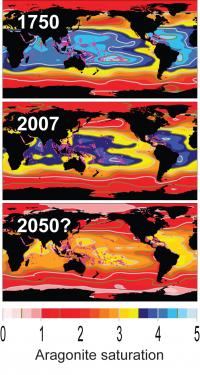
In year 1750, over 98 percent of coral reefs (magenta dots) grew in optimal conditions with aragonite saturation greater than 3.5 (blue colors). Such water is rapidly disappearing and will be gone in several decades if current carbon dioxide emission trends continue. Atmospheric CO2 levels are 280 ppm, 380 ppm, and 550 ppm for years 1750, 2007, and 2050, respectively. Credit: Ken Caldeira Carbon emissions from human activities are not just heating up the globe, they are changing the ocean’s chemistry. This could soon be fatal to coral reefs, which are havens for marine biodiversity and underpin the economies of many coastal communities. Scientists from the Carnegie Institution’s Department of Global Ecology have calculated that if current carbon dioxide emission trends continue, by mid-century 98% of present-day reef habitats will be bathed in water too acidic for reef growth. Among the first victims will be Australia’s Great Barrier Reef, the world’s largest organic structure.
| Full story | 0 Comments | 6698 views |
| Molecular & Cell Biology | December 14, 2007 03:46 PM |
Time-lapse videos and computer simulations provide the first concrete molecular explanation of how a cell flexes tiny muscle-like structures to pinch itself into two daughter cells at the end of each cell division, according to a report in Science Express.
| Full story | 0 Comments | 5802 views |

- In some genetic cases of microcephaly, stem cells fail to launch
- Yale team discovers how Zika virus causes fetal brain damage
- Scientists uncover the way a common cell enzyme alerts the body to invading bacteria
- Arctic gives clues on worst mass extinction of life
- Calcium channel blockers caught in the act at atomic level
Search Bio News Net
Free Biology Newsletter
- Flexibility That A.C.A. Lent to Work Force Is Threatened by...International Herald Tribune
- Bacteria Behind Legionnaires’ Disease Found at New York Police StationInternational Herald Tribune
- Prescription Price Crisis? 28 Million Americans See Spike in Drug...MSNBC.com: Health
- Seizing on Opioid Crisis, a Drug Maker Lobbies Hard for...International Herald Tribune
- Republicans are taking a big political risk on health careAP Health News
- Why We're So Divided Over Saving WolvesNational Geographic News