

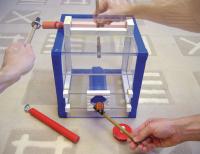
Adult retrieves turtle from puzzle box as part of experiment that determined children "over-imitate " adult behavior. Children learn by imitating adults—so much so that they will rethink how an object works if they observe an adult taking unnecessary steps when using that object, according to a Yale study today in Proceedings of the National Academy of Sciences.

| Biology | December 6, 2007 11:35 PM |
| Full story | 0 Comments | 5757 views |

| Biotechnology | December 6, 2007 10:35 PM |
The combination of beer, wastewater, microbes, fuel cells, high school students and teachers sounds like a witches’ brew for an old –fashioned, illicit ‘60s beach party.
| Full story | 0 Comments | 6342 views |

| Stem Cell Research | December 6, 2007 09:35 PM |
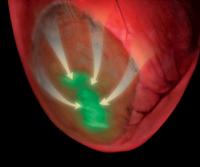
Cells implanted within damaged heart tissue (darker area) express a green fluorescent molecular sensor. Implantation of these cells, which express the protein connexin43, reduces the risk of the damaged heart developing fatal arrhythmias by enhancing electrical conduction (arrows). The fluorescent molecular sensor is activated when the cells contract, demonstrating conduction of electrical waves into the damaged area. Credit: Michael Simmons When researchers at Cornell, the University of Bonn and the University of Pittsburgh transplanted living embryonic heart cells into cardiac tissue of mice that had suffered heart attacks, the mice became resistant to cardiac arrhythmias, thereby avoiding one of the most dangerous and fatal consequences of heart attacks.
| Full story | 0 Comments | 8177 views |
| Biology | December 6, 2007 08:35 PM |
Comparisons of the brains of young and old people have revealed that normal aging may cause cognitive decline due to deterioration of the connections among large-scale brain systems. The researchers linked the deterioration to a decrease in the integrity of the brain’s “white matter,” the tissue containing nerve cells that carry information. The researchers found that the disruption occurred even in the absence of pathology associated with Alzheimer’s disease (AD).
| Full story | 0 Comments | 6654 views |

| Gene Therapy | December 6, 2007 07:35 PM |
Mice with a human sickle-cell anemia disease trait have been treated successfully in a process that begins by directly reprogramming their own cells to an embryonic-stem-cell-like state, without the use of eggs. This is the first proof-of-principle of therapeutic application in mice of directly reprogrammed “induced pluripotent stem” (IPS) cells, which recently have been derived in mice as well as humans.
| Full story | 0 Comments | 8855 views |
| Biology | December 6, 2007 06:35 PM |
A team of Howard Hughes Medical Institute researchers has shown that normal aging disrupts communication between different regions of the brain. The new research, which used advanced medical imaging techniques to look at the brain function of 93 healthy individuals from 18 to 93 years old, shows that this decline happens even in the absence of serious pathologies like Alzheimer's disease.
| Full story | 0 Comments | 7150 views |

| Molecular & Cell Biology | December 6, 2007 05:35 PM |
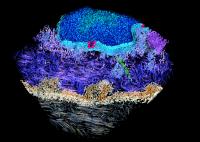
This 3-D reconstruction of a human skin cell was produced by electron tomography and shows organelles in different colours: regions of cell-cell contact (sandy brown), nucleus and nuclear envelope (blue) with pores (red), microtubules (green), mitochondria (purple), endoplasmic reticulum (steel blue). Credit: Achilleas Frangakis EMBL Seeing proteins in their natural environment and interactions inside cells has been a long-standing goal. Using an advanced microscopy technique called cryo-electron tomography, researchers from the European Molecular Biology Laboratory [EMBL] have visualised proteins responsible for cell-cell contacts for the first time. In this week’s issue of Nature they publish the first 3D image of human skin at molecular resolution and reveal the molecular Velcro-like organisation that interlinks cells.
| Full story | 0 Comments | 6397 views |
| Biology | December 6, 2007 04:35 PM |
In the wake of a study that documented for the first time the use of weaponry by Cross River gorillas to ward off threats by humans, the Wildlife Conservation Society announced today new field surveys to better protect this most endangered great ape.
| Full story | 0 Comments | 10502 views |

| Microbiology | December 6, 2007 03:35 PM |
Scientists from The University of Manchester have pioneered new ways of tweaking the molecular structure of antibiotics – an innovation that could be crucial in the fight against powerful super bugs.
| Full story | 0 Comments | 7627 views |

| Microarray | December 6, 2007 02:35 PM |
Gene-expression profiles might be used to identify prognostic biomarkers for Kawasaki disease, and help to unravel the underlying biology of the illness, research published this week in the online open access journal Genome Biology reveals. The new findings also support the idea that gene-expression profiles might be used to generate biomarkers for other systemic inflammatory illnesses.
| Full story | 0 Comments | 10552 views |

| AIDS & HIV | December 6, 2007 12:35 PM |
Researchers in Montreal and Boston have identified a potential new treatment for the HIV/HAART*-associated Lipodystrophy Syndrome. This syndrome is a common side-effect of anti-retroviral medications to treat HIV infection. Dr. Julian Falutz, Director of the HIV Metabolic Clinic at the McGill University Health Centre (MUHC), and Dr. Steven Grinspoon, Director at the Massachusetts General Hospital Program in Nutritional Metabolism are publishing the results of their recent clinical trial in the December 6, 2007 issue of the New England Journal of Medicine.
| Full story | 0 Comments | 7101 views |
| Biology | December 6, 2007 10:35 AM |
A family of proteins commonly found in mouse urine is able to trigger fighting between male mice, a study in the Dec. 6, 2007, issue of Nature has found. The study, which is the first to identify protein pheromones responsible for the aggression response in mice, was funded in part by the National Institute on Deafness and Other Communication Disorders (NIDCD), one of the National Institutes of Health. Pheromones are chemical cues that are released into the air, secreted from glands, or excreted in urine and picked up by animals of the same species, initiating various social and reproductive behaviors.
| Full story | 0 Comments | 7625 views |

- In some genetic cases of microcephaly, stem cells fail to launch
- Yale team discovers how Zika virus causes fetal brain damage
- Scientists uncover the way a common cell enzyme alerts the body to invading bacteria
- Arctic gives clues on worst mass extinction of life
- Calcium channel blockers caught in the act at atomic level
Search Bio News Net
Free Biology Newsletter
- Flexibility That A.C.A. Lent to Work Force Is Threatened by...International Herald Tribune
- Bacteria Behind Legionnaires’ Disease Found at New York Police StationInternational Herald Tribune
- Prescription Price Crisis? 28 Million Americans See Spike in Drug...MSNBC.com: Health
- Seizing on Opioid Crisis, a Drug Maker Lobbies Hard for...International Herald Tribune
- Republicans are taking a big political risk on health careAP Health News
- Why We're So Divided Over Saving WolvesNational Geographic News