


Why a pathogen is a pathogen may be answered as scientists study the recently mapped genetic makeup of a fungus that spawns the worst cereal grains disease known and also can produce toxins potentially fatal to people and livestock.

| Biology | October 6, 2007 07:50 PM |
In the ultimatum game - which was developed by another German, Werner Güth, now at the Max Planck Institute for Economics in Jena - one person, the proposer, is given money by an experimenter. That proposer can then divide the "manna from heaven" with a second person, the responder. The responder is not powerless - if he accepts the division, both people take home the offered amounts. But if he rejects it, both get nothing.
| Full story | 0 Comments | 6001 views |

| Microbiology | October 6, 2007 05:50 PM |
The Marburg virus, like its fearsome cousin Ebola, belongs to the Filoviridae family. It carries the name of the German town where it was first detected in 1967, after a mysterious epidemic had hit employees of the Behring laboratory. The workers had been contaminated as they took organ samples from green monkeys imported from Uganda. Up to the end of the 20th Century, rare cases of violent haemorrhagic fever attack linked to Marburg virus were subsequently registered, essentially in East Africa: (in Kenya, Zimbabwe, parts of South Africa). However, in 1998, a more extensive epidemic affected 149 people near Durba, a town in the North-East of the Democratic Republic of Congo (DRC). More than 80% of these people succumbed to the haemorrhagic fever the virus caused. In 2005, a second epidemic that broke out in Angola infected over 252 people, 227 of whom died - a mortality rate of nearly 90%. That was the most severe epidemic of Marburg haemorrhagic fever (MHF) known to date.
| Full story | 0 Comments | 5721 views |
| Biology | October 6, 2007 03:50 PM |
The two closely related bird species, the collared flycatcher and the pied flycatcher, can reproduce with each other, but the females are more strongly attracted to a male of their own species. This has been shown by an international research team directed by Anna Qvarnström at Uppsala University in today’s Net edition of Science. They demonstrate that the gene for this sexual preference is found on the sex chromosome that is inherited from the father and that only females have a copy of. The discovery sheds new light on how new species are formed.
| Full story | 0 Comments | 7161 views |

| Biotechnology | October 6, 2007 01:50 PM |
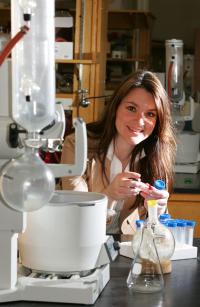
Eva Harth in her laboratory. There are two aspects to creating an effective drug: finding a chemical compound that has the desired biological effect and minimal side-effects and then delivering it to the right place in the body for it to do its job.
| Full story | 0 Comments | 6305 views |

| Health & Medicine | October 6, 2007 11:50 AM |
The evidence linking amateur boxing and chronic traumatic brain injury is not strong, concludes a study published on bmj.com today. As such, the researchers say they cannot firmly prove nor reject the theory that amateur boxing leads to chronic brain injury.
| Full story | 0 Comments | 6364 views |

- In some genetic cases of microcephaly, stem cells fail to launch
- Yale team discovers how Zika virus causes fetal brain damage
- Scientists uncover the way a common cell enzyme alerts the body to invading bacteria
- Arctic gives clues on worst mass extinction of life
- Calcium channel blockers caught in the act at atomic level
Search Bio News Net
Free Biology Newsletter
- Flexibility That A.C.A. Lent to Work Force Is Threatened by...International Herald Tribune
- Bacteria Behind Legionnaires’ Disease Found at New York Police StationInternational Herald Tribune
- Prescription Price Crisis? 28 Million Americans See Spike in Drug...MSNBC.com: Health
- Seizing on Opioid Crisis, a Drug Maker Lobbies Hard for...International Herald Tribune
- Republicans are taking a big political risk on health careAP Health News
- Why We're So Divided Over Saving WolvesNational Geographic News