

A new study by biologists at Tufts University has discovered a dark side lurking behind the magical light shows put on by fireflies each summer. Using both laboratory and field experiments to explore the potential costs of firefly courtship displays, the biologists have uncovered some surprising answers.

| Molecular & Cell Biology | September 19, 2007 10:15 PM |
Anti-cancer treatments often effectively shrink the size of tumors, but some might have an opposite effect, actually expanding the small population of cancer stem cells believed to drive the disease, according to findings presented today in Atlanta, Georgia at the American Association for Cancer Research’s second International Conference on Molecular Diagnostics in Cancer Therapeutic Development.
| Full story | 0 Comments | 7310 views |

| Microarray | September 19, 2007 09:15 PM |
Like many oncologists, Eric P. Lester, M.D., was faced with a dilemma: seven patients with advanced, incurable cancer, an arsenal of drugs that may or may not help them, and not enough solid proof about treatment efficacy to guide him. So Dr. Lester devised what he called a “simple-minded experiment” that illustrates the promise of personalized medicine. Using DNA microarray “chips,” Dr. Lester analyzed his patients’ tumors for expression of genes associated with good response to various anti-cancer drugs, and based his drug treatment plans on the results. Four out of seven patients with advanced cancer enrolled in the extremely limited study had a better outcome than expected.
| Full story | 1 Comment | 6362 views |

| Microbiology | September 19, 2007 08:15 PM |
A resistance gene that allows bacteria to beat an important class of antibiotics has started to appear in microorganisms taken from Midwestern patients, according to researchers at Washington University School of Medicine in St. Louis.
| Full story | 0 Comments | 5869 views |

| Biology | September 19, 2007 07:15 PM |
While the visual regions of the brain have been intensively mapped, many important regions for auditory processing remain terra incognita. Now, researchers have identified the region responsible for a key auditory process—perceiving “sound space,” the location of sounds. The findings settle a controversy in earlier studies that failed to establish the auditory region, called the planum temporale, as responsible for perceiving auditory space.
| Full story | 0 Comments | 5124 views |
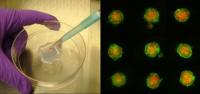
At left is a new 3-D petri dish developed by Brown University biomedical engineers. At right are the "microtissues," or cell clusters, that the dish produces for transplantation or drug development. Credit: Anthony Napolitano & Peter Chai/Brown University A team of Brown University biomedical engineers has invented a 3-D Petri dish that can grow cells in three dimensions, a method that promises to quickly and cheaply produce more realistic cells for drug development and tissue transplantation.
| Full story | 0 Comments | 6035 views |

| Biotechnology | September 19, 2007 04:18 PM |
Scientists have developed unique technology to grow stem cells and other tissue in the laboratory in conditions similar to the way they grow in the human body.
| Full story | 0 Comments | 6528 views |
| Molecular & Cell Biology | September 19, 2007 02:18 PM |
This study focused on the gene for AMPK (adenosine monophosphate-activated protein kinase), which controls the amount of energy in our cells by becoming active when fuel stores start to deplete, such as during exercise. The mutation discovered in individuals from two unrelated families caused a doubling of AMPK activity in muscle during rest, mimicking a state of exercise.
| Full story | 0 Comments | 5961 views |
| Microbiology | September 19, 2007 12:18 PM |
Metagenomics is a revolutionary approach to study microbes. Rather than isolating pure cultures, the power of high-throughput sequencing is applied directly to environmental samples to obtain information about the genomes of the prokaryotic cells present in a specific habitat studied. The ocean is an ideal subject of this approach because of its enormous microbiota, whose biomass equals that of all other living organisms on earth is mostly microbial, and also because most of these microbes are extremely fastidious to cultivate.
| Full story | 0 Comments | 5149 views |

| Health & Medicine | September 19, 2007 10:18 AM |
Administering hydrogen sulfide (H2S) directly into the heart during a simulated heart attack significantly reduces the tissue and cell damage often seen in oxygen-starved organs, according to a new study from researchers at the University of Alabama at Birmingham.
| Full story | 0 Comments | 7253 views |

- In some genetic cases of microcephaly, stem cells fail to launch
- Yale team discovers how Zika virus causes fetal brain damage
- Scientists uncover the way a common cell enzyme alerts the body to invading bacteria
- Arctic gives clues on worst mass extinction of life
- Calcium channel blockers caught in the act at atomic level
Search Bio News Net
Free Biology Newsletter
- Flexibility That A.C.A. Lent to Work Force Is Threatened by...International Herald Tribune
- Bacteria Behind Legionnaires’ Disease Found at New York Police StationInternational Herald Tribune
- Prescription Price Crisis? 28 Million Americans See Spike in Drug...MSNBC.com: Health
- Seizing on Opioid Crisis, a Drug Maker Lobbies Hard for...International Herald Tribune
- Republicans are taking a big political risk on health careAP Health News
- Why We're So Divided Over Saving WolvesNational Geographic News