

A team led by biophysicist Jeremy Smith of the University of Tennessee and Oak Ridge National Laboratory (ORNL) has taken a significant step toward unraveling the mystery of how proteins fold into unique, three-dimensional shapes.

| Microbiology | September 17, 2007 09:36 PM |
Biologists have determined the three-dimensional structure of an unusual viral enzyme that is required in the assembly of new viruses.
| Full story | 0 Comments | 8242 views |

| Biology | September 17, 2007 08:36 PM |
For the first time, researchers have discovered that when Cyprian honeybees mob and kill their arch enemy, the Oriental hornet, the cause of death is asphyxiation. They reported their findings in the September 18, 2007, issue of Current Biology, a publication of Cell Press.
| Full story | 0 Comments | 7236 views |
| Biology | September 17, 2007 07:36 PM |
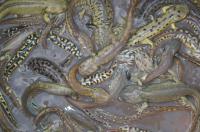
This image shows California Tiger and Barred Tiger Salamanders in a California pond. New research shows that the two species have interbred to create a hybrids that have shown remarkable vigor. Credit: Bruce Delgado/Bureau of Land Management What began more than 50 years ago as a way to improve fishing bait in California has led a University of Tennessee researcher to a significant finding about how animal species interact and that raises important questions about conservation.
| Full story | 0 Comments | 7703 views |

| Environment | September 17, 2007 06:36 PM |
A groundbreaking environmental study to be published in a prestigious American science journal proves that mercury atmospheric emissions will end up in fish in as little as three years. Biologists from the University of Alberta in Edmonton, Canada, played a key role in designing and carrying out the experiment.
| Full story | 0 Comments | 6266 views |

| Molecular & Cell Biology | September 17, 2007 06:18 PM |
A new study published in Nature Genetics on Sunday 16 September 2007 show that common, complex diseases are more likely to be due to genetic variation in regions that control activity of genes, rather than in the regions that specify the protein code.
| Full story | 0 Comments | 8299 views |
| Biology | September 17, 2007 05:18 PM |
Key components of a new approach to discover life on Mars were successfully launched into space Friday as part of a twelve-day, low-Earth orbit experiment to assess their survivability in the space radiation environment—a prelude future journeys to Mars.
| Full story | 0 Comments | 7288 views |

| Biotechnology | September 17, 2007 03:18 PM |
Good news for public health: Bioengineering researchers from the EPFL in Lausanne, Switzerland, have developed and patented a nanoparticle that can deliver vaccines more effectively, with fewer side effects, and at a fraction of the cost of current vaccine technologies.
| Full story | 0 Comments | 5488 views |
| Molecular & Cell Biology | September 17, 2007 01:18 PM |
For the first time scientists have been able to film, in real time, the nanoscale interaction of an enzyme and a DNA strand from an attacking virus. Researchers from the University of Cambridge have used a revolutionary Scanning Atomic Force Microscope in Japan to produce amazing footage of a protective enzyme unravelling the DNA of a virus trying to infect a bacterial host.
| Full story | 1 Comment | 6059 views |
| Molecular & Cell Biology | September 17, 2007 11:18 AM |
It all started with flowers: in the nineties of the last century Norwegian researchers discovered that additional copies of a particular gene in petunias inhibited its activity instead of reinforcing it as had been assumed. A few years later it was found that the mechanism is based on the degradation of messenger RNA in the cells. Finally, in the late nineties the Nobel prizewinners Andrew Fire and Craig Mello established the technique of RNA interference, in which double-stranded RNA switches genes off efficiently and specifically. The scientists used the nematode (roundworm) Caenorhabditis elegans to study this. Subsequently, however, considerable problems arose in the attempt to transfer the strategy used by Mello and Fire to vertebrates. In particular the administration of small RNAs, known as siRNAs (small interfering RNAs), in animals proved difficult. Although it was possible to administer siRNAs successfully by using various methods such as high-pressure injections or in conjunction with cholesterol, the underlying mechanisms remained obscure. Markus Stoffel, ETH Zurich Professor at the Institute for Molecular Systems Biology, together with chemists from the Alnylam Company, has now succeeded in elucidating the mechanism for the uptake of siRNA in combination with fatty acids in mammals. The corresponding paper, which has just been published in the scientific journal “Nature Biotechnology” and will also adorn the title page of the printed version in October, represents the basis for possible siRNA therapies, among other things. This is because Stoffel showed that siRNA can be coupled effectively to various fatty acids.
| Full story | 0 Comments | 6116 views |

- In some genetic cases of microcephaly, stem cells fail to launch
- Yale team discovers how Zika virus causes fetal brain damage
- Scientists uncover the way a common cell enzyme alerts the body to invading bacteria
- Arctic gives clues on worst mass extinction of life
- Calcium channel blockers caught in the act at atomic level
Search Bio News Net
Free Biology Newsletter
- Flexibility That A.C.A. Lent to Work Force Is Threatened by...International Herald Tribune
- Bacteria Behind Legionnaires’ Disease Found at New York Police StationInternational Herald Tribune
- Prescription Price Crisis? 28 Million Americans See Spike in Drug...MSNBC.com: Health
- Seizing on Opioid Crisis, a Drug Maker Lobbies Hard for...International Herald Tribune
- Republicans are taking a big political risk on health careAP Health News
- Why We're So Divided Over Saving WolvesNational Geographic News