

When trying to understand someone's intentions, non-human primates expect others to act rationally by performing the most appropriate action allowed by the environment, according to a new study by researchers at Harvard University.

| Biotechnology | September 6, 2007 08:56 PM |
A partnership between Kent State University, Summa Health System and IC-MedTech Inc. has yielded an innovative liquid crystal technology that offers the promise of new drugs which may more effectively manage cancer and other diseases.
| Full story | 0 Comments | 8031 views |

| AIDS & HIV | September 6, 2007 07:56 PM |
Three related papers published in the Sept. 1 edition of The Journal of Immunology provide key new insights into the complexity of HIV/AIDS. Don Sodora, Ph.D., a principal investigator in SBRI’s Viral Vaccines Program who recently joined SBRI from the University of Texas, Southwestern Medical Center, is senior author on one of three papers that collectively show CD4 T-cell depletion, a critical symptom of AIDS, is likely a part of a multifaceted scenario that triggers disease rather than the only cause.
| Full story | 0 Comments | 6177 views |
| AIDS & HIV | September 6, 2007 06:56 PM |
By furthering scientists’ understanding of the molecular mechanisms that separate the minority of successful HIV antibodies from the majority of ineffective antibodies, the work may have implications for future attempts to design an HIV vaccine.
| Full story | 0 Comments | 6521 views |

| Bioinformatics | September 6, 2007 05:56 PM |
Evil forces thrive in an unstable environment. At least, that’s the picture being painted in the first waves of data being reaped from the genome sequence of the fungal plant pathogen, Fusarium graminearum. The sequencing has provided scientists a road map to someday combat a fungus that infects wheat and barley crops, rendering them unusable.
| Full story | 0 Comments | 6152 views |

| Biology | September 6, 2007 04:56 PM |
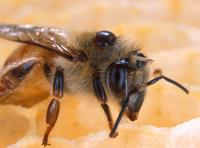
Honey bee worker carrying a parasitic Varroa mite. A comparison of healthy and unhealthy bee colonies points to a virus contributing to Colony Collapse Disorder (CCD), according to a report being published by the journal Science, at the Science Express web site, on 06 September. Science is published by AAAS, the nonprofit science society.
| Full story | 0 Comments | 10632 views |

| Health & Medicine | September 6, 2007 03:56 PM |
Howard Hughes Medical Institute researchers have genetically engineered mice that harbor the same genetic mutation found in some people with autism and Asperger syndrome. Mice with this mutation show a similar type of social impairment and cognitive enhancement as the type seen in some people with autism spectrum disorders (ASDs). ASDs are enigmatic cognitive disorders that impair a patient's social interactions, but do not necessarily limit their intelligence.
| Full story | 0 Comments | 5632 views |

- In some genetic cases of microcephaly, stem cells fail to launch
- Yale team discovers how Zika virus causes fetal brain damage
- Scientists uncover the way a common cell enzyme alerts the body to invading bacteria
- Arctic gives clues on worst mass extinction of life
- Calcium channel blockers caught in the act at atomic level
Search Bio News Net
Free Biology Newsletter
- Flexibility That A.C.A. Lent to Work Force Is Threatened by...International Herald Tribune
- Bacteria Behind Legionnaires’ Disease Found at New York Police StationInternational Herald Tribune
- Prescription Price Crisis? 28 Million Americans See Spike in Drug...MSNBC.com: Health
- Seizing on Opioid Crisis, a Drug Maker Lobbies Hard for...International Herald Tribune
- Republicans are taking a big political risk on health careAP Health News
- Why We're So Divided Over Saving WolvesNational Geographic News