


This week, more than eight hundred pathologists from around Europe and the world will take part in a first of its kind, large-scale virtual microscopy slide seminar on the web. The seminar is arranged by the Biomedical Informatics Research Group from the University of Helsinki in conjunction with the 21st European Congress of Pathology, which will be held in Istanbul, Turkey.

| Biology | September 5, 2007 08:39 PM |
The wily dingo out-competed the much larger marsupial thylacine by being better built anatomically to resist the “mechanical stresses” associated with killing large prey, say Australian scientists.
| Full story | 0 Comments | 6073 views |
| Biology | September 5, 2007 07:39 PM |
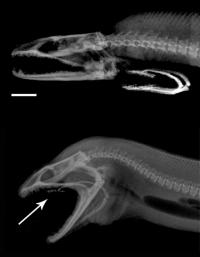
These X-rays show the normal position of the pharyngeal jaws (upper), and how they can move forward into the mouth to seize food (lower). Moray eels have a unique way of feeding reminiscent of a science fiction thriller, researchers at UC Davis have discovered. After seizing prey in its jaws, a second set of jaws located in the moray's throat reaches forward into the mouth, grabs the food and carries it back to the esophagus for swallowing.
| Full story | 0 Comments | 8798 views |
| Biology | September 5, 2007 06:39 PM |
Behind the sailor's lore of fearsome battles between sperm whale and giant squid lies a deep question of evolution: How did these leviathans develop the underwater sonar needed to chase and catch squid in the inky depths"
| Full story | 0 Comments | 7858 views |

| Microbiology | September 5, 2007 05:39 PM |
IRD researchers showed that Epinephilus maculates, a fairly abundant species of grouper off New Caledonia, was parasitized by 12 species of microscopic monogenean worms. This diversity of parasites has just been confirmed also in the malabar grouper, Epinephilus malabaricus, another the coral reef species. If such a level of parasite diversity prevails in all coral-reef fish, tens of thousands of parasite species are in this ecosystem waiting to be discovered.
| Full story | 0 Comments | 7115 views |
| Microbiology | September 5, 2007 04:39 PM |
Scientists at MIT’s Department of Civil and Environmental Engineering and the Technion Israel Institute of Technology have for the first time recorded the entire genomic expression of both a host bacterium and an infecting virus over the eight-hour course of infection.
| Full story | 0 Comments | 4701 views |
| Biology | September 5, 2007 03:39 PM |
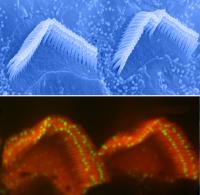
Scanning electron microscopy shows the stair-step pattern of stereocilia. Bottom: Fluorescence microscopy image shows the presence of CDH 23 (green) at the point where each short stereocilium (red) meets the side of its taller neighbor. Credit: B. Kachar, National Institute on Deafness and Other Communication Disorders Our ability to hear is made possible by way of a Rube Goldberg-style process in which sound vibrations entering the ear shake and jostle a successive chain of structures until, lo and behold, they are converted into electrical signals that can be interpreted by the brain. Exactly how the electrical signal is generated has been the subject of ongoing research interest.
| Full story | 0 Comments | 6551 views |

| Molecular & Cell Biology | September 5, 2007 02:39 PM |
So vital is the p53 tumor suppressor gene in controlling cancer that its dysfunction is linked to more than half of human cancers. At the same time, the gene’s capacity for shutting down cell growth, even causing cells to commit suicide if necessary, is so absolute that it must be tightly regulated to maintain the optimal balance between protecting against cancer and permitting normal growth.
| Full story | 0 Comments | 6475 views |

- In some genetic cases of microcephaly, stem cells fail to launch
- Yale team discovers how Zika virus causes fetal brain damage
- Scientists uncover the way a common cell enzyme alerts the body to invading bacteria
- Arctic gives clues on worst mass extinction of life
- Calcium channel blockers caught in the act at atomic level
Search Bio News Net
Free Biology Newsletter
- Flexibility That A.C.A. Lent to Work Force Is Threatened by...International Herald Tribune
- Bacteria Behind Legionnaires’ Disease Found at New York Police StationInternational Herald Tribune
- Prescription Price Crisis? 28 Million Americans See Spike in Drug...MSNBC.com: Health
- Seizing on Opioid Crisis, a Drug Maker Lobbies Hard for...International Herald Tribune
- Republicans are taking a big political risk on health careAP Health News
- Why We're So Divided Over Saving WolvesNational Geographic News