

New technology has allowed an international team including UK scientists from University of St Andrews and British Antarctic Survey to witness for the first time the behaviour of the southern elephant seal (Mirounga leonina) and how it relates to its physical environment. Small sensors were attached to 85 seals to track their movements and collect data about their marine environment. Results are published this week in the journal Proceedings of the National Academy of Sciences.

| Molecular & Cell Biology | August 9, 2007 10:53 PM |
Researchers at the University of Pennsylvania School of Medicine recently identified how a regulatory protein called Bcl-3 helps to control the body’s inflammation response to infection by interfering a critical biochemical process called ubiquitination. While previous studies suggested Bcl-3 plays a role in immunity, this is the first report that Bcl-3 regulates inflammation by blocking ubiquitination.
| Full story | 0 Comments | 5280 views |

| Microbiology | August 9, 2007 08:53 PM |
Using DNA sequence data, botanists have shown that the large southern hemisphere plant family Proteaceae lived on the super-continent Gondwanaland almost 120 million years ago. As Gondwanaland broke up, it was originally thought that these plants merely moved with the newly formed continents. But now a new study published in the Journal of Biogeography has shown that, while this is the case for some of these plants, others are far too recent to have lived at the time when the super-continent broke up. They must therefore have dispersed across oceans to reach their current distribution ranges.
| Full story | 0 Comments | 5004 views |

| Biotechnology | August 9, 2007 06:53 PM |
‘Second generation’ biorefineries – those making biofuel from lignocellulosic feedstocks like straw, grasses and wood – have long been touted as the successor to today’s grain ethanol plants, but until now the technology has been considered too expensive to compete. However, recent increases in grain prices mean that production costs are now similar for grain ethanol and second generation biofuels, according to a paper published in the first edition of Biofuels, Bioproducts & Biorefining.
| Full story | 0 Comments | 7895 views |

| Biology | August 9, 2007 04:53 PM |
Fossils often have provided important insights into the evolution of humans and our ancestors. Even small fossils, such as bones from the hand or foot can tell us much about our ancestor’s and their behavior. Such may be the case with an ape that lived more than nine million years ago.
| Full story | 0 Comments | 5334 views |

| Health & Medicine | August 9, 2007 02:53 PM |
The usefulness of established molecular imaging/nuclear medicine approaches in identifying the “hows” and “whys” of brain dysfunction and its potential in providing immediately useful information in treating depression are emphasized in a study in the August Journal of Nuclear Medicine.
| Full story | 0 Comments | 5933 views |
| Biology | August 9, 2007 02:13 PM |
Hearing and balance experts at Johns Hopkins report successful testing in animals of an electrical device that partly restores a damaged or impaired sense of balance.
| Full story | 0 Comments | 4733 views |
| Biology | August 9, 2007 12:53 PM |
A new WWF study tracking pygmy elephants by satellite shows that the remaining herds of these endangered elephants, which live only on the island of Borneo, are under threat from forest fragmentation and loss of habitat.
| Full story | 0 Comments | 5671 views |
| Health & Medicine | August 9, 2007 12:13 PM |
For every man with a migraine, three women are struck by the severe headaches that often come with nausea, sensitivity to light and sound, and aura. That means a staggering 18 to 25 percent of women suffer from migraines, making it one of the most common disabling conditions faced by women around the globe.
| Full story | 0 Comments | 6623 views |
| Microbiology | August 9, 2007 10:53 AM |
The emerging threat of pesticide resistance means that biological malaria control methods are once again in vogue. New research published in the online open access journal BMC Public Health shows how Nile tilapia, a fish more commonly served up to Kenyan diners, is a valuable weapon against malaria mosquitoes.
| Full story | 0 Comments | 6100 views |
| Molecular & Cell Biology | August 9, 2007 10:13 AM |
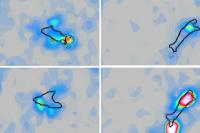
These frames of a video of a Dictyostelium discoideum cell crawling on a elastic substrate shows the magnitude of the stresses as color contours. Scientists at UC San Diego have discovered how cells of higher organisms change the speed at which they move, a basic biological discovery that may help researchers devise ways to prevent cancer cells from spreading throughout the body.
| Full story | 0 Comments | 4915 views |

- In some genetic cases of microcephaly, stem cells fail to launch
- Yale team discovers how Zika virus causes fetal brain damage
- Scientists uncover the way a common cell enzyme alerts the body to invading bacteria
- Arctic gives clues on worst mass extinction of life
- Calcium channel blockers caught in the act at atomic level
Search Bio News Net
Free Biology Newsletter
- Flexibility That A.C.A. Lent to Work Force Is Threatened by...International Herald Tribune
- Bacteria Behind Legionnaires’ Disease Found at New York Police StationInternational Herald Tribune
- Prescription Price Crisis? 28 Million Americans See Spike in Drug...MSNBC.com: Health
- Seizing on Opioid Crisis, a Drug Maker Lobbies Hard for...International Herald Tribune
- Republicans are taking a big political risk on health careAP Health News
- Why We're So Divided Over Saving WolvesNational Geographic News