

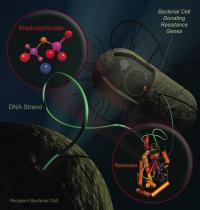
Antibiotic resistance propagates in bacteria by moving DNA strands containing the resistance genes to neighboring cells. An enzyme called relaxase is essential for this process. Bisphosphonates, already approved to treat bone loss, have now been shown to potently disrupt the relaxase function. Some bisphosphonates prevent the transfer of antibiotic resistance genes and selectively kill bacterial cells that harbor resistance. Credit: Scott Lujan, University of North Carolina at Chapel Hill Putting bacteria on birth control could stop the spread of drug-resistant microbes, and researchers at the University of North Carolina at Chapel Hill have found a way to do just that.

| Microbiology | July 9, 2007 11:38 PM |
| Full story | 0 Comments | 7103 views |

| Molecular & Cell Biology | July 9, 2007 10:24 PM |
While most RNAs work to create, package, and transfer proteins as determined by the cell’s immediate needs, miniature pieces of RNA, called microRNAs (miRNAs) regulate gene expression. Recently, researchers from the University of Pennsylvania School of Medicine determined how miRNAs team up with a regulatory protein to halt protein production. Results of the study were published recently in Cell.
| Full story | 0 Comments | 6679 views |

| Biology | July 9, 2007 09:23 PM |
A multi-institutional consortium including Duke University has created startlingly crisp 3-D microscopic views of tiny mouse brains -- unveiled layer by layer -- by extending the capabilities of conventional magnetic resonance imaging.
| Full story | 0 Comments | 5285 views |
| Molecular & Cell Biology | July 9, 2007 08:23 PM |
A new study shows that the activity of a particular gene can identify people who have a more lethal form of acute myeloid leukemia, singling out those patients who should receive more intense therapy.
| Full story | 0 Comments | 6474 views |

| Biotechnology | July 9, 2007 04:49 PM |
Viruses are notorious villains. They cause serious human diseases like AIDS, polio, and influenza, and can lead to system crashes and data loss in computers.
| Full story | 0 Comments | 5129 views |
| Molecular & Cell Biology | July 9, 2007 03:49 PM |
One of the basic tenets of evolution is speciation in which populations of the same species become so genetically and morphologically variable that they can be classified as two different species. Individuals of these species may be capable of mating, but they may not produce offspring, and if offspring are produced, they will be sterile or so defective that they die before they are able to reproduce. Although speciation has been observed and studied since Darwin and Wallace first proposed their theory, the complex molecular mechanisms responsible are not yet fully known. One of these molecular mechanisms, hybrid necrosis, was studied by Dr. Detlef Weigel and his colleagues at the Max Planck Institute for Developmental Biology in Germany. Dr. Kirsten Bomblies will present their results at the President’s symposium at the annual meeting of the American Society of Plant Biologists (July 11, 2PM). Bomblies and Weigel observed hybrid necrosis in crosses of thale cress, Arabidopsis thaliana, a member of the mustard family, and found that it is associated with plant genes that respond to pathogen attack.
| Full story | 0 Comments | 5973 views |

| Environment | July 9, 2007 02:49 PM |
A central eastern Queensland mine has turned up bat fossils which show climate change has had a negative impact on the state’s bat population.
| Full story | 0 Comments | 6891 views |
| Biology | July 9, 2007 01:49 PM |
Unlike moths and butterflies that are often brilliantly colored to warn potential predators that they carry toxins, flowers and the fruits they produce have brilliant colors and unusual shapes because they want to attract the attention of pollinators and frugivores who will disperse their pollen and seed, thus guaranteeing the next generation. In their work, Dr. Endress and his colleagues found that the sizes and positioning of the anthers facilitates pollen collection by buzz-pollinating bees. The male floral structures, anthers, release the pollen gradually, like tiny gumball dispensers. All of these characteristics--size, shape, placement, and timing—may be controlled by networks of genes as well as by regulatory sequences that do not encode proteins. Slight changes in these networks or in the non-coding sequences can change the developmental pattern of a flower and thus its morphology—either dooming it if its pollinators can no longer “fit” properly or guaranteeing the success of the species if it acquires new pollinators. This type of information is becoming ever more critical as we struggle to understand, maintain, and modify the plant and pollinator systems that we depend on for life.
| Full story | 0 Comments | 4257 views |
| Microbiology | July 9, 2007 12:49 PM |
In one of the first potential applications of synthetic biology, an emerging field that aims to design and build useful biomolecular systems, researchers from MIT and Boston University are engineering viruses to attack and destroy the surface “biofilms” that harbor harmful bacteria in the body and on industrial and medical devices.
| Full story | 0 Comments | 4899 views |

- In some genetic cases of microcephaly, stem cells fail to launch
- Yale team discovers how Zika virus causes fetal brain damage
- Scientists uncover the way a common cell enzyme alerts the body to invading bacteria
- Arctic gives clues on worst mass extinction of life
- Calcium channel blockers caught in the act at atomic level
Search Bio News Net
Free Biology Newsletter
- Flexibility That A.C.A. Lent to Work Force Is Threatened by...International Herald Tribune
- Bacteria Behind Legionnaires’ Disease Found at New York Police StationInternational Herald Tribune
- Prescription Price Crisis? 28 Million Americans See Spike in Drug...MSNBC.com: Health
- Seizing on Opioid Crisis, a Drug Maker Lobbies Hard for...International Herald Tribune
- Republicans are taking a big political risk on health careAP Health News
- Why We're So Divided Over Saving WolvesNational Geographic News