

Research in evolutionary developmental biology, known as ‘evo-devo’, is being held back because the dominant model organisms used by scientists are unable to illustrate key questions about evolution, argue biologists in the latest issue of Nature Reviews Genetics.

| Biotechnology | March 29, 2007 10:11 PM |
Biodegradable polymers created from poultry feathers may add value to the poultry industry and help solve the growing environmental problem of plastic waste.
| Full story | 0 Comments | 6525 views |

| Molecular & Cell Biology | March 29, 2007 09:22 PM |
Today, researchers report the identification of a gene that may play a role in susceptibility to osteoporosis—the crippling disease that leads to bone fractures, especially of the hip and spine. The study, conducted by scientists at the Musculoskeletal Diseases Center of the Jerry L Pettis Memorial Veteran's Affairs Medical Center at Loma Linda, shows convincing evidence that a gene called DARC negatively regulates bone density in mice. The report appears online in Genome Research.
| Full story | 0 Comments | 5304 views |

| Microarray | March 29, 2007 09:11 PM |
Genetics tests could help provide cystic fibrosis (CF) patients with targeted treatment in future, pilot study authors suggest. Results from a French clinical trial published today in BMC Medicine show how a small percentage of CF sufferers with a rare genetic stop mutation responded positively to gentamicin treatment.
| Full story | 0 Comments | 5893 views |
| Microarray | March 29, 2007 08:22 PM |
The NIH Neuroscience Microarray Consortium today announced that it has added high-density genotyping on both the Affymetrix and Illumina platforms to its list of services. Stan Nelson, the principal investigator at UCLA, says that "adding ultra-high throughput genotyping for its user-base of ~10,000 investigators across the world keeps the Consortium current with the demands of the scientific community."
| Full story | 0 Comments | 6777 views |

| Health & Medicine | March 29, 2007 08:11 PM |
A new report published in the prestigious New England Journal of Medicine (NEJM) shows that patients treated with bronchial thermoplasty, the first non-drug treatment for asthma, demonstrated an overall improvement in asthma control.
| Full story | 0 Comments | 6815 views |
| Health & Medicine | March 29, 2007 07:22 PM |
A study led by scientists from the University of North Carolina at Chapel Hill may have identified a molecular mechanism involved in the development of schizophrenia.
| Full story | 0 Comments | 5682 views |

| Microbiology | March 29, 2007 07:11 PM |
Scientists at MIT have created an ocean model so realistic that the virtual forests of diverse microscopic plants they "sowed" have grown in population patterns that precisely mimic their real-world counterparts.
| Full story | 0 Comments | 6549 views |
Researchers at UC San Diego have discovered that iron-containing nanoparticles being tested for use in several biomedical applications can be toxic to nerve cells and interfere with the formation of their signal-transmitting extensions.
| Full story | 0 Comments | 7162 views |
| Molecular & Cell Biology | March 29, 2007 06:11 PM |
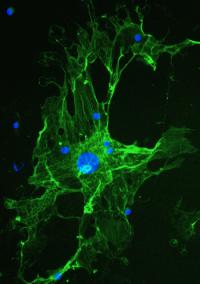
A hepatic stellate cell activated by the p75 Neurotrophin Receptor promotes repair in the liver.
In studies in mouse models, researchers at the University of California, San Diego (UCSD) School of Medicine have found that a cellular receptor involved in triggering cell death is also a necessary component of tissue repair and regeneration immediately following liver injury. This discovery could have implications for early intervention or therapy in liver disease such as cirrhosis or hepatitis.
| Full story | 0 Comments | 8779 views |
| Molecular & Cell Biology | March 29, 2007 05:22 PM |
Scientists at Penn State University will reveal in the 29 March 2007 issue of the journal Nature the first complete high-resolution map of important structures that control how genes are packaged and regulated throughout an entire genome. "For the first time, we are seeing in very high resolution on a genome-wide scale how nucleosomes control the expression of an organism's genes," said B. Franklin Pugh, professor of biochemistry and molecular biology and the study's lead investigator.
| Full story | 0 Comments | 6487 views |

| Biology | March 29, 2007 04:22 PM |
A new, complete 'tree of life' tracing the history of all 4,500 mammals on Earth shows that they did not diversify as a result of the death of the dinosaurs, says new research published in Nature today.
| Full story | 0 Comments | 8322 views |
| Health & Medicine | March 29, 2007 02:22 PM |
Mayo Clinic researchers report that freezing kidney tumors through percutaneous cryoablation shows promise for patients who are not good candidates for surgery. Their early findings showing short-term success in more than 90 percent of selected patients are published in this month’s issue of Radiology.
| Full story | 0 Comments | 8725 views |

| Stem Cell Research | March 29, 2007 12:22 PM |
For the millions of Americans whose vision is slowly ebbing due to degenerative diseases of the eye, the lowly neural progenitor cell may be riding to the rescue.
| Full story | 0 Comments | 26729 views |
| Molecular & Cell Biology | March 29, 2007 10:22 AM |
Breaking down bone is a tough job. Yet, our bones undergo remodeling every day of our lives, as old material is cleared away so that new bone can form. In diseases such as osteoporosis, an imbalance in this process is responsible for the characteristic bone loss. New research at the Weizmann Institute of Science, which recently appeared in the online journal PLoS ONE, has revealed in unprecedented detail how the roving cells whose job is to digest bone seal off their work area as they get down to business.
| Full story | 0 Comments | 8196 views |

- In some genetic cases of microcephaly, stem cells fail to launch
- Yale team discovers how Zika virus causes fetal brain damage
- Scientists uncover the way a common cell enzyme alerts the body to invading bacteria
- Arctic gives clues on worst mass extinction of life
- Calcium channel blockers caught in the act at atomic level
Search Bio News Net
Free Biology Newsletter
- Flexibility That A.C.A. Lent to Work Force Is Threatened by...International Herald Tribune
- Bacteria Behind Legionnaires’ Disease Found at New York Police StationInternational Herald Tribune
- Prescription Price Crisis? 28 Million Americans See Spike in Drug...MSNBC.com: Health
- Seizing on Opioid Crisis, a Drug Maker Lobbies Hard for...International Herald Tribune
- Republicans are taking a big political risk on health careAP Health News
- Why We're So Divided Over Saving WolvesNational Geographic News