


A newly discovered small molecule called IQ-1 plays a key role in preventing embryonic stem cells from differentiating into one or more specific cell types, allowing them to instead continue growing and dividing indefinitely, according to research performed by a team of scientists who have recently joined the stem-cell research efforts at the Keck School of Medicine of the University of Southern California. Their findings are being published today in an early online edition of the Proceedings of the National Academy of Sciences.

| Biotechnology | March 20, 2007 10:35 PM |
Using lasers and tuning forks, researchers at Pacific Northwest National Laboratory have developed a chemical weapon agent sensing technique that promises to meet or exceed current and emerging defense and homeland security chemical detection requirements. The technique, called Quartz Laser Photo-Acoustic Sensing, or "QPAS," is now ready for prototyping and field testing.
| Full story | 0 Comments | 4778 views |

| Biology | March 20, 2007 09:35 PM |
Researchers from CSIRO and UNSW@ADFA have shown that termites can tell what sort of material their food is made of, without having to actually touch it. The findings may lead to improvements in the control of feeding termites.
| Full story | 0 Comments | 5253 views |

| Molecular & Cell Biology | March 20, 2007 08:35 PM |
An overexpressed protein protects human pancreatic cancer cells from being forced to devour themselves, removing one of the body's natural defenses against out-of-control cell growth, researchers at The University of Texas M. D. Anderson Cancer Center report in the March issue of Molecular Cancer Research.
| Full story | 0 Comments | 6508 views |
| Biology | March 20, 2007 07:35 PM |
A group of organisms that has never had sex in over 40 million years of existence has nevertheless managed to evolve into distinct species, says new research published today. The study challenges the assumption that sex is necessary for organisms to diversify and provides scientists with new insight into why species evolve in the first place.
| Full story | 0 Comments | 6414 views |
| Molecular & Cell Biology | March 20, 2007 06:35 PM |
FINDINGS: UCLA scientists have devised a novel way to correct abnormal gene splicing – a common mutation that often leads to disease. Splicing edits out the punctuation from a cell’s genetic blueprint, enabling its code to dictate protein production by the cell. Using new technology made by Gene Tools of Oregon, the researchers designed a custom mask to camouflage each abnormal splice. The technique prevents the cell from seeing the genetic defects and restores splicing to the correct location in the gene.
| Full story | 0 Comments | 5527 views |

| Health & Medicine | March 20, 2007 05:35 PM |
A new calibration technique that involves measuring the distance between the upper ear and chin in photographs could help facial plastic surgeons use computer imaging software to achieve aesthetic harmony in their patients, according to a report in the March/April issue of Archives of Facial Plastic Surgery, one of the JAMA/Archives journals.
| Full story | 0 Comments | 4052 views |
| Molecular & Cell Biology | March 20, 2007 04:35 PM |
A small molecule derived from the spacer domain of the tumor-suppressor gene Rb2/p130 has demonstrated the ability to inhibit tumor growth in vivo and could be developed into an anti-cancer therapeutic, according to researchers at Temple University's Sbarro Institute for Cancer Research and Molecular Medicine.
| Full story | 0 Comments | 4160 views |

| Microbiology | March 20, 2007 03:35 PM |
Recent discoveries by researchers at the Uniformed Services University of the Health Sciences (USU) could lead to new avenues of exploration for radioprotection in diverse settings. Michael J. Daly, Ph.D., an associate professor in USU's Department of Pathology, and his colleagues have uncovered evidence pointing to the mechanism through which the extremely resilient bacterium Deinococcus radiodurans protects itself from high doses of ionizing radiation (IR). The results of the recent study, titled "Protein Oxidation Implicated as the Primary Determinant of Bacterial Radioresistance" were published in the March 20 edition of PLoS Biology.
| Full story | 0 Comments | 4338 views |
| Health & Medicine | March 20, 2007 02:35 PM |
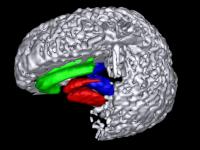
Brain scans of smokers studied by Duke researchers revealed three specific regions deep within the brain that appear to control dependence on nicotine and craving for cigarettes. Shown in blue is the thalamus, an region of the brain critical to one's ability to calm down when stressed. In red is the striatum, a region implicated in the pleasure system of the brain. In green is the anterior cingulate cortex, a region vital to self-control and concentration. Credit: Duke University Medical Center News Office Within the mind of every smoker trying to quit rages a battle between the higher-order functions of the brain wanting to break the habit and the lower-order functions screaming for another cigarette, say researchers at Duke University Medical Center. More often than not, that cigarette gets lit.
| Full story | 0 Comments | 5850 views |
| Health & Medicine | March 20, 2007 01:35 PM |
Scientists who focus on the molecular signaling that underlies prostate cancer have discovered a compound that shows promise against a debilitating neurodegenerative condition known as Kennedy's disease, which is caused by a mutant gene. Currently there is no treatment for the inherited disorder, which resembles a slowly progressive form of Lou Gehrig's disease and affects only men.
| Full story | 0 Comments | 3742 views |

- In some genetic cases of microcephaly, stem cells fail to launch
- Yale team discovers how Zika virus causes fetal brain damage
- Scientists uncover the way a common cell enzyme alerts the body to invading bacteria
- Arctic gives clues on worst mass extinction of life
- Calcium channel blockers caught in the act at atomic level
Search Bio News Net
Free Biology Newsletter
- Flexibility That A.C.A. Lent to Work Force Is Threatened by...International Herald Tribune
- Bacteria Behind Legionnaires’ Disease Found at New York Police StationInternational Herald Tribune
- Prescription Price Crisis? 28 Million Americans See Spike in Drug...MSNBC.com: Health
- Seizing on Opioid Crisis, a Drug Maker Lobbies Hard for...International Herald Tribune
- Republicans are taking a big political risk on health careAP Health News
- Why We're So Divided Over Saving WolvesNational Geographic News