


A new report, the first to take a comprehensive look at market competition between wild and farmed salmon, sheds new light on the contentious and complex issues surrounding farmed and wild salmon.

| Molecular & Cell Biology | March 7, 2007 10:30 PM |
A secret long held by plants has been revealed by Howard Hughes Medical Institute researchers. The new discovery, which builds on more than a decade of painstaking surveillance of cellular communication between different types of plant tissues, shows clearly for the first time how plants "decide" to grow.
| Full story | 0 Comments | 6079 views |
| Molecular & Cell Biology | March 7, 2007 09:30 PM |
Investigators at St. Jude Children's Research Hospital have discovered previously unsuspected mutations that contribute to the formation of pediatric acute lymphoblastic leukemia (ALL), the most common cancer in children. The discovery not only suggests novel methods for treating pediatric ALL, but also provides a roadmap for the identification of unsuspected mutations in adult cancers.
| Full story | 0 Comments | 5506 views |

| Microbiology | March 7, 2007 08:30 PM |
Pink slime at the surface of water trickling through an old mine in California is proving to be a treasure for researchers in their quest to learn more about how bacterial communities exist in nature.
| Full story | 0 Comments | 6412 views |
| Molecular & Cell Biology | March 7, 2007 07:30 PM |
Wheat has ways to battle the tiny, red wormlike insects that nibble on the plant's leaves and can destroy crops worldwide, but the Hessian fly larvae that survive eventually evolve methods to overcome plant defenses.
| Full story | 0 Comments | 6240 views |
| Microbiology | March 7, 2007 06:30 PM |
A surprising finding by a team of University of Georgia scientists suggests that curbing the use of antibiotics on poultry farms will do little – if anything – to reduce rates of antibiotic resistant bacteria that have the potential to threaten human health.
| Full story | 0 Comments | 8452 views |
| Molecular & Cell Biology | March 7, 2007 05:30 PM |
They might be giants, but many dinosaurs apparently had genomes no larger than that of a modern hummingbird.
| Full story | 0 Comments | 6100 views |

| Biotechnology | March 7, 2007 05:01 PM |
A team of UCSB researchers, in collaboration with colleagues from UC Berkeley and StrataGent Life Sciences, of Los Gatos, California, has designed a novel pulsed microjet system engineered to deliver protein drugs into the skin without the pain or bruising that deeper penetration injection systems cause. The research was published online today in the Proceedings of the National Academy of Sciences.
| Full story | 0 Comments | 4331 views |
| Biotechnology | March 7, 2007 04:01 PM |
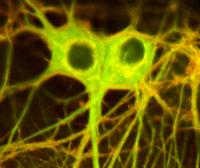
A compound that halts nerve cell activity only when exposed to light glows in this image of two nerve cells. Scientists hope the compound will one day be adapted for use as an epilepsy treatment. Credit: Washington University School of Medicine Brain activity has been compared to a light bulb turning on in the head. Scientists at Washington University School of Medicine in St. Louis have reversed this notion, creating a drug that stops brain activity when a light shines on it.
| Full story | 0 Comments | 4342 views |

| Health & Medicine | March 7, 2007 02:01 PM |
Critical portions of the brain in those who are obese don’t really know they are overweight, researchers have reported in the March issue of the journal Cell Metabolism, published by Cell Press. These findings in obese mice show that a sensor in the brain that normally detects a critical fat hormone—causing a cascade of events that keeps energy balance in check—fails to engage. Meanwhile, the rest of the metabolic pathway remains ready to respond.
| Full story | 0 Comments | 6313 views |
| Biotechnology | March 7, 2007 12:01 PM |
In experiments with laboratory mice that bear aggressive human breast cancers, UC Davis researchers have used hot nanoprobes to slow the growth of tumors -- without damage to surrounding healthy tissue. The researchers describe their work in the March issue of the Journal of Nuclear Medicine.
| Full story | 0 Comments | 5221 views |
| Health & Medicine | March 7, 2007 10:01 AM |
Dementia diseases develop insidiously and are generally discovered when the memory has already started to deteriorate. New research form Karolinska Institutet shows, however, that approaching Alzheimer's can be detected several years before the symptoms manifest themselves.
| Full story | 0 Comments | 7953 views |

- In some genetic cases of microcephaly, stem cells fail to launch
- Yale team discovers how Zika virus causes fetal brain damage
- Scientists uncover the way a common cell enzyme alerts the body to invading bacteria
- Arctic gives clues on worst mass extinction of life
- Calcium channel blockers caught in the act at atomic level
Search Bio News Net
Free Biology Newsletter
- Flexibility That A.C.A. Lent to Work Force Is Threatened by...International Herald Tribune
- Bacteria Behind Legionnaires’ Disease Found at New York Police StationInternational Herald Tribune
- Prescription Price Crisis? 28 Million Americans See Spike in Drug...MSNBC.com: Health
- Seizing on Opioid Crisis, a Drug Maker Lobbies Hard for...International Herald Tribune
- Republicans are taking a big political risk on health careAP Health News
- Why We're So Divided Over Saving WolvesNational Geographic News